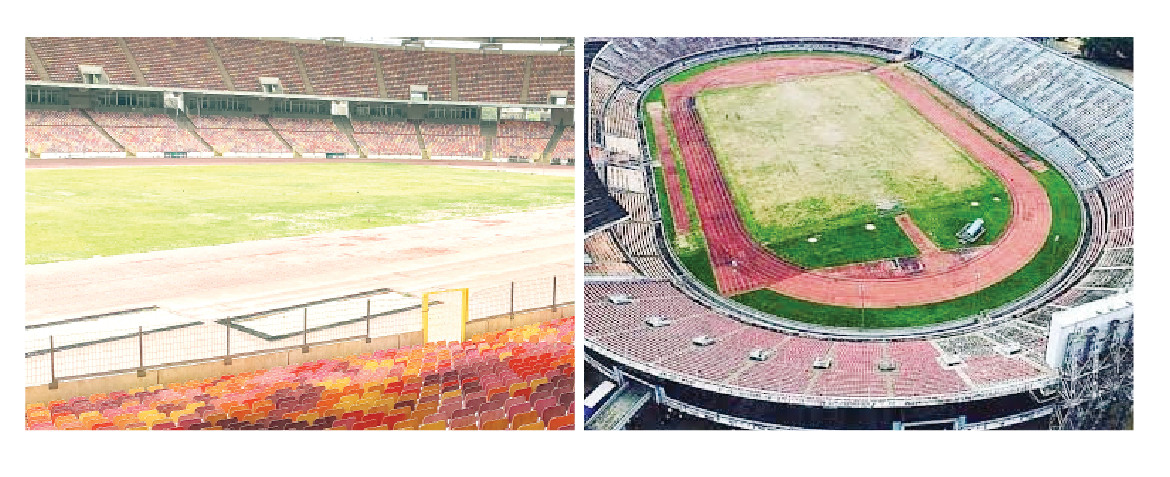
Across Nigeria, towering stadiums stand as monuments to ambition—symbols of national pride, political will and sporting aspiration. From the bustling commercial nerve centre of Lagos to the administrative heart of Abuja and beyond, these arenas were conceived as hubs of excellence, designed to host international competitions, nurture local talent and inspire future generations. Yet, years after their commissioning, many of these facilities tell a different story—one of neglect, decay and missed opportunity. The pattern is as familiar as it is troubling: Nigeria builds stadiums, but struggles to maintain them. SALIFU USMAN captured how deeply ingrained the culture of indifference and allegations of financial mismanagement has left a nation of 250 million people with only one world-class pitch to call home.
Nigeria’s stadium construction boom gained momentum in the late 1990s and early 2000s, driven largely by preparations for major sporting events, most notably the 1999 FIFA World Youth Championship. Facilities such as the iconic National Stadium in Lagos were expected to usher in a new era for Nigerian sport.
At the time, these investments appeared justified. The stadiums were not only venues for football matches but also centres for athletics, community engagement and national celebrations. They represented a vision of Nigeria as a continental sporting powerhouse.
However, more than two decades later, many of these once-proud structures are in varying states of disrepair. Broken seats, overgrown pitches, faulty floodlights and dilapidated dressing rooms have become commonplace. In some cases, sections of stadiums have been overtaken by informal traders or repurposed for non-sporting activities.
The decline of the Lagos National Stadium is perhaps the most cited example. Once the pride of Nigerian sport, the facility has suffered years of neglect, despite intermittent promises of rehabilitation. While recent efforts have aimed to restore parts of it, the broader issue of sustainable maintenance remains unresolved.
The challenge is not confined to Lagos. In Kaduna, the Ahmadu Bello Stadium, Sani Abacha Stadium, Kano; Liberty Stadium, Ibadan; Abubakar Tafawa Balewa Stadium, Bauchi; Nnamdi Azikiwe Stadium, Enugu; Yakubu Gowon Stadium, Port Harcourt; U.J. Esuene Stadium, Calabar and several others across Nigeria faced similar struggles, with maintenance issues periodically affecting their usability. The narrative is strikingly similar in Abuja, where the MKO Abiola National Stadium once represented a new dawn.
Commissioned in 2003 at a staggering cost of $360 million, it was envisioned as a world-class facility capable of hosting the biggest global events. At its peak, it delivered on that promise, earning recognition as one of Africa’s finest sporting venues. Equipped with modern amenities — corporate suites, electronic scoreboards, floodlights, and extensive training facilities — the stadium was meant to set a new standard. It provided Nigeria with a worthy alternative to the ageing Lagos complex and became a symbol of progress.
Yet, less than two decades later, that symbol has faltered. Reports of vandalism, power outages, and poor maintenance have plagued the facility. The irony is difficult to ignore: a stadium built at such immense cost now struggles with basic upkeep. Electrical cables have been stolen, leaving parts of the complex in darkness, while routine maintenance has been replaced by sporadic, inadequate repairs.
Against this bleak backdrop, one stadium stands almost defiantly apart — the Godswill Akpabio International Stadium in Uyo. Modern, well-maintained, and internationally certified, it has become Nigeria’s lone beacon of sporting excellence. Approved by both the Confederation of African Football (CAF) and FIFA, it is currently the only stadium in the country deemed fit for international matches. Should a single floodlight fail in Akwa Ibom, a country that breathes football would, quite literally, be homeless on the global stage
The consequences of this decline extend far beyond infrastructure. For athletes, the lack of quality facilities is a significant barrier to development. Sporting excellence does not emerge in a vacuum; it is cultivated through consistent access to world-class training environments. Without such facilities, even the most talented individuals are at a disadvantage.
This is particularly evident when comparing Nigerian athletes at home with those in the diaspora. While Nigerians continue to excel on the global stage, many achieve success only after relocating to countries with better infrastructure and support systems. Those who remain often struggle to reach their full potential, constrained by inadequate training conditions and limited opportunities.
Why Maintenance Is The Problem
Several factors contribute to Nigeria’s stadium maintenance challenges. Chief among them is funding. While substantial resources are often allocated for construction, far less attention is given to the recurring costs of upkeep.
Maintenance requires a steady stream of funding for repairs, staffing, utilities and upgrades. Without dedicated budgets or revenue-generating models, stadiums quickly become financial burdens.
Another issue is governance. Many stadiums are owned and managed by government agencies, which can be hampered by bureaucratic inefficiencies and unclear lines of responsibility. In some cases, there is little accountability for the condition of facilities. Corruption and mismanagement have also been cited as contributing factors, with funds earmarked for maintenance sometimes failing to reach their intended purpose.
In an interview with our correspondent, a facility expert and CEO of Monimichelle Sports Facilities Construction Limited, Mr. Ebi Egbe, delivered a scathing assessment of the country’s sporting infrastructure. Egbe argued, is a systemic failure in how stadiums are conceived and delivered. “We build stadiums as projects, not as performance systems,” he explained, pointing to recurring issues such as poor pitch substructure, inadequate drainage, weak irrigation, and the absence of maintenance frameworks.
According to him, these shortcomings inevitably lead to rapid deterioration, rendering facilities unsuitable for elite football within a short period. “Once the pitch fails, the stadium is effectively unusable,” he added.
However, Egbe insisted that viable solutions already exist within the country, urging stakeholders to shift from criticism to adopting proven execution models. He cited ongoing upgrades at the Yakubu Gowon Stadium in Rivers State, the Aper Aku Stadium, and the Sardauna Memorial Stadium as examples of a new approach.
“These are not just upgrades; they represent a complete systems rethink,” he said. The projects incorporate all-weather hybrid synthetic pitch technology designed for durability in Nigeria’s climate, engineered drainage systems featuring extensive pipe networks, and broadcast-standard floodlighting integrated with athletics facilities.
Egbe noted that such designs are tailored to withstand what he described as the “zero-maintenance culture” often associated with public infrastructure, by embedding durability and reduced upkeep into the construction itself while maintaining the playing quality of natural grass.
He further highlighted developments in Benue State as evidence of growing awareness among authorities. “What’s happening there reflects a shift in thinking — sustainability must come before aesthetics, and maintenance must be built into the design, not left for later,” he said.
Beyond infrastructure, Egbe stressed the direct link between quality pitches and football development. He argued that modern hybrid surfaces improve the speed of play, boost player confidence, reduce injuries, and enhance overall match quality — all of which are essential for building competitive teams and a stronger domestic league.
Looking ahead, he called for a strategic overhaul of Nigeria’s approach to stadium development. This includes focusing on fewer, high-performance venues, adopting hybrid pitch systems certified by FIFA for local conditions, and implementing professional facility management structures. “Every stadium must be treated as a long-term operational asset, not a one-off project,” he said.
The Ghost of Surulere: From Wembley to Wasteland
For decades, the National Stadium in Surulere, Lagos, was the undisputed heartbeat of Nigerian sport. It was here, in 1980, that the Green Eagles lifted their first Africa Cup of Nations (AFCON) trophy. It was the stadium where the legendary Samuel Okwaraji tragically collapsed and died in 1989, wearing the national colours with a passion that defined an era.
“The way the English see Wembley is the same way we see the National Stadium,” says Morakinyo Abodunrin, Sports Editor at The Nation. “It was our home. For older generations of players, just walking into that atmosphere gave them the confidence that they could not lose.”
Former Super Eagles midfielder Mutiu Adepoju, famously nicknamed “The Headmaster” for his aerial prowess, recalls the ground with a mixture of reverence and heartbreak. “I have such good memories. We never lost a game there, except the AFCON 2000 final on penalties. The situation now is not good. We have to be intentional; we have to upgrade to FIFA standards,” Adepoju declared.
Today, the “Sporting Mecca” is a shell. The seats are shattered, the dressing rooms are dilapidated, and the main bowl is often overtaken by weeds rather than wingers. Daniel Alana, a lifelong fan who used to walk from Ajegunle to watch matches for N50, laments the loss of soul. “It has become a ghost area. Back then, it was pure joy. Now, I don’t think that passion can ever return.”
The rot is not just aesthetic; it is structural. The Building Collapse Prevention Guild (BCPG) has issued urgent warnings, with its Coordinator, Engr Francis Redemi, describing the facility’s condition as “pathetic.” Experts fear that without radical intervention, the stands themselves could give way.
A Trail of Broken Promises and “Media Gimmicks”
Why has Nigeria allowed its national assets to crumble? According to Ahmed Shuaibu Gara Gombe, former Gombe State FA Chairman, the blame lies squarely at the feet of administrative failure and a lack of transparency. Gombe points the finger at two former Ministers of Youth and Sports Development: Solomon Dalung and Sunday Dare.
“The total decay rests on their shoulders,” Gombe asserts. He alleges that under Dalung, key parts of the Lagos stadium—including the swimming pool and Games Village—were concessioned to private entities without transparent bidding processes. “Money has changed hands. There were allegations of a N200 million payment. What was the procedure? Was it advertised?”
Gombe is equally scathing of Sunday Dare’s tenure, despite the high-profile “Adopt-a-Pitch” initiative, which saw billionaires like Aliko Dangote and Chief Kessington Adebutu (Baba Ijebu) donate funds for renovations.
“Dare made all the noise in the world,” Gombe says. “He chased away traders and showed us pictures of work on the pitch. But why did he start when he knew the money wasn’t enough? He collected $1 million from Dangote for Abuja, and yet the stadium was downgraded. We need to know who the contractors were and where the money went.”
The Defence: “Fabricated Stories”
In a robust rebuttal, Solomon Dalung dismissed Gara Gombe’s claims as “blackmail” and “fabricated stories.”
“There was no concession under my watch,” Dalung insists, challenging Gombe to produce documentation. He argues that he inherited ongoing processes and worked to revive the swimming pool by reimbursing contractors through budgetary funds.
Dalung recounted how the then-governor of Lagos State, Akinwunmi Ambode, approached his ministry with a robust N11 billion funding proposal for the stadium’s rehabilitation. “Governor Ambode approached the Ministry that he has secured N11 billion funding, and he wanted to rehabilitate the National Stadium, Lagos and make it an African Wembley,” Dalung stated.
Inspired by this ambitious vision, Dalung said he penned a memo to President Buhari and personally met with him to explain the proposal. The President, according to Dalung, gave his approval, but with a significant caveat: the stadium’s name wouldn’t be changed. This presidential directive led to the formation of a 20-member technical committee, equally represented by the Ministry and the Lagos State government, to oversee the renovation.
Dalung vividly recalled an inspection of the stadium with Governor Ambode and his team, where the Lagos State government expressed its readiness to take over and commence the rehabilitation work. However, the promising initiative took an unexpected turn when President Buhari fell ill and was admitted to a hospital in London.
“When the President took ill and was on admission in London, a letter forged from the office of the Chief of Staff to the President with the signature of the President forged,” Dalung revealed. He further explained that this fraudulent letter was sent directly to the Governor of Lagos State, informing him that the President had disapproved the renovation. “It was Governor Ambode who, perplexed by the communication, forwarded a copy of the letter to me,” Dalung revealed. “I took the letter to the then Acting President, insisting on an investigation. I told him that this letter was forged because it didn’t follow the government’s communication protocol. The Lagos State government did not write a letter to the President. They wrote to the Minister, and I put up a memo to the President. So, the President cannot reply to the Governor of Lagos State; he would reply to me,” Dalung explained, highlighting the breach of established governmental procedures.
Despite his insistence, the Acting President appealed to Dalung to “allow it to slide.” It was this decision, Dalung asserts, that sealed the fate of the “African Wembley” project. “That was how we lost an opportunity for the renovation of the National Stadium in Lagos,” he lamented, recalling President Buhari’s initial commitment to a partnership agreement that would ensure free training for athletes while allowing the government to generate revenue.
Dalung expressed deep personal pain at leaving office, regretting the loss of such a significant opportunity. He also addressed ongoing discussions about concessions, stating, “If there were subsequent concessions, maybe after I have left office, because in my handover note, the report suggested that there were ongoing concessions that we inherited and were unable to conclude.”
The Uyo Exception: A Lone Beacon
In this landscape of ruin, the Godswill Akpabio International Stadium in Uyo stands defiantly isolated. Built to international specifications and rigorously maintained, it remains the only venue in Nigeria fit for FIFA-sanctioned matches. While its success is a testament to what is possible with political will, it also highlights a dangerous precariousness. For a nation that breathes and unites through football, relying on a single pitch is a logistical embarrassment.
The Cost of Neglect
The consequences of poor maintenance extend beyond aesthetics. For athletes, substandard facilities can hinder performance and increase the risk of injury. Poorly maintained pitches, for instance, can affect the quality of play and discourage staging local and international competitions in Nigeria.
Clubs in the Nigerian Premier Football League (NPFL) often grapple with inconsistent playing conditions, with some teams forced to adopt alternative venues due to the unavailability or unsuitability of their home grounds. This not only disrupts the league but also undermines fan engagement and revenue generation.
For the national teams, the situation can be equally challenging. While efforts have been made to upgrade certain facilities to meet international standards, Nigeria has at times struggled to present venues that satisfy the requirements of global governing bodies.
Beyond sport, the economic implications are significant. Well-maintained stadiums can host concerts, exhibitions and other large-scale events, generating income and creating jobs. When facilities fall into disrepair, these opportunities are lost.
Lessons from Elsewhere
Globally, successful stadium management often relies on a combination of public and private sector involvement. In countries with well-maintained sports infrastructure, stadiums are treated as commercial assets rather than mere public utilities.
Naming rights, sponsorship deals, ticket sales and multi-purpose usage all contribute to sustainable revenue streams. Private operators, driven by profit incentives, are often better positioned to ensure regular maintenance and efficient management. Nigeria has begun to explore such models. The concessioning of certain facilities to private firms has shown promise, although results have been mixed. Experts argue that with the right regulatory framework and transparency, public-private partnerships could transform the sector.
We’ve got the edge. Get real-time reports, breaking scoops, and exclusive angles delivered straight to your phone. Don’t settle for stale news. Join LEADERSHIP NEWS on WhatsApp for 24/7 updates →
Join Our WhatsApp Channel