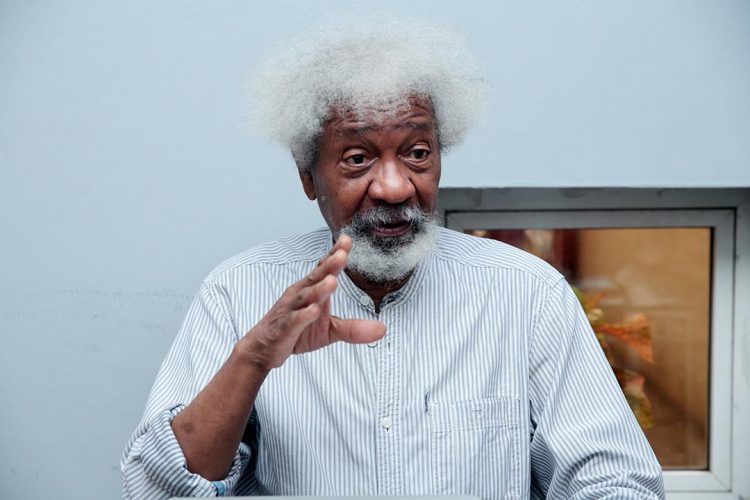
Nobel Laureate Prof. Wole Soyinka has faulted the considerable security detail assigned to Mr Seyi Tinubu, the son of President Bola Tinubu, urging the president to reconsider the heavy deployment of police and military personnel attached to his son.
Soyinka remarked on an occasion held in honour of veteran poet Odia Ofeimun, who received a special recognition award at the Wole Soyinka Centre for Investigative Journalism held at the MUSON Centre, Onikan, Lagos.
The literary icon recounted that he was surprised when he saw a young man surrounded by many security officers, saying the scenario was akin to that of a film production due to the presence of uniformed security personnel.
Soyinka said the well-cultured young man guarded by the security operatives who later approached to greet him turned out to be the son of the President.
Amid the bewilderment, Soyinka said he was compelled to relate what he saw to the National Security Adviser (NSA), wondering why such a large deployment of personnel would be assigned to one individual, especially when the nation is grappling with pockets of insecurity.
He said, “I was so astonished that I started looking for the national security adviser. I said track him down for me. I think they got him somewhere in Paris. But he was with the president; he was in a meeting.
“Then, I said I had just seen something I couldn’t believe, and I described the scene to him. I said, “Do you mean that a child of the head of state goes around with an army for his protection or whatever?”
“I couldn’t believe it. Later, I conducted investigative journalism and discovered that this is apparently how the young man leads his battalion, accompanied by heavily armed soldiers.
“I was astonished. Children must understand their place. They are not elected leaders, and they must not inherit the architecture of state power simply by proximity.”
Invoking his sense of humour, he averred that if the country faced an outbreak of insurrection, the President could quell the rebellion by asking his son Seyi to “go and handle it,” given the number of officers around him.
Soyinka maintained that assigning a battalion of security operatives, paid with taxpayers’ money, to a single individual does not reflect well on a nation encountering worsening insecurity, which manifests in humanitarian crises.
According to Soyinka, it is high time Tinubu reviewed the level of security protection provided to individuals, insisting that the presence of military personnel should be concentrated in volatile regions where citizens genuinely need support and reassurance.
Commenting on the large security attachment to Seyi Tinubu raised by Nobel Laureate Professor Wole Soyinka, Civil Society Organisations have an apparent concern about the imbalance in how security assets are allocated in a country where communities continue to face severe insecurity, which is worrisome.
The Executive Director, Human Rights Journalists Network Nigeria, Kehinde Adegboyega, told LEADERSHIP that, “Professor Wole Soyinka’s recent comments on the huge security escort attached to Seyi Tinubu raise issues that go far beyond personalities. They speak directly to the principles of public accountability that should govern the use of state resources in any democracy.
“State security personnel are funded by the public and are meant to serve the public. When a “battalion-size” escort is deployed for a private citizen, as widely reported and criticised by Soyinka, it creates a clear imbalance in how security assets are allocated. This is particularly troubling in a country where communities continue to face severe insecurity and where many citizens lack adequate police presence.
“The federal government itself has acknowledged the problem of VIP overuse of security escorts and recently indicated plans to curb such misuse.
“From a human-rights perspective, the first duty of the state is to guarantee the safety of all citizens without discrimination or privilege. Prioritising extensive state protection for individuals who hold no public office, while ordinary Nigerians remain vulnerable, undermines both fairness and public trust. Public security resources must be deployed based on demonstrable risk and the broader public interest, not social status or proximity to power.
“This moment should serve as an opportunity to strengthen transparency and reinforce the principle that state security exists for collective safety, not private convenience.”
For the Director, Administration and Programmes, Centre for Anti-Corruption and Open Leadership (CACOL), Tola Oresanwo, “That’s one of the things we see in the leaders we have in this part of the world. Once they assume office, they tend to see themselves as more powerful and more influential. They put on this larger-than-life attitude. That’s why one person will have a battalion of soldiers guiding them when they are not a general in the army.
“So my position is that I think it is a natural tendency of our politicians to live a godlike life, even among the most insecure people in the world, because Nigeria today or Nigerians today are among the most insecure people in the world.
“Yet one person who is not a political office holder, by the way, is having a battalion of soldiers following him. Soldiers who spend state money, taxpayers’ money, on guarding just one individual, who is not a political office holder, who is not voted into power or elected into an elective position, are following just one individual. So it is an aberration.”
Also commenting, a Socialist, activist, Education Rights Campaign (ERC), Taiwo Hassan Soweto said, “The Prof has said it all, and I think the whole idea of withdrawing police from the VIPS to beef up security is just a hypocritical action by the government.
“One doesn’t expect that this will be taken into account sooner or later. Looking at the President’s son’s entourage and that of the first lady who were not voted for. The large security escort of these people who aren’t voted for by the populace is a source of concern.
“And this just shows how elected officials speak with two mouths and make proclamations and nothing comes out of it.
And this fight against insecurity can’t lead to any progress at the end of the day, as the Nigerian State can’t tackle insecurity with all this going on.
He further said, “At the end of the day what is good for the goose is good for the gander. If Nigerians can place their demands at the helm of the president and see that it’s met then it shows the type of people we have in government.
“I think it just shows how our elected officials are and I think the professor has said it all. What is good for the goose, is good for the gander
“It’s high time they act up and do what’s right for the state and the citizens prioritising their security against that of an individual with a high presence of armed personnel,” says Soweto
We’ve got the edge. Get real-time reports, breaking scoops, and exclusive angles delivered straight to your phone. Don’t settle for stale news. Join LEADERSHIP NEWS on WhatsApp for 24/7 updates →
Join Our WhatsApp Channel