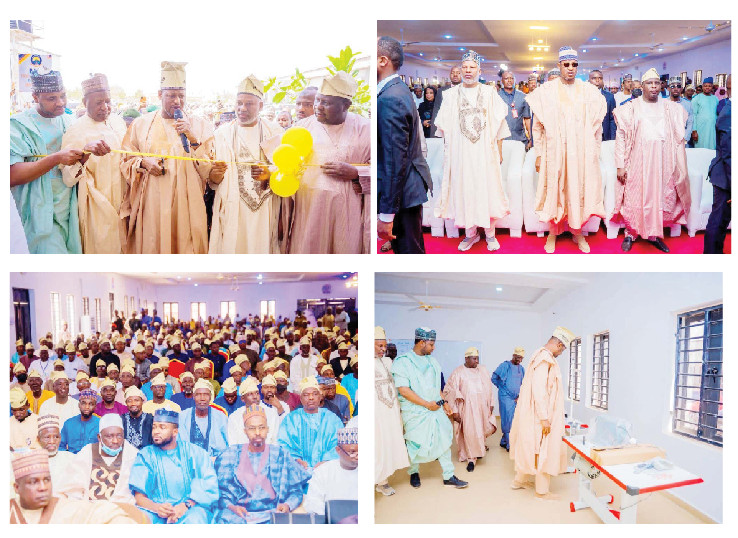
The launch of Phase 10 of the Gwagware Foundation Ramadan Empowerment Programme was more than a ceremonial prelude to the fasting season.
It was a moment layered with symbolism, politics, and social meaning. Standing at the foundation’s headquarters, Governor Dikko Umaru Radda’s endorsement of the initiative as a “vital partner” in humanitarian efforts subtly reframed what might once have been viewed as private charity into something closer to parallel social governance.
The language mattered, it suggested that philanthropy in Katsina is no longer merely supportive of government policy but is becoming woven into the state’s welfare architecture.
Ramadan, by its spiritual nature, has always been associated with generosity, reflection, and solidarity. Across northern Nigeria, foundations, political actors, and community leaders routinely anchor their social interventions around the holy month. Yet, what distinguishes the Gwagware Foundation’s trajectory is continuity.
Ten phases over approximately a decade imply organisational endurance, financial resilience, and a capacity to adapt. In a context where many well-publicised initiatives dissolve after a few cycles, longevity itself becomes a form of legitimacy.
Governor Radda’s remarks carried an undertone of mutual validation. By acknowledging the foundation’s consistent outreach to widows, orphans, and vulnerable citizens, the governor reinforced a narrative of shared responsibility between the state and non-state actors.
At the same time, the foundation’s visibility enhances the administration’s social image.
This reciprocity is emblematic of a broader governance pattern in Nigeria: the boundaries between political authority and philanthropic influence are increasingly fluid. Welfare programmes often serve dual functions, delivering material relief while also strengthening networks of loyalty, gratitude, and public trust.
The decision to distribute Ramadan food packages across all wards amplifies this interplay between compassion and visibility. It projects inclusivity and geographic fairness, echoing the logic of state-level welfare distribution.
In doing so, the programme situates the foundation within everyday community life rather than confining it to elite philanthropic circles. Such reach is not only logistical; it is psychological.
Communities interpret repeated presence as reliability, and reliability as sincerity. Yet beneath the immediate humanitarian narrative lies a deeper strategic shift.
The announcement of the Nana Safara’u Umar Radda College of Advanced Studies signalled a transition from short-term relief to long-term investment in human capital. Educational philanthropy occupies a unique moral and developmental space. Feeding vulnerable households addresses urgent need, but building institutions speaks to legacy.
Smart classrooms, modern teaching tools, and digital libraries evoke aspirations of competitiveness in an economy increasingly defined by knowledge and technology. The move reflects an understanding that sustainable empowerment cannot rely solely on consumable aid.
Partnerships with academic and research institutions further embed the foundation’s ambitions within a wider intellectual framework. Collaboration with Federal University Dutsin-Ma and IIIT indicates an effort to bridge philanthropy and academic credibility.
These alliances carry implications beyond infrastructure. They shape curriculum standards, research culture, and graduate employability. In a region where educational institutions often struggle with outdated resources and limited industry linkage, such partnerships can reposition a philanthropic initiative as a catalyst for systemic improvement.
The vocational training dimension, driven through cooperation with Salson Designers, introduces another layer of socioeconomic transformation. Skills development programmes frequently populate empowerment narratives, but their real impact depends on how well they integrate technical instruction with market realities.
The emphasis on entrepreneurship, branding, and business ethics hints at an attempt to address a recurring weakness in many training schemes: the gap between learning a craft and sustaining a livelihood. Providing industrial machines alongside mentorship suggests recognition that dignity and independence are as crucial as income generation.
Importantly, the event’s atmosphere – marked by the presence of government officials, legislators, traditional rulers, and business leaders reflected a convergence of authority structures.
In Katsina, as in much of northern Nigeria, legitimacy is not derived from political office alone. It is co-produced through tradition, religion, and communal recognition.
When these spheres gather around a philanthropic milestone, the occasion becomes a theatre of social consensus. It communicates that empowerment is not simply an administrative programme but a collective moral project.
Still, the intersection of philanthropy and politics inevitably invites scrutiny. Recognition of party delegates within a humanitarian framework underscores how social initiatives can overlap with political identity.
Such overlaps are not inherently problematic, but they raise enduring questions about neutrality, inclusiveness, and perception. Can a foundation maintain broad-based trust while operating within politically charged environments?
The answer often rests not in rhetoric but in consistency of delivery and fairness of access.
What Phase 10 ultimately reveals is an evolving ecosystem of welfare provision in Katsina. Government structures, philanthropic foundations, and private sector actors are increasingly interconnected.
This hybridisation reflects both necessity and opportunity. Fiscal constraints, rising social needs, and demographic pressures compel governments to welcome collaborative models. At the same time, foundations leverage these partnerships to extend influence, visibility, and impact.
For citizens, the meaning is immediate and practical. Food relief eases hardship during a spiritually significant month. Educational facilities promise pathways to advancement. Skills programmes offer the possibility of economic independence.
For policymakers and observers, however, the significance is structural. The programme illustrates how sustained philanthropy can mature into a quasi-institutional force shaping social policy, economic participation, and community expectations.
As Katsina navigates economic volatility and persistent security concerns, the durability of such initiatives will be tested not only by their ceremonial launches but by measurable outcomes. Longevity must translate into transformation.
If the foundation’s decade-long momentum continues to produce tangible improvements in livelihoods and educational quality, Phase 10 may come to represent more than a charitable milestone.
It may stand as evidence that faith-driven philanthropy, when strategically aligned with governance and development goals, can evolve from acts of generosity into instruments of social stability and progress.
We’ve got the edge. Get real-time reports, breaking scoops, and exclusive angles delivered straight to your phone. Don’t settle for stale news. Join LEADERSHIP NEWS on WhatsApp for 24/7 updates →
Join Our WhatsApp Channel