Nigeria’s food inflation is predicted to moderate in the coming months, paving the way for a substantial drop in headline inflation.
This is to be driven by the expected outcomes of the zero-duty import policy on essential food items and the harvest season.
Headline inflation slowed for the first time in 19 months to 33.40 percent in July 2024 from 34.19 percent in June 2024 on lower food prices, according to the National Bureau of Statistics (NBS).
An economist and lead consultant on private sector development to the ECOWAS Commission, Prof. Ken Ife, said the six-month duty-free food importation policy will also likely lower both the food inflation sub-index, which accounts for over 17 per cent of the inflation and core inflation by reducing the cost of raw produce and imported processed foods.
The NBS report also showed that Nigeria’s food inflation surged to 39.53 per cent in July 2024 on a year-on-year basis, this is 12.55 percent higher compared to the rate recorded in July 2023 (26.98 per cent).
According to Ife, “Cheap food import resulting from the expected six months duty-free policy, the raw produce and lower price of imported processed food will reduce both the food inflation sub-index and core inflation.
Food inflation accounts for over 17 per cent of the inflation itself. However, the significant drive down on prices may be attenuated by the higher cost of the US dollar.
“The six-month zero-duty food importation window coming from the south will counter the cross-border elastic food import from the northern frontier states by the 100 million francophone citizens surrounding Nigeria. That demand is fuelled by deep naira devaluation” he said.
“Entering the harvest season generally brings down food prices, though hostage to ongoing fraud and the one-month lack of rain that stunted the growth of many crops, particularly maize.
A financial expert, Rotimi Fakeyejo, noted that even though food inflation, year-on-year, is currently increasing at a slower pace, it is easing monthly.
“By the time we see the figures for September in October, we will begin to see a reversal in the rate at which the inflation has been going.”
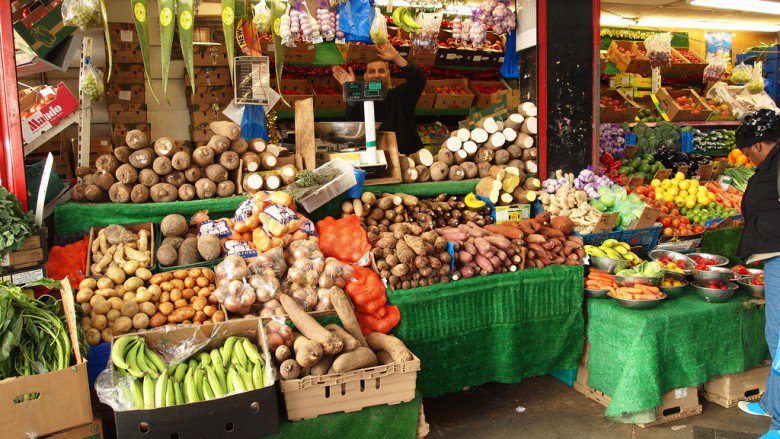
According to the NBS, the rise in food inflation on a year-on-year basis was caused by the increase in prices of staples like Semovita, yam flour, wheat flour, yam, Irish potatoes, water yam, groundnut oil, palm oil, Milo, Bournvita, Ovaltine.
While analysts linked the rise in food prices in a year mainly to insufficient local production and transportation costs, particularly in critical staples like yam, cassava, rice, the Federal Competition and Consumer Pricing Commission (FCCPC) has blamed the disproportionate pricing of imported goods mostly among retailers for rising consumer goods in the country.
The price of bread, a staple in almost all Nigerian households, increased over 60 per cent in the last one year.
Findings also showed that five tubers of yam which were sold at about N4500 last year, now go for almost N15000.
Analysts said insecurity, low production, high transportation costs, and subsidy removal were part of the factors that contributed to the inflation.
Analysts, therefore, suggest that the government focus on boosting agricultural productivity, enforcing strategic interventions like zero-duty food imports, enhancing local production, improving security, and ensuring efficient distribution to effectively reduce inflation.
Adetokunbo Kayode, chief counsel at Tokunbo Kayode Law Practice, recommends that the government integrate security measures with agricultural activities to protect farmers, modernise farming practices with mechanisation, and provide targeted support for transporters to reduce costs.
These combined efforts, according to him, are expected to significantly improve inflationary pressures and stabilise the economy.
Kayode also recommended specific support for key players in the food supply chain, stating, “The government should introduce targeted subsidies for farmers and transporters to offset the high costs of inputs and logistics.
“This would help ensure that food prices remain stable and affordable, even in the face of rising production costs.”
Ken Ife urged the government to implement more fiscal stimulus, aggressive production, processing and distribution of staples, particularly cassava/garri and distribution of input to farmers as well as bringing more land into cultivation through the states.
We’ve got the edge. Get real-time reports, breaking scoops, and exclusive angles delivered straight to your phone. Don’t settle for stale news. Join LEADERSHIP NEWS on WhatsApp for 24/7 updates →
Join Our WhatsApp Channel