Husbands and wives used to be identified as the best of friends who hardly cause physical harm, let alone kill one another. But the times seem to have changed as reports of spousal killing have continued to increase. BY FELIX IGBEKOYI, ANGELA NKWO-AKPOLU, HAFSAT BELLO BAFARA and KABIR WURMA, write.
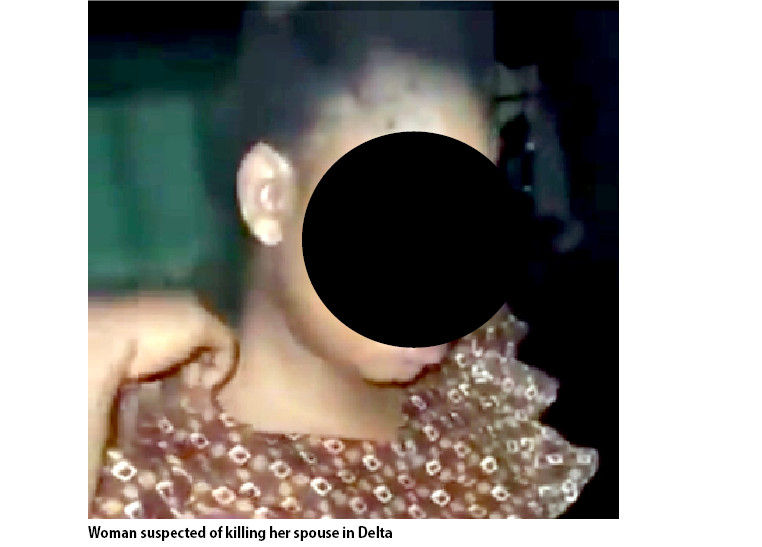
A yet-to-be identified housewife from Isoko ethnic nationality of Delta State has been arrested for allegedly killing her husband and another woman said to be the man’s lover.
The incident occurred in the Ighwre-Ovie area of Ughelli North local government area of Delta state, following prolonged marital disputes linked to the husband’s alleged extramarital affairs.
The suspect has been kept in custody at the Police headquarters in Asaba, Delta State Police Command while the Command Police Public Relations Officer (PPRO), SP Bright Edafe, confirmed that the suspect was being interrogated over the incident but yet to make any reasonable confession.
A community source confirmed that the woman, a mother of two, had repeatedly accused her husband of infidelity.
“Fed up with her husband’s alleged infidelity, on that fateful day, the husband came back home drunk and on entering the house, the wife welcomed him with multiple machete cuts on his head from which he died instantly.
“Not satisfied with her quest for more blood, a female neighbour who tried to intervene to stop her, got what she didn’t expect as her jaw was slit with a machete and has been admitted in the hospital.
“After, she went to her husband’s side chick’s house within the same area. On entering her house, she bashed her head with a hammer. A woman who heard the noise from her neighbour’s house narrowly escaped being attacked in the process and it was her alarm that attracted people that led to the suspect’s arrest,” the source narrated.
The permanent secretary of the State Ministry of Women Affairs, Community and Social Development, Mrs Oghenekevwe Agas, said nobody has the right to kill anybody.
The state chairman of the Delta State Child Rights Implementation Committee, who is also a marriage counsellor, said if a man or woman complains of cheating, there are several options, either to simply divorce or leave the marriage and continue with his or her life somewhere else or take peaceful steps to make themselves comfortable instead of resorting to crime.
The solicitor-general and permanent secretary, Ministry of Justice, Delta State, Omamuzo Erebe, stated that diligent investigation and consistent prosecution would serve as a deterrent to offenders and reinforce public confidence in the justice system.
“The aspect of displaying a face that’s calling for sympathy after committing a crime is uncalled for. There is always a penalty for any offence.
“Even though one is really hurt, it is not enough to have decided to risk taking the lives of others. Looking at her face now, she’s regretting not leaving the family instead of the mess she is battling with.”
Speaking on the matter, a father, Joseph Izese, said the two major reasons why women are in correctional centres and neuro-psychiatric hospitals are simply because of their husbands.
“Women should accept the fact that men are polygamous in nature. Stop killing your husband because he has another woman. A face of regret after the irreparable damage has been done is not enough to evade justice,” he stated.
Similarly, last week, the Police in Jigawa State arrested a newlywed woman over the alleged poisoning and death of her husband in Gauza village, Jahun local government area of the state.
The Police Command in the state said it recorded a tragic incident involving the death of a newly wedded man who allegedly died after consuming a poisoned meal prepared by his new wife.
The Jigawa State police spokesman, SP Shiisu Lawan Adam, said preliminary investigations revealed that the deceased reportedly took his lunch at home, after which he fell seriously ill and was rushed to the hospital for medical attention, but was later pronounced dead while receiving treatment.
The command said detectives from the Jahun Divisional Police Headquarters immediately commenced an investigation and arrested the wife as the principal suspect.
During interrogation, she confessed to the act. The police said she confessed to lacing her husband’s food with rat poison, and further revealed that she sent her cousin to purchase the rat poison used in committing the act.
According to the police, the woman said she was forced into the marriage by her parents, a situation she claimed led to her action.
In Imo State, a 58-year-old man, Vitalis Nwoko of Umuagba, Ahiazu Mbaise local government area, has been arrested for the death of his wife during a fight.
Police spokesperson in the state, DSP Henry Okoye had in a statement said the suspect had a misunderstanding with his late wife, Uloma which escalated into a violent fight.
According to him, during the fight, Uloma collapsed, and though she was rushed to a hospital, she was pronounced dead on arrival.
Okoye had said, “During preliminary investigation, the suspect stated that a misunderstanding between him and his wife on 11 December 2025, escalated into a physical altercation, during which the victim collapsed. She was rushed to Cecilia Hospital, Ogbe, where she was confirmed dead by a medical doctor.”
According to the Police, the suspect has been transferred to the State Criminal Investigation Department (SCID), Owerri, for thorough investigation and prosecution.
It is common practice for church leaders to harp on the importance of enduring challenges and staying in marriage, especially when children are involved.
Furthermore, traditional institutions especially families and traditional rulers in their palace listen to loads of cases by aggrieved spouses which often centre on finances, feeding, upkeep, intimacy, and sometimes other family members like siblings and or parents.
Several church leaders listen to spouses’ complaints even as they try to resolve them where possible.
Reacting to the issue, a psychologist, Dr Ijeoma Nwafor, in an interview, lamented that there was a rise in spousal killings and domestic harm in Nigeria, adding that it was deeply troubling as it reflects a mix of psychological, social, economic and cultural pressures.
According to her, the key factors responsible include “poor anger control, unresolved trauma, substance abuse, economic hardship, jealousy, possessiveness, rigid gender norms and cultural beliefs that normalise dominance or silence victims. Weak access to mental healthcare and poor conflict-resolution skills worsen the problem.”
Dr Nwafor advocated anger management training, effective communication training, mental health support, stronger laws and enforcement, and community education.
She said anger management training could help individuals recognise triggers, regulate emotions and respond without violence.
Further, she said effective communication training could help couples learn to express needs, disagree respectfully, and listen actively, adding that there should be accessible counselling and crisis intervention services for mental health support.
The psychologist advocated stronger laws and enforcement to deter abuse and protect victims, and that religious leaders (clerics), traditional rulers and schools must speak clearly against domestic violence.
On options for couples to address issues, she called for “premarital and marital counselling, mediation by trained professionals (not family pressure), temporary separation for safety and reflection, support groups and therapy and safe exit from violent relationships where necessary.”
Nwafor maintained that some cultural and traditional factors must be addressed to reduce the narrative.
They include the belief that men must “control” women, stigmatisation of divorce or separation even in abusive unions, encouraging the culture of silence under the guise of protecting family name, bride-price and ownership mentality and the culture of glorifying endurance over safety.
Nwafor maintained that couples should live and operate in love, noting that when disagreements ensue, dialogue remains the most important approach.
She said, “Love should never hurt. As a society, we must replace silence with support, dominance with dialogue and violence with healing.”
Perhaps, the high bride price in Igbo land contributes to the notion by some men that their wives are their eternal property and must not question their authority. An attitude that reflects in constant bickering, arguments and fights.
Meanwhile, the Imo State Police Commissioner, Aboki Danjuma, has appealed to residents to “promptly report cases of domestic violence, assuring the public of the Command’s resolve to deal decisively with perpetrators.”
Similar incidents of spousal killing have occurred in Kebbi State. Only recently, one Sule Gumu killed his wife, Umaima Maidawa, in Bayawa village in the Augie local government area of Kebbi State.
It was learnt that the culprit, Sule Gumu, killed his wife by hitting her head with a pestle during an argument in their matrimonial home.
He was later arrested by security personnel on the order of the chairman of the local government and was transferred to the State Criminal Investigation Department at the police headquarters in Birnin Kebbi for prosecution.
The deceased was, however, buried according to Islamic rites in Bayawa village as thousands of sympathisers, including her relatives and friends, gathered to witness the sad event.
A senior member of the deceased family who craved anonymity told LEADERSHIP Sundaythat they leave everything for God to judge.
We’ve got the edge. Get real-time reports, breaking scoops, and exclusive angles delivered straight to your phone. Don’t settle for stale news. Join LEADERSHIP NEWS on WhatsApp for 24/7 updates →
Join Our WhatsApp Channel