Kano State’s drive to transform agriculture through strategic investments in irrigation, mechanisation and farmer support programmes is beginning to yield measurable results, with the state government reporting that it has achieved about 80 per cent of the targets outlined in its agricultural development blueprint.
For a state whose economy and livelihoods are deeply tied to agriculture, the achievement is being seen as a significant milestone in efforts to boost food security, reduce poverty and strengthen rural economies.
The Commissioner for Agriculture and Natural Resources, Dr Yakubu Danjuma Mahmud, attributed the progress to deliberate policies initiated by the administration of Governor Abba Kabir Yusuf since assuming office in 2023.
According to him, one of the first steps taken by the government was the establishment of a comprehensive database of farmers across the state to provide accurate statistics for planning and implementation.
“We started with establishing the baseline and generating a database of farmers because if you are planning, you have to plan with statistics,” Mahmud said during an interaction with journalists in Kano.
He explained that the database has enabled the government and development partners to identify farmers, determine farm locations and sizes, and deliver targeted interventions more effectively.
The commissioner noted that the administration inherited significant challenges in the agricultural sector but has recorded substantial progress in rebuilding infrastructure and expanding production capacity.
Among the key achievements, he said, was the rehabilitation and recovery of irrigation facilities across the state.
“What we have recovered and repaired is in the region of 1,230 hectares of cultivable and irrigable land across the state,” he said, adding that the government also succeeded in reclaiming the Kadawa irrigation facility and returning it to state ownership.
The state has also invested in measures aimed at addressing the perennial clashes between farmers and herders. According to Mahmud, about 1,300 kilometres of cattle routes have been demarcated across Kano to reduce conflicts and improve livestock management.
“That project has really achieved a lot in helping to resolve the conflict between farmers and herders,” he stated.
Perhaps the most ambitious agricultural project currently underway in the state is the construction of a major irrigation dam at Dantsoshiya Forest.
Mahmud described the project as one of the biggest irrigation investments in Kano’s history. “The dam is about two kilometres in length and will have the capacity to store up to three billion cubic litres of water. It will irrigate about 1,250 hectares of farmland when completed,” he said.
According to the commissioner, the project forms part of a broader strategy to restore abandoned irrigation sites, develop new ones and improve access to water for agricultural production.
Work on the project, he disclosed, has reached an advanced stage, while a 14-kilometre access road is also being constructed to facilitate the evacuation of farm produce from the irrigation site.
Beyond the flagship dam project, the government has developed 11 small earth dams across local government areas including Albasu, Shanono, Gari, Dawakin Kudu, Rogo, Ajingi and Bichi.
Mahmud said the dams have a combined irrigation capacity of about 1,200 hectares, with improved designs expected to increase coverage to nearly 2,000 hectares.
“In some cases, we now have a new design that will allow us to achieve about 2,000 hectares of irrigated land within rural communities,” he explained.
The government’s intervention has also extended to the provision of farm inputs. Over the past three years, Kano has supplied more than 623 truckloads of fertiliser to farmers while also leveraging support from the Federal Government.
The state, according to the commissioner, has distributed fertilisers free of charge in some instances and at subsidised rates in others to ensure affordability for farmers.
As preparations intensify for the 2026 wet season farming activities, the government is rolling out fresh measures to boost farmers’ confidence amid concerns over fluctuating commodity prices and production costs.
Mahmud acknowledged that many farmers suffered losses due to low produce prices and irregular rainfall patterns during previous seasons. To address these concerns, he said Governor Yusuf had approved the purchase of fertilisers that would be sold to farmers at subsidised rates.
“The governor is going to make fertilisers available at subsidised prices so that farmers can recover part of what they lost during the previous farming seasons,” he said.
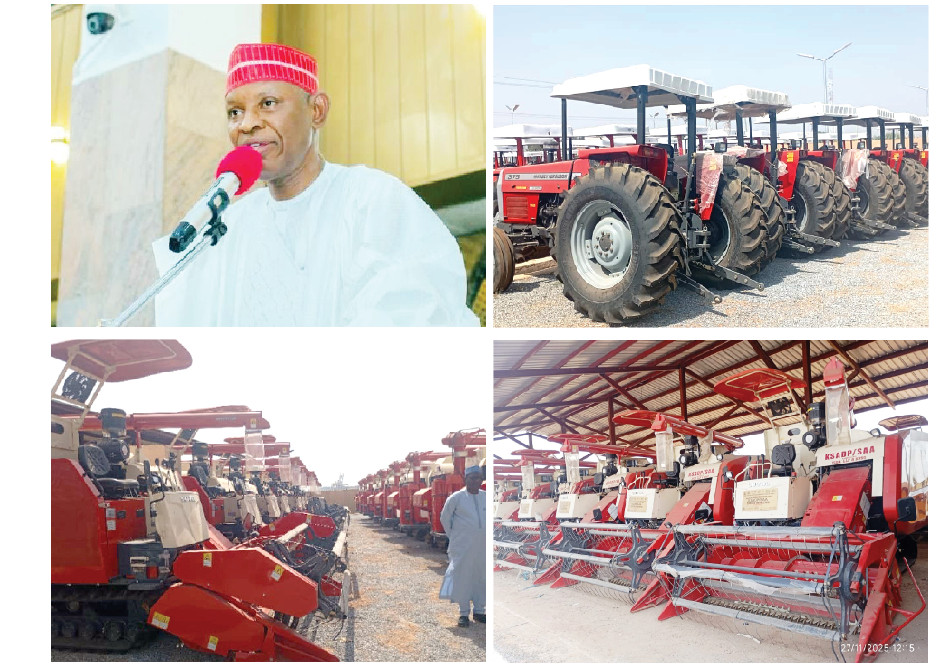
The state is also pursuing an ambitious mechanisation programme aimed at reducing production costs and increasing efficiency. According to the commissioner, three major Agricultural Mechanisation Centres have been established in Gaya, Kadawa and Dambatta.
The centres are equipped with tractors, combine harvesters, planters, transplanters, sprayers and threshers, which will be made available to farmers through a public-private partnership arrangement.
“We are moving towards highly mechanised agriculture. Farmers will have access to these machines at discounted rates,” Mahmud said.
The government is equally promoting climate-smart agriculture through the introduction of drought-resistant and early-maturing seed varieties to help farmers adapt to changing weather conditions.
In addition, solar-powered irrigation pumps are expected to be distributed to farmers’ cooperatives to reduce dependence on costly fuel-powered systems and expand dry-season farming.
For Mahmud, the independent assessment that rated the ministry’s performance at 80 per cent validates the administration’s agricultural strategy.
“The assessment was carried out by independent professionals using milestones, benchmarks and key performance indicators contained in the development blueprint,” he said.
With major investments in irrigation infrastructure, mechanisation, farmer support programmes and climate-resilient agriculture, Kano is positioning itself to consolidate its gains and increase food production in the years ahead.
As the state prepares for the 2026 planting season, the Yusuf administration said it is determined to build on its achievements and strengthen Kano’s status as one of Nigeria’s leading agricultural economies.
We’ve got the edge. Get real-time reports, breaking scoops, and exclusive angles delivered straight to your phone. Don’t settle for stale news. Join LEADERSHIP NEWS on WhatsApp for 24/7 updates →
Join Our WhatsApp Channel