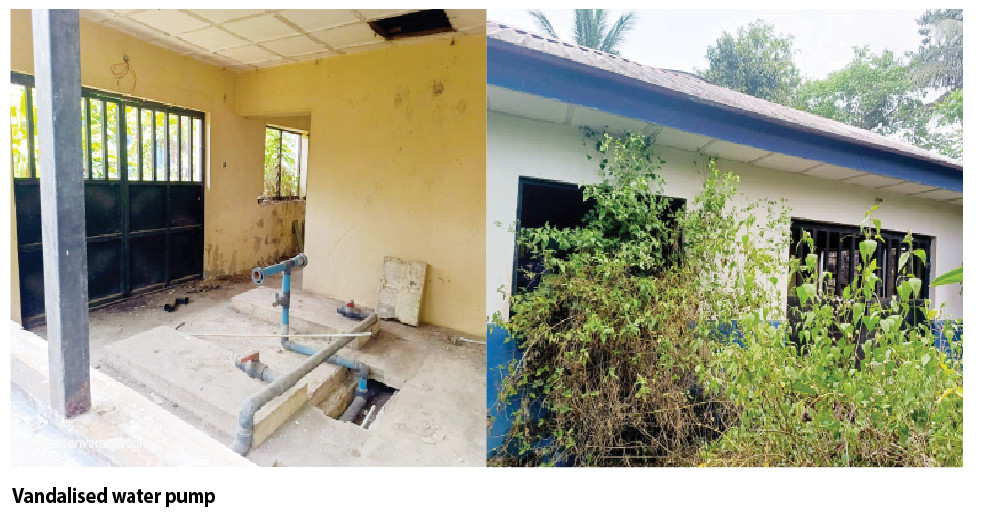
When the Akpab Okoyong Water Scheme was commissioned in 2007, it promised life, dignity, and a reliable water supply for the community. Today, 19 years later, vandalism has left the taps dry, turning hope into hardship. Residents face chronic thirst, deteriorating health, and daily struggles that expose the long-lasting consequences of neglect and sabotage. RICHARD NDOMA reports on a crisis that continues to deepen with each passing year.
When the water scheme at Akpab Okoyong community (home town of Mary Slessor, the missionary who abolished the killing of twins), in Odukpani local government area, Cross River State, was commissioned in 2007, it felt like a miracle.
The project was part of broader EU-supported Water Supply and Sanitation Sector Reform Programmes (WSSSRP) in the state, implemented in partnership with the Cross River State government meant to provide water to the residents of Akpab Okoyong for at least 25 years.
The facility, with its eight pumps and reticulated pipes, once delivered water to every nook and cranny of the community. “We were excited when the government brought the water scheme project to our community to make life meaningful to us,” recalled His Royal Highness, Ubon Obo Effiom, the village head of Akpab Okoyong community.
For years, women and children no longer trekked long distances to fetch water from distant streams. The borehole, the overhead tank and the humming generator powered life into the village, supporting households, the market and the health centre.
But the hope was short-lived. One night, vandals slipped into the water facility, broke into the generator house and stole the power generator kick-starters with other vital components. By morning, the generator was silent, and water stopped flowing.
“Bad people thwarted government effort when the facility which gulped millions of naira became vandalised,” the monarch lamented.
The impact was immediate and brutal; the taps ran dry and families began scrambling for alternatives.
Households resorted to buying water from private boreholes, a cost many could not afford. Others fetched from far-away streams, risking waterborne diseases like cholera, diarrhoea and others.
The health centre, already struggling with a broken solar system, could no longer pump water for patients.
The market toilet, once a symbol of sanitation, became a locked, dry shell. Traders and customers trekked long distances back to their homes just to relieve themselves. “A situation where market traders always trek some kilometres away from the market back to their homes to defecate does not augur well for us,” said a market woman, Affiong Okon Ekpo.
The community’s response was swift and rooted in tradition. Elders, led by His Royal Highness (HRH) Obon Obo Effiom, summoned customary law, threatening punishment for anyone involved in the vandalism.
“We threatened to punish anyone who had a hand in the vandalisation of the generator components,” the monarch declared. Fear of traditional sanctions forced the thieves to return the stolen parts overnight, but the damage was already done.
The returned parts were damaged, and without proper repairs, the water scheme remained dead.
“The generator is there, but it cannot work without its parts. We are left with nothing,” one the community residents lamented, pointing at the rusting machine.
The vandalisation exposed several lapses in the execution of the project. There were no security, no barb-wire on the perimeter fence, no guards and no government maintenance plan. What was meant to be a symbol of development became a ghost of broken pipes and silent pumps.
But the community refuses to give up. “If the government revives this water facility, we will guard it with our lives,” HRH Obon Obo Effiom vowed, his eyes reflecting both pain and determination.
Akpab Okoyong, a small, predominantly Efik-speaking community, sits in the southern senatorial district of the state, just north of Calabar, and forms part of Akamkpa ward in Odukpani local government of the state. It is one of many rural hamlets in Odukpani, with a population of about 257,800 people.
Before the water scheme, residents suffered daily to get water. The project’s launch in 2000 (and commissioning in 2007) was a lifeline.
For several years, the system worked, transforming lives. Water meant health, hygiene, and dignity. “Water made it possible to maintain personal hygiene, handwashing, bathing and household cleanliness,” a resident, Mrs Eminika Ekpeyong stated.
The market toilet operated, preventing open defecation and reducing disease. Women and children no longer trekked for water, freeing time for farming activities, trading and education.
Market traders kept the premises clean, knowing a clean environment attracted more customers. Farmers used water for small-scale irrigation farming and livestock rearing, improving food security and income.
Shared water points became places for social interaction and collective responsibility. The health centre relied on water for sterilising equipment, delivering babies and maintaining hygiene.
Water availability meant the clinic could respond better to disease outbreaks and emergencies. The scheme represented government and EU investment in rural development, raising community morale and trust.
Due to the absence of water in the area, residents of the community have no option than resorting to buying water from private boreholes or fetch from streams, exposing themselves to waterborne diseases. The market toilet’s closure led to open defecation and unhygienic conditions.
The health officer in charge of Akpab Okoyong Primary Health Care Centre, Mrs Mary Ekpo-Eyo, lamented the prevailing situation, calling on the state and federal government to look into their plight. According to her, the clinic could no longer pump water, affecting healthcare delivery since the only renewable energy (solar power) that was servicing the health centre broke down.
“We now use a power generator to provide water for the health centre, but it hampers smooth flow of activities,” she said.
At the forefront of the cry for intervention stood HRH Obon Obo Effiom, his royal staff glinting in the sunlight. “We are calling on the state and federal government thorough their Ministry of Water Resources to pity us and revive this water facility,” he pleaded.
“Our people are suffering, and without water, there is no life. We promise to guard it jealously this time, as if it were our own child,” he added.
In his remarks, Councillor Okon Edem Okon, representing Akamkpa ward in Odukpani local government area legislative Assembly, echoed the call, saying, “Apart from the borehole water provided by Barr. Ekpeyong Akiba, we have no other source of water. We cannot continue like this.
“Water is not a luxury; it is a life.” He urged the government at all levels to restore the project for the sake of the people.
“Barr. Ekpeyong Akiba, special adviser to Governor Bassey Otu, had sunk a borehole for temporary relief. “We are grateful to Barr. Akiba for his kindness, but one borehole cannot serve a whole community,” a youth leader remarked.
Also, Mrs. Mary Ekpo-Eyo said, “Without water, our health facility cannot function properly. We need government support to fix this and to provide renewable energy (solar power) so that we can serve our people better.”
“Imagine trying to deliver a baby without water to clean up. It’s like a nightmare,” she maintained.
“When we had water, our market was clean, our children were healthy, and our women didn’t have to trek miles for a basic need,” recalled Affiong Okon Ekpo, a market trader.
The community’s plea echoes beyond its borders, a reminder that in the heart of Cross River State, a village thirsts for more than just water; it thirsts for attention, for action, for a government to remember its promise.
HRH Obon Obo Effiom said, “We are ready to protect this project with our lives, but we need it revived first. Come, see our struggle, and help us end it.”
The broken pipes and silent generator at Akpab Okoyong tell a story of loss, but they also point to a roadmap for recovery. Community leaders, residents, and stakeholders are laying the foundation for change.
“We are ready to protect this water facility with our lives, but first, it must be revived,” declares HRH Obon Obo Effiom. The community called for the immediate repairs and rehabilitation, restoration of the power generator, to replace the corroded pipes, and fix the overhead tank.
In his remarks, the Cross River State Commissioner for Water Resources, Barr. Bassey Offiong Mensah, described the state of the Akpab Okoyong water facility as “a sad situation”, lamenting that there was no justifiable reason for the project to have deteriorated, especially considering the huge financial investment made by the European Union (EU) in partnership with the Cross River State government.
Condemning the act of vandalism in its entirety, the commissioner questioned why members of the community allowed hoodlums to destroy a facility meant to serve them.
“It can be discouraging for one not to protect what was given to the community,” he remarked, stressing that he was going to raise a memo to draw attention of the state government to come to the rescue of Akpab Okoyong community.
The story of Akpab Okoyong’s water scheme is more than a tale of broken pipes and stolen generators. It is a story of resilience, community spirit and an urgent cry for help. From the once-joyful sound of water gushing into the households. The community residents called governments at all levels, non-governmental organisation (NGOs) and international donor agencies to come to their aid, so that they can revive the broken water scheme that once served the community residents with potable water.
We’ve got the edge. Get real-time reports, breaking scoops, and exclusive angles delivered straight to your phone. Don’t settle for stale news. Join LEADERSHIP NEWS on WhatsApp for 24/7 updates →
Join Our WhatsApp Channel