
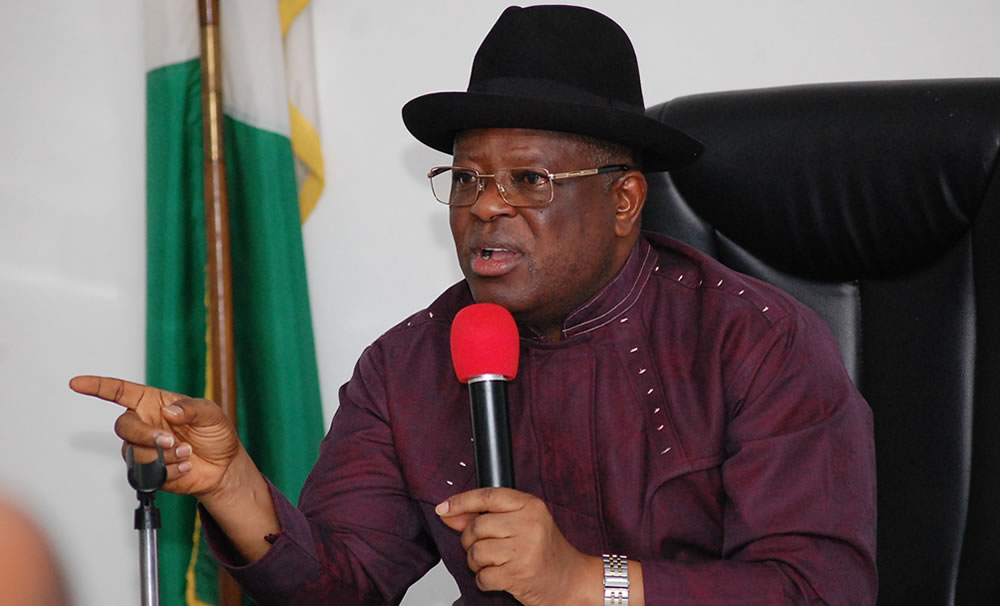
The Minister of Works, David Umahi, has defended the ₦1.06tn contract sum for Section One of the Lagos-Calabar Coastal Highway, insisting that the project is competitively priced when its engineering specifications, terrain and supporting infrastructure are taken into account.
Umahi made the clarification during an interview with ARISE News anchor on Friday where he argued that critics had misrepresented the project’s cost by dividing the total contract sum by the length of the road without considering its multiple carriageways and other infrastructure.
“Section One of the coastal highway covers 47.47 kilometres, stretching from Victoria Island to Eleko Village in Lagos State,” he said
According to the minister, the cost translates to approximately ₦7.3bn to ₦7.5bn per kilometre when adjusted to the equivalent of a standard two-lane carriageway.
“I deserve kudos for the cost of the coastal highway,” Umahi said as he compared the project with other major road developments
“You have to compare apple to apple,” Umahi said, arguing that meaningful comparisons between road projects must account for road width, pavement specifications, bridges, drainage systems and terrain.
He explained that the highway was being constructed with reinforced concrete pavement and would feature solar-powered streetlights, underground drainage, two-metre walkways, crash barriers and a corridor reserved for a railway line.
The minister also highlighted the extensive ground preparation required along the Lagos section, saying about 30 kilometres of the route involved removing unsuitable soil to an average depth of 10 metres before refilling the area.
He added that the road level had to be raised by an average of five metres, further increasing the engineering demands of the project.
Umahi also cited rising construction material costs, particularly concrete, as another factor affecting the economics of the project.
“When we started, concrete was ₦350,000 per cubic metre. Today, it is ₦460,000 per cubic metre. The contract price has not changed,” he said.
According to him, the increase in the price of concrete had not resulted in a corresponding adjustment to the contract sum.
Umahi compared the Lagos-Calabar Coastal Highway with the Bodo-Bonny Road in Rivers State, sections of the East-West Road and other coastal road projects in West Africa.
He maintained that the project was competitively priced when assessed against roads with comparable engineering requirements.
The minister also cited the involvement of Deutsche Bank, which led the financing for Section One, as evidence that the project’s pricing had undergone scrutiny.
According to Umahi, the bank considered the project underpriced, while subscriptions to the financing exceeded the amount being sought by $100m.
However, the minister did not suggest that the financing assessment alone settled the wider debate over the project’s cost.
Umahi cautioned against using the cost of the first section to estimate the cost of the entire 750-kilometre Lagos-Calabar Coastal Highway.
He explained that soil conditions, bridges and other engineering requirements differed along the route, meaning that construction costs would vary from one section to another.
“There are no two sections that are the same,” he said.
The minister’s defence came amid sustained public scrutiny of the coastal highway’s contract sum, with critics questioning the scale of expenditure and the government’s justification for the project.
Umahi, however, insisted that assessments based solely on the contract value and road length failed to capture the project’s engineering complexity.
He maintained that the highway represented value for money, arguing that a fair assessment must consider the construction specifications, supporting infrastructure and challenging terrain involved in delivering the project.
We’ve got the edge. Get real-time reports, breaking scoops, and exclusive angles delivered straight to your phone. Don’t settle for stale news. Join LEADERSHIP NEWS on WhatsApp for 24/7 updates →
Join Our WhatsApp Channel