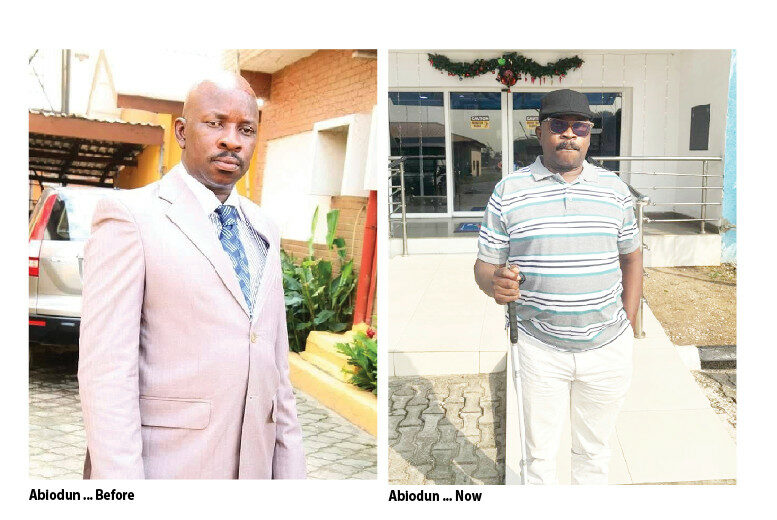
Kolapo Abiodun is a journalist, businessman and founder of the Arike Eye Care Support Foundation. In this interview with ZULEIHAT CHATTA, he reflects on life beyond blindness, personal resilience, and Nigeria’s unresolved responsibility to persons with disabilities
People often focus on your visual impairment. Can you share how your life has unfolded in terms of your career, leadership, and community involvement ?
People often start and end the conversation with my blindness, but that is only one chapter of my life. I was born in the late 1960s. I studied English at Ogun State University and began my career as a journalist, specialising in health reporting. That experience shaped how I think, how I analyse issues, and how I communicate.
Beyond journalism, I have lived a very active professional life. I went into commercial transportation and built a fleet of buses from scratch. I ventured into oil and gas trading, ran a business centre, worked in corporate communications, and later established a printing press that did quite well.
I have also been deeply involved in community service. I served as president of my estate association for four years, chaired a professional printers’ body, and held leadership positions in alumni associations. People see me as strong-willed, sometimes stubborn, but those close to me know I am very soft-hearted. I believe deeply in dignity, responsibility and service.
When did you first realise your sight was changing, and how did that moment affect you emotionally?
I had lived with glaucoma for years and managed it well. Before 2020, I drove at night without glasses and lived a very active life. Then in February 2020, I experienced a sudden complication. I sought treatment, but shortly after that, COVID-19 happened and the country went into lockdown.
All eye clinics were shut. For three months, I stayed at home, and my sight continued to deteriorate. That period was devastating, not just physically but emotionally. When the lockdown was lifted, everyone returned to their lives. I was left behind.
Emotionally, it was traumatic. I fell into depression. I struggled with isolation. There was a point where suicidal thoughts crossed my mind. What stopped me was the thought of my children and what my absence would do to them. That moment forced me to choose life, even when life felt unbearable.
What was the hardest adjustment you had to make in your daily life?
The silence. That was the hardest part.
When my family went back to work and school, the house became unbearably quiet. I was used to being busy, productive, surrounded by people. Suddenly, I was alone with my thoughts. That isolation was more difficult than learning how to walk with a white cane or use assistive technology.
I had to learn emotional discipline. I had to learn how to sit with my pain without letting it destroy me.
Many people assume visual impairment limits independence. How would you describe your own sense of independence today?
Independence is not about doing everything the same way you used to. It is about learning new ways to function.
Today, I am independent. I use screen-reading technology. I move confidently with my white cane. I cook. I work. I manage a foundation. I make decisions. Blindness did not take away my brain or my ability to contribute.
What it changed was my method, not my value.
Can you share a small everyday victory that might seem ordinary to others but means a lot to you?
Listening to music and walking alone outside my comfort zone.
It may sound simple, but being able to put on my headphones, walk for hours, listen to music and clear my mind is a huge victory for me. It helps me manage emotional stress and reminds me that I am still in control of my life.
How has access to education or training changed how you see your future?
Retooling saved me. Blindness takes away certain abilities, but it demands that you acquire new ones. I learned white cane mobility. I learned how to use assistive devices. I adapted to modern technology. Education did not end for me. It evolved.
That mindset is what I try to pass on to others through the foundation.
What role has community played in your journey, both supportive and challenging?
Community can either lift you or limit you.
I have received support from individuals who genuinely care, and I am grateful for that. At the same time, society still struggles to see beyond disability. Once people hear you are blind, they assume incompetence. They assume dependency.
That mindset is one of our biggest challenges.
Are there moments when you feel misunderstood by society? What do you wish people knew?
Very often. I wish people understood that disability does not erase intelligence, experience or competence. I wish they knew that visually impaired people can contribute meaningfully to the economy and society.
Every human being is a potential disabled person. Six years ago, I never imagined I would be blind. Today, I am.
You did not speak extensively about government support earlier, but how would you assess government responsibility to persons with disabilities in Nigeria?
The truth is that government has not done enough.
Nigeria passed the Discrimination Against Persons with Disabilities Act in 2018. On paper, it is a strong law. In reality, implementation is weak. The five percent employment quota for persons with disabilities is not being enforced. Public buildings remain inaccessible. There is little accountability.
The closure of the FarmCraft Vocational Centre for the Blind in Lagos for nearly two years is a painful example. Unity schools are never shut down like that. Why is it always institutions meant for the disabled that are treated as expendable?
We are treated as second-class citizens, and that must change.
Are there any government interventions you believe deserve recognition?
Yes. I must acknowledge Senator Oluremi Tinubu’s empowerment programme for persons with disabilities. About 9,500 people reportedly received financial support. That is tangible, and it deserves recognition.
Anyone who supports the disabled deserves support.
What part of the Arike Foundation’s support means the most to you?
We focus on skills acquisition and small grants that help people regain dignity and purpose. I know what it means to feel helpless, and I do not want others to remain in that space.
How do you stay motivated on days when things feel overwhelming?
I stay quiet. I listen to music. I work. I avoid emotional nagging. I have learned that no one is obligated to carry my burden. When help comes, it is a privilege.
That mindset keeps me grounded.
Has your experience reshaped how you define strength or resilience?
Absolutely. Strength is not pretending you are okay. It is accepting reality and still choosing to move forward. Resilience is not noise. It is quiet consistency.
What brings you joy right now in your life?
Purpose. Knowing that my experience can help someone else survive gives my life meaning.
If you could speak to someone newly adjusting to visual impairment, what would you tell them?
Accept yourself. Love yourself. Retool. Do not blame the world. When help comes, receive it with gratitude.You are still valuable.
Why the Arike Eye Care Support Foundation?
Because this work is a calling.I do it with sincerity and purpose. I know what visually impaired people go through, and I believe society must do better by them.
We’ve got the edge. Get real-time reports, breaking scoops, and exclusive angles delivered straight to your phone. Don’t settle for stale news. Join LEADERSHIP NEWS on WhatsApp for 24/7 updates →
Join Our WhatsApp Channel