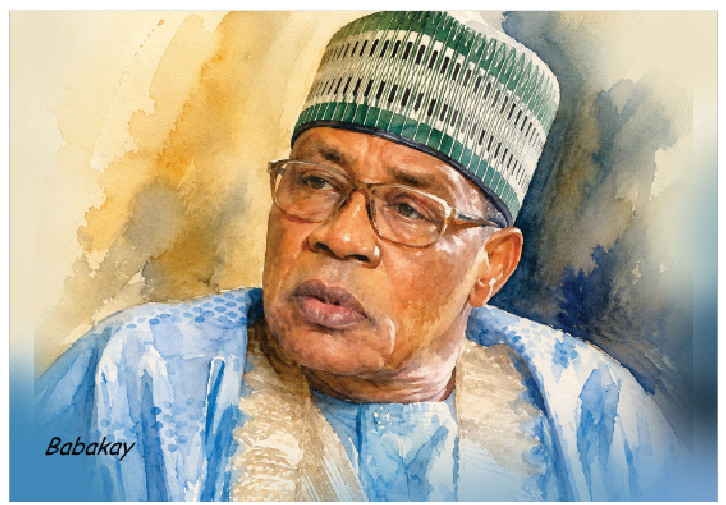
This Wednesday, 26th August, marked the 33rd anniversary of former military president General Ibrahim Badamasi Babangida (retd) ‘stepping aside’ from power. After willingly exiting power and handing over to the Interim National Government, headed by Chief Ernest Shonekan, the curtains closed on eight years that saw the intellectualisation of governance turn the country into a laboratory of brains and brawn for national development. As military president from 1985 to 1993, Babangida led one of the most complex, ambitious, and deeply polarising eras in the nation’s post-colonial history.
Economic Liberalisation
Determined to find solutions for a nation blessed with so much yet giving so little to its citizens, the former Chief of Army Staff, who rose to the pinnacle of political power, established the 17-member Political Bureau, headed by an intellectual and diplomat, Dr Samuel Joseph Cookey. The Bureau’s report gave him an inkling of what to expect, and he refused, in line with public opinion, to borrow the $2.4 billion from the International Monetary Fund (IMF).
Babangida’s economic legacy is defined by the Structural Adjustment Programme (SAP), introduced in 1986 in collaboration with the IMF and the World Bank. Facing a tanking, oil-dependent economy characterised by fixed exchange rates and severe shortages, the government resolved to introduce market-driven reforms.
The SAP programme included economic diversification, deregulation of local markets, and encouragement of private-sector growth through the privatisation of inefficient state enterprises. SAP planted the seeds of Nigeria’s modern economy, liberalised the banking sector, ended the monopoly of foreign-dominated banks, and paved the way for indigenous financial institutions that now dominate the African continent. Babangida opened the domestic aviation and media industries, breaking state monopolies and allowing private airlines to emerge.
To this day, discordant tunes reverberate over the gains and losses; however, rejecting the loan prevented Nigeria from becoming a dumping ground for imports and created an opportunity to push the economic frontier beyond the manipulative control of the Bretton Woods institutions.
New States, LGAs
Since Nigeria attained political freedom from British colonialists in 1960, no government before or after Babangida’s administration has reshaped the country’s physical and geopolitical map. During his watch, he created 11 states and hundreds of local government areas (LGAs) to improve governance.
The IBB-led regime created Akwa Ibom, Katsina, Delta, Edo, Enugu, Jigawa, Kebbi, Osun, Kogi, Taraba, and Yobe. Over three decades since the creation of these states, the state capitals and newly created LGAs have served to improve economic activities and political participation of citizens.
In doing so, Babangida used military decrees to expand the nation’s internal administrative boundaries radically. In 1987 and 1991, he created 11 new states to bring governance closer to local populations, decentralise resources, and create new administrative capitals that have since evolved into major commercial and political hubs.
Analogous to state creation, IBB played an indispensable role in realising the dream of a master plan for the Federal Capital Territory (FCT), Abuja. The concept of a new capital was initiated under the Yakubu Gowon administration, but it was born under General Murtala Mohammed.
General Babangida systematically built the infrastructure, accelerated layout development, and officially moved the seat of power from Lagos to Abuja’s central heartland on December 12, 1991. The monumental structures that define Abuja’s skyline, its intricate network of central highways, and the city’s institutional layouts were largely fast-tracked under his watch. While other regimes dream of Abuja, Babangida turned architectural drawings into a new capital city that earned admiration not just at home but worldwide.
Institutional Modernisation
Beyond creating a capital city, he launched iconic projects like the Third Mainland Bridge, which for decades stood as Africa’s longest bridge and served as a critical economic artery connecting the mainland to the commercial islands.
Under his government, the Abuja-Kaduna-Kano dual carriageway was constructed, along with numerous regional airports and the dual-refinery and petrochemical complex in Port Harcourt, to bolster domestic energy independence. The IBB era also pioneered a massive institutional overhaul, creating enduring regulatory agencies that remain foundational to governance.
The Federal Road Safety Corps (FRSC), established in 1988, took charge of highway safety, while the National Drug Law Enforcement Agency (NDLEA) was founded in 1989 to tackle transnational narcotics trafficking. The legal framework for establishing the National Agency for Food and Drug Administration and Control (NAFDAC) was instituted in 1993 to combat counterfeit products. These organisations, alongside frameworks like the Code of Conduct Bureau (CCB), among others, have continued to define public administration and law enforcement in the country. It’s on record that the IBB-led regime left no stone unturned to overhaul the administrative machinery of governance.
Cloudy Matters
The conspiracy surrounding the 1986 murder of the pioneering Editor-in-Chief of Newswatch, Dele Giwa, Nigeria’s membership of the Organisation of Islamic Cooperation (OIC), the $12 billion windfall, the Vatsa coup and the June 12 conundrum, among a few others, remain some of the issues that continue to trail national discourse on the IBB years. However, emerging evidence may force a rethink of some largely unsubstantiated accusations.
For instance, the founding member of Newswatch magazine, Yakubu Mohammed, in his memoir, debunked the allegation that the news platform was investigating the story of a drug peddler, Gloria Okon, connected to top officials of the IBB regime. Despite efforts by the Ribadu-led Economic and Financial Crimes Commission (EFCC) to trace the alleged missing $12 billion, it never indicted the former military president. If a military official was dismissed for misappropriating N300,000 under Babangida, then the recent conviction of a former minister for illegally diverting N33.8 billion meant for power projects has won IBB a saintly crown.
The annulment of the June 12 presidential poll may remain a stain. Still, some members of the political and military class supported the dynamics and dialectics behind the annulment. General Babangida refused to hand power to the presumed winner of the June 12 poll, MKO Abiola, to avert a catastrophe that could have trailed the de-annulment. After leaving power 33 years ago, IBB remains a consequential visionary force whose transformational leadership overshadowed his failures. He is “more sinned against than sinning”.
We’ve got the edge. Get real-time reports, breaking scoops, and exclusive angles delivered straight to your phone. Don’t settle for stale news. Join LEADERSHIP NEWS on WhatsApp for 24/7 updates →
Join Our WhatsApp Channel