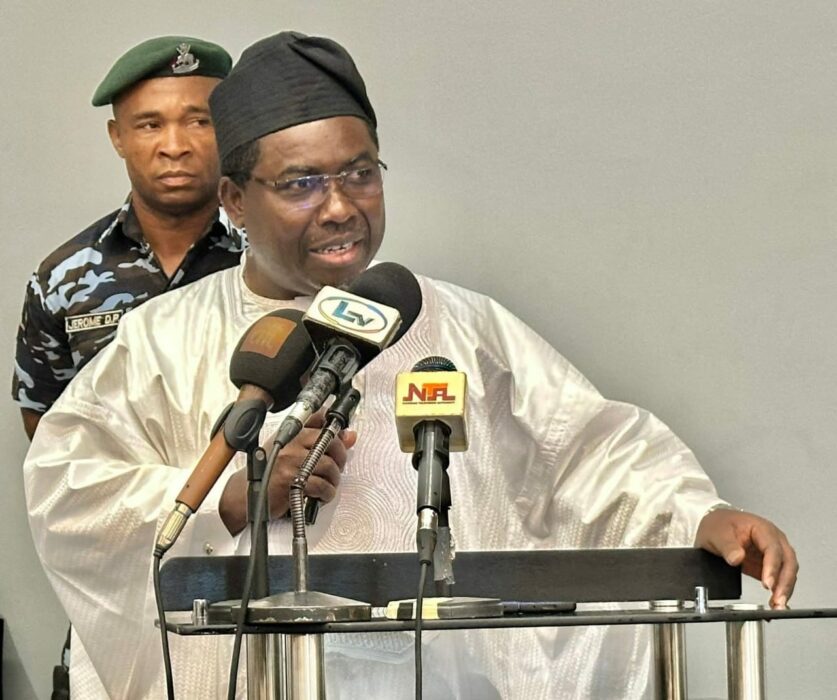
The chairman of the Independent National Electoral Commission (INEC), Prof. Joash Amupitan (SAN), has assured Nigerians that the 2027 General Election will be free, fair, transparent and technology-driven, warning that the Commission will not tolerate any form of misconduct in the electoral process.
Amupitan gave the assurance in Lagos on Thursday while speaking at the 2026 Induction and Strategic Retreat of the Commission, holding from January 9 to 10. He said INEC was positioning itself to meet the demands of a rapidly changing electoral environment and the growing expectations of Nigerians.
“We are gathered here not just as electoral administrators, but as custodians of the will of the Nigerian people. This retreat is a bridge between our institutional experience and the innovative demands of a fast-evolving electoral landscape,” he said.
The INEC chairman commended staff of the Commission for their performance during the November 2025 Anambra State governorship election, describing it as a defining moment early in his tenure.
He noted that preparations for the 2027 General Election would involve critical electoral milestones, including the February 2026 Federal Capital Territory (FCT) Area Council elections and off-cycle governorship polls in Ekiti and Osun States.
According to him, these elections would serve as testing grounds for INEC’s preparedness. “They are not routine exercises, but opportunities to fine-tune our processes and ensure that every technical and logistical gear is well oiled ahead of the 2027 polls,” he said.
Amupitan identified five non-negotiable pillars that would guide the Commission’s work: free, fair, credible, transparent and inclusive elections.
“We are committed to organising elections free from interference, fair to all contestants and political parties, credible in the eyes of the global community, transparent in every process, and inclusive of every Nigerian, regardless of physical ability or location,” he said.
He also highlighted the growing influence of first-time voters, particularly young Nigerians, in the 2027 elections, noting that they would demand openness and real-time transparency.
“Millions of young citizens will be voting for the first time. These digital natives demand transparency in real time and have little tolerance for opacity. It is our responsibility to earn their trust,” he added.
On the legal framework, the INEC chairman stressed strict compliance with the law, declaring that the rule of law would remain central to the Commission’s operations.
“Under my leadership, the rule of law is not a suggestion; it is our operating system,” he said.
He disclosed that the retreat would deliberate on 17 key thematic areas, including logistics, ad-hoc staffing, transportation, voter registration, election security and political party management.
“We must ensure that the Continuous Voter Registration and revalidation processes are beyond reproach. We will also examine election security and how to enforce internal democracy and transparency in party finances,” he said.
Amupitan said INEC had an opportunity to redefine Nigeria’s electoral history ahead of 2027, setting ambitious goals for the Commission.
“The 2027 General Election must be a watershed in Nigeria’s electoral history. Let it be said that under our watch, INEC emerged as the best Election Management Body in Africa — a symbol of integrity, technological efficiency and democratic values,” he declared.
He warned that any breach of the Commission’s values would attract sanctions, stressing that there would be no tolerance for compromise.
“I am committed to staff welfare, but any compromise of our values or processes will have consequences. There is no room for misconduct, whether by omission or commission,” he said.
In his remarks, the Lagos State Resident Electoral Commissioner (REC), Prof. Ayobami Salami, described the retreat as a significant milestone in the Commission’s continuous evolution.
Salami said the programme was designed to strengthen leadership capacity and improve operational readiness, noting that public expectations of the electoral process were higher than ever.
He added that the retreat would deepen institutional understanding, encourage peer engagement and foster cohesion within the Commission.
“As we move towards the 2027 General Election, early planning, strategic coordination and institutional unity are critical,” Salami said.
We’ve got the edge. Get real-time reports, breaking scoops, and exclusive angles delivered straight to your phone. Don’t settle for stale news. Join LEADERSHIP NEWS on WhatsApp for 24/7 updates →
Join Our WhatsApp Channel