
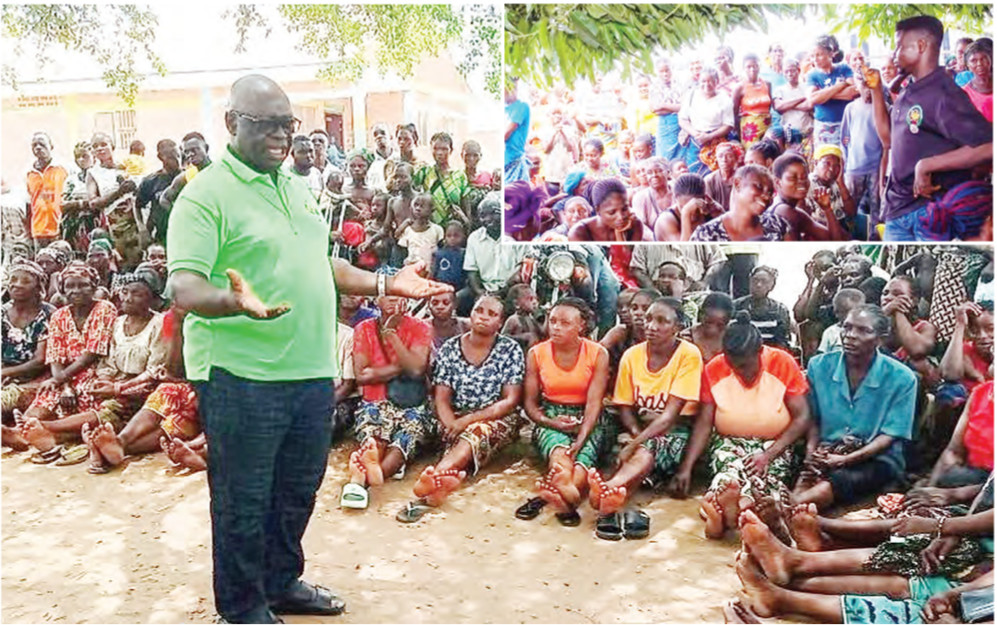
| IDPs abandon camps for mining sites | Benue has 14 camps | Banditry turned us into IDPs – Katsina residents
BY SOLA OJO, ABU NMODU, AZA MSUE, GODWIN ENNA, ACHOR ABIMAJE AND ABDULLAHI OLESIN
Years after attacks on communities across Northern Nigeria forced thousands of families from their homes, many displaced persons are still battling hunger, poor living conditions and persistent insecurity, with little prospect of rebuilding their lives.
Some internally displaced persons (IDPs), unable to cope with the hardship in camps, have reportedly abandoned the facilities for artisanal mining sites, where they work to earn a living.
While some displaced families have managed to reintegrate into communities where they sought refuge, others remain trapped in poverty, uncertainty and the daily struggle for survival.
In Kaduna State, hundreds of families displaced by banditry and kidnappings in Chikun, Igabi, Birnin Gwari, Kajuru and Kachia Local Government Areas are still struggling to rebuild their lives years after fleeing their ancestral communities.
Findings by LEADERSHIP revealed that many displaced persons face hunger, inadequate shelter, disrupted education and persistent insecurity.
Investigations in Ungwan Zawu and Mararaban Rido showed that many of the displaced persons, most of whom were farmers, had lost their homes, farmlands and sources of livelihood. They now depend on humanitarian organisations, host communities and well-meaning individuals for survival.
At Ungwan Zawu, in Gonin Gora, displaced families from Rumanan Gbagyi and other communities in Birnin Gwari have continued to seek refuge since 2019.
Similarly, about 4,000 displaced persons from communities in Chikun, Kachia and Kajuru have been living in difficult circumstances at Mararaban Rido, according to Comrade Adam Sule, an IDP who is now the chairman of the displaced persons in the local government area.
He said the families were grappling with food shortages, loss of livelihoods and psychological trauma, while some children had dropped out of school because their parents could no longer afford the costs.
The village head of Mararaban Rido, Auta Alkali Ganyi, acknowledged the prolonged displacement, saying some families had spent between five and seven years away from their ancestral communities.
He said the state government was pursuing a housing scheme for vulnerable families and strengthening the State Vigilance Service to improve security.
IDPs Abandon Camps For Mining Sites In Niger
In Niger State, many occupants of IDP camps have reportedly abandoned the facilities and taken up artisanal mining of gold and gemstones.
One of them, Abdulsalam Yakubu, who was displaced from Allawa in Shiroro Local Government Area, now mines gold at the Lokoto mining fields around Minna, the state capital.
Yakubu said he turned to artisanal mining after bandits forced him and other residents to flee their farms and communities.
“I came into mining to earn a livelihood, and I am making enough money to take care of my aged parents,” he said.
He said he narrowly escaped death during the arrest of miners who later died in the custody of the Nigeria Security and Civil Defence Corps (NSCDC), adding that the incident would not discourage him from continuing with the activity.
Yakubu explained that he had no alternative means of livelihood because bandits had continued to prevent displaced residents from returning to their farms.
“We are still going into the mining site because we don’t have any other means of livelihood. We came into mining because we have been displaced from our community in Allawa by armed bandits,” he said.
Benue Has 14 IDP Camps
In Benue State, at least 14 IDP camps have been identified across Makurdi, the state capital, and other locations following attacks by suspected armed herdsmen and other security threats.
Investigations revealed that some displaced persons had spent almost 10 years in the camps, while others still visit their ancestral farmlands to cultivate crops before returning for fear of attacks.
Although some buildings have been provided to accommodate displaced families, the large population has necessitated the use of tents to provide additional shelter.
Thomas Asongu, a displaced person at the converted Makurdi International Market IDP camp, said he still farms in neighbouring villages in Makurdi.
He said, “Government is doing its best, but there are still many challenges facing us in IDP camps. There are many problems, such as lack of decent accommodation, shelter and even food. I am not accusing the government; they are trying, but the supplies they are providing us are not enough. No place like home, but we thank God for keeping us alive.”
Meanwhile, the Benue State Emergency Management Agency (Benue-SEMA) said the state government had been providing food and other essential items to IDP camps monthly to cushion the effects of hardship.
Speaking with LEADERSHIP, the Head of the Information Unit of Benue-SEMA, Tema Ager, said three schools had been built in IDP camps to provide education for children.
“Three schools were built in three IDP camps, namely Ortese, Agenagbe and Mega camps, for children living with their parents in the camps to attend.
“We signed an MoU with Benue State University Teaching Hospital (BSUTH), Makurdi, for the free treatment of people living in those camps. We also signed MoUs with many organisations to take care of displaced persons in IDP camps.
“A water plant was built in Naka to address water scarcity in the area. We sustained the provision of food and other items to all IDP camps across Benue State. There were 17 IDP camps, but now there are 14 camps,” he explained.
Five Years Displaced: How Banditry Turned Villagers Into IDPs In Matazu
For 70-year-old Lawal Mamud, life has become a daily struggle for survival since he fled Yalwa village in Matazu Local Government Area of Katsina State about four years ago.
His former home, which he shared with his three wives and three children, has been replaced by temporary accommodation in Matazu, where an imam provided shelter for him and other displaced families.
The years away from home have also taken a toll on his family. His three wives have since returned to their parents’ homes, leaving him with his children and the responsibility of finding food each day.
The septuagenarian said he depends on whatever came his way to survive.
With no stable source of livelihood and no home to return to, he appealed to the government for assistance, saying he would appreciate any support, whether cash or essential materials.
His experience reflects the difficult circumstances confronting other displaced residents in Matazu, where persistent insecurity has forced families to abandon their ancestral communities and seek refuge elsewhere.
For Safara’u, another displaced woman, the separation from home has lasted even longer. She said she left Saliyawa village about five years ago and had since been living in accommodation provided by the same imam.
According to her, Saliyawa has remained deserted for years, with residents abandoning the community because of insecurity.
With little assistance available, she said her children had become the family’s main source of food through farming, helping them cope with the hardship of displacement.
Beyond the daily struggle to find food, Safara’u said her greatest desire was to have a home of her own and return to her community.
She appealed to the government to help displaced families return to their ancestral homes, stressing that a safe place to live would mean more to them than temporary assistance.
Meanwhile, the security situation remains a source of concern for residents still living in the area.
Muhammed Lawal, a resident, described the situation as critical, saying that although attacks had reduced slightly in recent days, there were indications that insecurity was worsening again.
He alleged that, on the day he spoke with the reporter, suspected bandits operating under a leader identified as Muhammadu, popularly known as Maha, abducted about 20 people and took them into the bush.
Lawal said the persistent attacks had created an atmosphere of fear, disrupted livelihoods and worsened food shortages, leaving residents uncertain about their safety and future.
He called on the government to take urgent measures to restore security, adding that residents were living in constant fear and struggling to meet their basic needs.
For Mamud, Safara’u and many other displaced families, the crisis is not just about escaping attacks. It is also about years spent away from familiar surroundings, separated families, lost livelihoods and the uncertainty of ever returning home.
Their immediate needs may differ, but their desire remains the same: to live in safety, have a place to call home and rebuild the lives that insecurity has disrupted.
Kebbi Government Provides Relief To Displaced Persons
Kebbi State has recorded several attacks and kidnappings, particularly in communities in the southern part of the state, including Zuru, Yauri, Shanga, Ngaski and Danko/Wasagu, as well as the Tsamiya border area in Bagudo Local Government Area.
Checks by LEADERSHIP indicated that many victims of the attacks were temporarily accommodated in government facilities, including primary and secondary schools, as well as open spaces.
In Danko/Wasagu and Shanga in the Zuru and Yauri Emirates, the government, under Governor Nasir Idris, has provided facilities for displaced persons.
The governor and local government chairmen have also visited the centres, distributing relief materials, including assorted food items, clothing and cash.
Recently, Governor Idris, during a visit to the Zuru Emirate, donated N100 million to displaced persons in Danko/Wasagu Local Government Area.
The donation was in addition to food and clothing materials provided by the chairmen of the four local government areas in the emirate.
Some residents and victims who spoke with LEADERSHIP expressed gratitude to the state government and the local government chairmen for their interventions.
Plateau Has No Functional IDP Camp – SEMA
The executive secretary of the Plateau State Emergency Management Agency (SEMA), Hon. Sunday Abdu, told LEADERSHIP that the state had only one IDP camp, in Mangu Local Government Area, but it was not functional because no displaced persons were currently living there.
According to him, residents generally prefer staying with relatives in neighbouring communities rather than living in IDP camps.
“They prefer living with their relatives in neighbouring communities where they can be accommodated instead of staying in IDP camps,” he said.
At an IDP camp in Heipang, Barkin Ladi Local Government Area, LEADERSHIP gathered that some people displaced from their homes had left the facility to seek shelter with relatives in Jos and other locations.
However, they reportedly return to the camp whenever non-governmental organisations or the state government have relief materials to distribute.
Also speaking with LEADERSHIP, a former Mangu Local Government youth leader, Sunday Dankaka, said there were currently three IDP camps, two in Mangu and one in Pankshin, with more than 6,300 households displaced.
According to him, economic hardship and the lack of basic amenities in the camps had made it difficult for many displaced persons to continue living there.
He said only those who had no relatives outside their communities with whom they could stay remained in the camps.
“Whenever anybody wants to see them, the camp leader normally mobilises them to the camp,” he said.
Rescued Kidnap Victims Return To Woro, Fully Reintegrated
Victims of the February 2026 kidnapping in Woro community, Kaiama Local Government Area of Kwara State, have been reunited with their families.
The victims, who were rescued through a joint security operation on August 4, 2026, have since returned to their ancestral community in Kaiama Local Government Area.
LEADERSHIP gathered that they were living in good conditions following interventions by the state government. The pupils have also returned to school in Woro.
The member representing Gwanabe/Gwaria, Kaiama Local Government Area, in the Kwara State House of Assembly, Hon. Saidu Baba Ahmed, confirmed that the victims “now live happily with their families in Woro”.
He added that Governor AbdulRahman AbdulRazaq had gone beyond securing their release by providing interventions to ensure their full reintegration into the community.
Efforts to speak with the rescued victims proved unsuccessful, as Kaiama is located in the far northern part of Kwara State, sharing a border with the Republic of Benin.
However, two community leaders in Kaiama, who are also former members of the Kwara State House of Assembly, Hon. Aliyu Mande and Hon. Ibrahim Sabi, confirmed that the victims had been fully reintegrated and were living in Woro.
POINTS AT ISSUE
- Years of bandit attacks, kidnappings and insecurity forced thousands of residents across Northern Nigeria to flee their ancestral communities and seek refuge in IDP camps and neighbouring communities.
- The report examines the prolonged hardship facing displaced families in Kaduna, Niger, Benue, Katsina, Kebbi and Plateau states, including hunger, homelessness, poverty, disrupted education and loss of livelihoods.
- State governments are providing food, clothing, cash assistance, temporary accommodation, healthcare and educational facilities. Security agencies and state authorities are also pursuing measures to improve security and facilitate the return of displaced persons.
- Prolonged displacement has separated families, destroyed livelihoods and left children out of school. Some displaced persons have abandoned IDP camps for artisanal mining, while others depend on relatives and humanitarian assistance to survive.
- The situation highlights the urgent need for improved security, sustainable humanitarian support, livelihood opportunities and safe conditions for displaced families to return to their ancestral communities and rebuild their lives.
We’ve got the edge. Get real-time reports, breaking scoops, and exclusive angles delivered straight to your phone. Don’t settle for stale news. Join LEADERSHIP NEWS on WhatsApp for 24/7 updates →
Join Our WhatsApp Channel