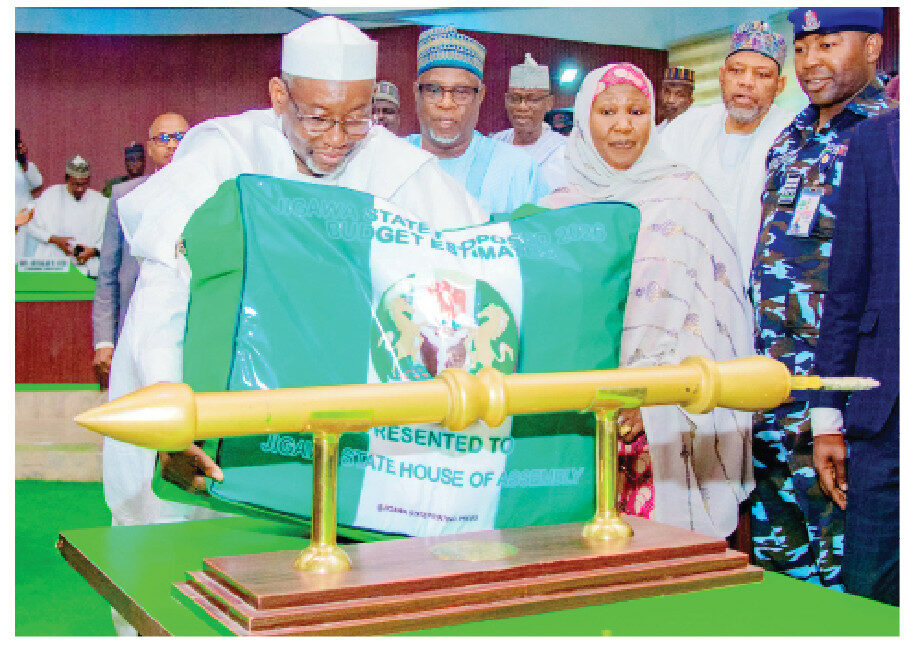
On Tuesday 25th November Jigawa state Governor His Excellency Governor Malam Umar Namadi made his second appearance to the state house of assembly for the presentation of the propose 2026 budget in which the government allocated over 70 percent of the budget to capital project.
The proposed budget 2026 tagged as budget of innovation for achieving greater Jigawa was carefully formulated to be realistic and achievable . It was designed with consideration of all relevant economic and social mechanisms and indices for public planning.
The highlight of the governor’s speech are:
- Mr. Speaker, the 2026 Budget is titled “Budget of Innovation & Transformation For Greater Jigawa II“. As hinted earlier, this is in consideration of the fact that, while sustaining the momentum of progress, the proposed budget, as conceived, will be trailing the development trajectory of its predecessor in terms of policy objectives and priorities.
- Right Honourable Speaker, based on the Consolidated Revenue and Expenditure Estimates of the 2026 Proposed Budget as derived from the 2026 – 2028 Medium-term Expenditure Framework, I would be presenting to the Honourable House a Bill to appropriate the sum of Nine Hundred and One Billion, Eight Hundred and Forty-One Million Naira (N901,841,000,000) for the services of the Jigawa State Government during the 2026 Fiscal year. Relative to the total appropriations of 2025, this is about 19.2% higher. Based on recent trends, this is by all means an ambitious budget but yet realistic.
- With all sense of modesty, I am pleased to inform the honourable members that painstaking effort was put in scrutinizing the proposed budget at various levels – from the routine bilateral discussions by the Ministry of Budget and Economic Planning, to the high-level review chaired by myself and subsequently by the State Economic Planning Board and the State Executive Council. Each of these platforms provided an opportunity to review and make appropriate adjustments to ensure that the proposed budget not only aligns with our development priorities but is also realistic in its revenue projections and scope of expenditure allocations.
- The breakdown of the major revenue sources for funding the budget are as follows:
- For the major expenditure components, the breakdown of the proposed N901.81 billion is as follows: Recurrent Expenditure
- As may be observed, while recurrent expenditure, including public debt charges and contingency fund, constitutes less than a quarter of the total proposed budget, i Statutory Allocation 96,265,000,000 10.7% ii Share of VAT 102,000,000,000 11.3% iii Other Federal Transfers including NLGN Dividends Refund 223,015,000,000 24.7% iv Internally Generated Revenues 88,975,104,000 9.9% v LEA and LGA PHC Reimbursements 42,063,896,000 4.7% vi Capital Receipts (Opening Balance, Loans and Grants) 349,522,000,000 38.8% Total Income 901,841,000,000 100.0% i Personnel Cost (All MDAs and LEAs) 120,048,000,000 13.3% ii Overheads and Other Recurrent Cost 75,670,000,000 8.4% iii Contingency & Stablization Funds 7,000,000,000 0.8% iv Public Debt Charges 5,720,000,000 0.6% vi Capital Expenditure Investments 693,403,000,000 76.9% Total 901,841,000,000 100.0% , conversely, almost 77% would be devoted to capital investments. This is actually the result of strategic resource allocation, which requires conscious alignment of the proposed budget with the focus and priorities of the State Government. With such a robust budget structure, we can comfortably pursue the implementation of our 12- Point Agenda targeting massive investments around critical infrastructure, agricultural transformation, human capital development and creating massive opportunities for youth empowerment and employment generation.
- Honourable Speaker and Members, the allocation for Personnel Cost is slightly over N120 billion, which includes Local Education Authorities (LEAs) under SUBEB and constitutes approximately 13.3% of the total budget. This provision enables necessary recruitments across various MDAs, particularly in areas where employment was previously suspended. Overheads and other recurrent expenditures are set at nearly N81.4 billion, accounting for about 9% of the budget. These funds support routine operations of MDAs and critical cost centres such as scholarships, public debt charges, legislative and judicial expenses, institutional feeding, student examinations, maintenance of water and lighting systems, civil servant vehicle loans, and utilities for government institutions.
- Further to the foregoing, I am pleased to inform the Honourable House that, looking at the overall budget, the education and health sectors constitute over one third of the total budget with an overall allocation of over N310 billion, including provisions of education and health-related expenditure in other MDAs such as Ministries of Humanitarian Affairs and Power. The education sector alone is earmarked for more than 26% of the budget, which, as usual, surpassed the so-called Education For All recommended benchmark Capital Investment Programs
- As previously indicated, the total proposed financing for capital investments during the 2026 Fiscal Year will amount to about N693.4 billion, representing almost 77% of the entire budget. This substantial allocation is consistent with our strategic priorities and underscores our commitment to fulfilling the objectives outlined in the 12-Point Agenda for Greater Jigawa. Furthermore, these investments have been systematically structured and clearly defined to align with the policy directions and priorities set forth in the budget, particularly in areas such as critical infrastructure, agricultural transformation, human capital development, and the empowerment of youth and women. – 18 –
- Honorable Members, permit me to expound further on some of the sectoral allocations and the major proposed investments therein to give you an insight into what we commit to deliver in the 2026 Fiscal Year.
- First and foremost is the traditional Economic Sector which comprises of investments around critical infrastructure, agricultural transformation inclusive of livestock development, commerce & investment, and other miscellaneous expenditure in Finance related MDAs. Total Allocations in these areas amount to over N396.2 billion equivalent to about 57% of the total proposed capital expenditure. Out of this amount, some of the most strategic investments proposed to be made towards advancing our Agenda for Greater Jigawa, our transformative agenda for a secure and prosperous future for the present and future generations will comprise among others: i
Roads and Transport Development N186,370,000,000 ii
Agriculture and Livestock Development N74,983,100,000 iii
Power and Energy N50,738,804,000 iv Commerce and Investments N17,577,765,000
v Strategic Investments under MOFI N17,425,000,000
vii Youth Empowerment and Employment Generation N12,682,000,000 50.
As would be observed, Roads Development constitutes the biggest investment area not only because it is highly capital intensive but most importantly, it has remained to be one area the development aspirations of the people continued to remain in high demand. This much was demonstrated by the array of community demands we received during the just concluded Citizens’ Engagement across all the 27 Local Governments in the State.
The proposed estimates of almost N186.4 billon earmarked for the roads sector will be for the completion or continuation of ongoing road projects including regional roads, township roads, upgrading/asphalt overlay of some existing roads, as well as continuation and newly proposed feeder roads. The project scope includes over 60 ongoing and newly proposed regional roads, more than 20 township roads, and numerous feeder roads, all of which are too many to be listed here and now.
- As we continue all ongoing townships and regional roads in earnest with a view to, as much as possible, completing and commissioning them during the year, we also commit to the commencement of new ones. Among these, will include
township roads in Hadejia, Basirka, Kila, Gantsa, Gagarawa, Birnin Kudu Phase IV, Maitsamiya, Malammadori PhaseII, Buji, Garun Gabas, Danzomo, Babaldu and Jahun Phase III. Musari, Harbo, Chamo and Amaryawa.
Among proposed new Regional Roads include: – 19
– i. Kafin Hausa – Gafasa – Jabo,
- Gidan Tilo – Kargo – Fake – Gidan Baye
iii. Kore- Garin Chiroma – Yalawa – Makerabu
- Sule Tankarkar – Sarkin Gandu
- Harbo Tsohuwa – Mai Yadiya – Fulatan – Gilima vi. Sule Tankarkar – Bango – Gago – Dangwanki
vii. Danzomo – Banaga – Danladin Gumel with spur to Takatsaba
viii. Masaya – Lafiya – Tukuda ix. Hadejia Road – Abakura x. Masama – Gilakocini Road xi. Sabon Gidan Kwatalo – Unik Gana xii. Kawaya – Unguwar Maina xiii. Dunguzu -Shatari- Lunkude- Kalagari – Shabiri- Tsalliya -Danfusan-Ruba xiv. Kwanar Baturiya – kalgwai – Ayama – Safa – K/Hausa Road xv. Kagadama-Barije – Bashe xvi. Garin Malan-Dibda Gaduwa-Damagi-Takazza Road xvii. Guri – Margadu Road xviii. Karkarna – Gwarta Road xix. Gwiwa – Daurawa – Shafe Road
- It is, however, worthy of noting that the proposed estimates also include construction or rehabilitation of bridges, provision of tarred roads in some tertiary educational institutions and major maintenance works by the State Roads Maintenance Agency. 53. The second highest proposed investment of almost N75 billion under the Economic Sector goes to Agriculture and Livestock Development. While this is unprecedented, it clearly demonstrates our unwavering commitment to strategic development objectives including advancing our agenda for food security, promoting economic diversification, fostering inclusive economic growth, and solidifying foundations for lasting prosperity for all citizens of Jigawa State. All the direct investments in these areas would be actively supported by the other initiatives pursuing in strategic partnerships with private sector stakeholders and development agencies with which we have already signed partnership agreements and MoUs meant to promote agricultural mechanization, enhance value addition, and improve market access for local producers. By encouraging joint ventures and providing incentives for agribusiness development, we also aim to create new opportunities for farmers, stimulate agro-processing industries, and boost export potential, thereby ensuring – 20 – that the benefits of agricultural growth are widely shared across the state. Specific Proposed Investments will majorly include the following:
- Our proposed investment of about N50.7 billion for the Power Sector will cover the implementation of several Renewable Energy Projects in partnership with Federal Rural Electrification Agency to be located in Agricultural SME Clusters, Educational and Health Institutions and other Interventions. Constructions and Renovations of Energy Infrastructure such as Grid and Transmission Lines, Solarization of Government Institutions notably the State Secretariate, Government House and Deputy Governor’s Office, Conversion of Streetlights from Diesel Generators to Solar Powered in about 20 Local Government Headquarters, as well as Provision Of Street Lights in other 20 Towns. The amount also includes a proposal of almost N5.0 billion for regular rural electrification projects under which we proposed to connect several rural communities to the national grid, some of which are already ongoing. i Irrigation Development involving regabilitation / expansion of Irrigtion structure, promoting irrigation and rain harvests in upland areas, and promoting climate smart smallholder solar-based irrigation projects 20,107,000,000 ii Livestock Development including Provision of Vetrinary Clinics, Cattle Ranch Development, Revitalization of LIBCs & Livestock Extension Program, and Animal and Dairy Production Support Programs 17,185,000,000 iii Agribusiness and Agricultural Markets Projects including support for Food Security Interventions for Vulnerable Households. 9,785,000,000 iiii Agricultural Production and Productivity Enhancement Initiatives including procurement of Organic Fertilizer and other inputs, Seeds Multiplication, participation in Federal Govt,’s National Agricultural Growth Program and support for Commercial Agriculture 9,305,000,000 iv Agricultural Mechanization & Procurement of Agriculture Plants and Implements including the establishment of Mechanization Service Centres across the State 4,040,000,000 v Developmet of Borehole – Surface Irrigation Scheme 2,500,000,000 vi Agricultural Extension Support Initiatives 1,500,000,000 vii Implementation of African Development Bank’s Supported Agricultural Transformation Initiatives 1,500,000,000 viii Mainstreaming of Gender, Youth, and Nutrition Programs 1,157,000,000 .
- As mentioned earlier, the sum of about N17.6 billion is proposed for the Commerce and Investments Sector. This is largely earmarked for the ongoing modern market development projects in Dutse, Hadejia, and Maigatari, which have already commenced. It also includes the sustained revitalisation of the Border Free Zone in Maigatari, which we hope to pursue in partnership with foreign investors. Additionally, the proposed allocation will cover the ongoing survey and mapping of solid minerals in the State, the exploration of which will be pursued once credible feasibility study reports are submitted. It is also worthy of noting that over N600 million is set aside for Investment Promotion activities to mobilize domestic and foreign direct investments into the State.
- Regarding Youth Empowerment and Employment Generation—a key component of the 12-Point Agenda—approximately N12.7 billion has been proposed. This allocation will support the development and maintenance of Skills Acquisition Centres, facilitate Microcredit and Business Start-up Support for Micro, Small, and Medium Enterprises, enhance ongoing Agro-Processing Equipment Leasing programs, and advance various Women’s and Youth Artisan Skills Development Initiatives. These measures are designed to foster entrepreneurship, encourage self-reliance, and provide youth and women with practical skills necessary for improved economic opportunities, contributing to sustained prosperity across the State.
- The Social Sector which is largely about human capital development comprises of Education, Health, Women & Social Development, and Information and Youth Development, has been allocated approximately N236 billion, accounting for over 36% of the total Capital Development Budget. This sector encompasses the advancement of both basic and post-basic education, with a primary emphasis on expanding access by addressing the issue of out-of-school children and striving to enhance educational outcomes. In addition, efforts are being made to promote accessible and affordable healthcare services, encompassing both preventive and curative measures. It also includes a variety of targeted initiatives in women’s development, social advancement, and social protection. Specific allocations in the sector include: I Ministry of Women Affairs & Social Development Programmes including Social Protection and Rehabilitation Programs N13.96 billon ii Basic Education Programmes N48,42 billion iii Post Basic Education N52.3 billion – 22 – iv Tertiary Education N38.6 billion V Other Educational Services including Quality Assurance, Educational Resources Management and ICT & Digital Economy Services and Teacher Development N12.3 billion vi Ministry of Health N27.2 billion vii Primary Health Care Development Agency N20.1 billion viii Development of Health Training Institutions N3.5 billion ix Information, Youth, Culture and Sports Development N2.8 billion
- A rundown of other projects and programmes to be covered under the proposed capital expenditure and their approximate allocation include: i Water Supply and Sanitation Services including Small Towns and Rural Water Supply N25.4 billion Ii Land, Housing, Urban Development & Regional Planning including the Establishment of GIS Unit, and Continuation of the Mass Housing Program N7.9 billion iii Administration of Law & Justice N5.9 billion Iv Environment Protection and Climate Resilience N35.4 billion V Local Governance and Community Development N2.3 billion
- Mr. Speaker, this represents the State Government’s proposed budget for the 2026 fiscal year, which I am presenting as the Appropriation Bill for your review and approval. While the budget may appear ambitious, I am confident that it is both achievable and closely aligned with our vision for a Greater Jigawa, reflecting the hopes and aspirations of the people of Jigawa State. Local Government Budgets
- As is customary, Honorable Speaker, I will now present a summary overview of the proposed budgets for the 27 Local Government Councils for the House’s review and approval as well. This comes after a thorough consideration by each Local Government Council under the guidance of the Ministry of Local Government and Community Development. Subsequently, this was endorsed and approved respectively by the State Economic Planning Board and the State Executive Council.
- Mr. Speaker, the consolidated income and expenditure position of all the 27 Local Government Councils indicated that N288,848,892,051 is expected to accrue into their Consolidated Revenue Fund to finance all the various expenditure components in their respective budgets. The sources of funds generally include statutory transfers from the State and Federal Governments, Internally Generated Revenues, Closing Balance of the 2025 Fiscal Year and some Capital Receipts. The proposed expenditure breakdown is as follows
- It is worthy of note that the Local Government Councils proposed budget was aligned with the policy objectives and priorities of the State Government. In fact, I am delighted to inform the Honourable Members that the Local Government Councils have adopted some of the initiatives being pursued by the State Government in furtherance of our development Agenda. These include among others, scale-up of mass housing program, establishment of greenhouses / dry-season irrigation projects in upland areas, scale-up of nutrition interventions and support to Tsangaya education meant to address the phenomenon of out-of-school-children. Conclusion
- In conclusion, Honorable Members, the proposed 2026 budget is the result of thorough planning and broad stakeholder engagement. As previously noted, the planning process incorporated the preparation of a medium-term expenditure framework, which guarantees that resource allocation is strategically prioritized according to the State’s policy direction and development priorities. We are therefore confident in its ability to maintain the momentum of progress as we work toward the vision we have set for our beloved State.
Mr. Speaker, while I urge you to painstakingly review the proposed budget, at the same time, I will also kindly request for an expeditious approval and passage of the 2026 Appropriation Bill 64. Finally, let me, on behalf of the Executive Arm of Government, express my sincere gratitude to the entire membership of the State House of Assembly for the continued support and cooperation in the development of State. While pledging to continue with our principles of accountability, open and participatory governance, all of us shall also (i) Personnel Cost (including of transfer for LEA and PHC Staff Salaries – N68,884969,458 (ii) Overhead Cost – N74,265,000,320 (iii) Contingency Provision – N8,100,000,000 (iii) Capital Expenditure – N137,598,273,000 – 24 – continue to be conscious of our duties and obligations. Permit me to end my presentation by re-echoing what I said to the House during my last year’s presentation. “Kullukum Ra’in Wa Kullukum Mas’ulun An Ra’iyyatihi”.
- Finally, we give glory to Allah (SWT), the Most Beneficent and the Most Merciful for His continued support, blessings and protections. Let us all continue to pray for lasting peace, unity and prosperity for our State and Country. Thank you very much. Long Live Jigawa State; Long Live the Federal Republic of Nigeria. 66.
Wa’assalam Alaikum.
We’ve got the edge. Get real-time reports, breaking scoops, and exclusive angles delivered straight to your phone. Don’t settle for stale news. Join LEADERSHIP NEWS on WhatsApp for 24/7 updates →
Join Our WhatsApp Channel