With a digital platform, 774 local government coordinators, and an unprecedented message discipline framework in APC history, President Bola Tinubu is not waiting until 2027; he is already fighting it. JONATHAN NDA-ISAIAH writes.
There is a telling phrase buried inside the formal structure of the Renewed Hope Ambassadors, the political mobilisation network that President Bola Tinubu quietly commissioned in November 2025 and that is now moving into full operational mode. The phrase is this: “One Party, One Message, One Mobilisation Framework.”
Three words. Three disciplines. And behind them, the most deliberately constructed political communication architecture any Nigerian president has attempted to build this far from an election cycle.
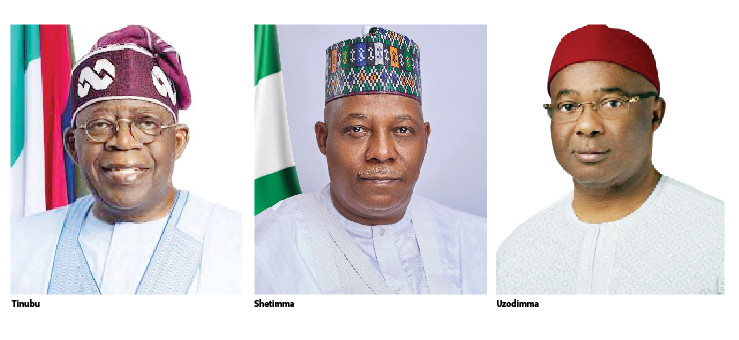
When Imo State Governor Hope Uzodinma unveiled the Renewed Hope Ambassadors’ official website in Abuja recently, and some weeks earlier, he activated the network’s nationwide grassroots structure at its fourth strategic meeting, the twin events were reported as administrative milestones, the routine machinery of a ruling party preparing for an election. That reading is accurate but insufficient. What is being assembled here is something more ambitious, more structurally sophisticated, and more revealing of how Tinubu intends to fight and win the 2027 presidential election than anything his administration has done in the open political arena.
Start with the numbers, because they tell the story more directly than any political declaration. The Renewed Hope Ambassadors network, as currently structured, has a national coordinator, a deputy director general, a secretary, a deputy secretary, six zonal coordinators, 37 state coordinators, and 774 local government coordinators. Sitting above all of this is a directorate structure of 16 specialised units, each headed by a named director with a specific mandate: Youth, Organisation and Mobilisation, Media and Publicity, Digital and New Media, Finance, Monitoring and Compliance, Technology and Data, Support Groups, Intelligence, Special Duties, Planning, Welfare, Administration, Women Affairs, Diaspora, and Research and Innovation.
Could you read that list carefully? This is not a campaign committee. This organisational chart would not look out of place in a mid-sized corporation or a government ministry. It has a finance directorate and a legal directorate. It has an intelligence directorate. It has a research and innovation arm headed by Hadiza Bala Usman, one of the most operationally experienced figures in contemporary Nigerian public administration. It has a diaspora directorate under Abike Dabiri-Erewa, whose institutional knowledge of the Nigerian diaspora is unmatched in the country’s political space.
The deliberateness of these appointments signals that the RHA is not designed to produce noise. It is designed to deliver measurable, trackable, ward-level political results across the country before the 2027 election campaign formally begins.
The website launch, which Uzodinma described with characteristic enthusiasm as “like an octopus,” is the visible tip of a much larger digital strategy.
The platform www.rhambassadors.org, according to the governor, is bold, interactive, content-specific, infographic-driven, data-focused, and capable of direct user engagement with immediate response functionality. Sunday Dare, who heads the Digital and New Media directorate, described it as a one-stop hub aggregating government projects, ongoing programmes, and data from state directors across the federation, designed to leverage multiple digital platforms for information dissemination.
Stripped of the promotional language, what this describes is a centralised digital command centre for the administration’s political communication, a platform engineered to push a consistent message about Tinubu’s reforms across social media, mobile devices, and digital channels simultaneously, while aggregating incoming data about public sentiment and state-level progress in real time.
The timing is instructive. Nigerian political campaigns have historically been waged in the final months before an election, with digital activity concentrated in a frantic sprint. What Tinubu is doing is structurally different: building the digital infrastructure months before the election, populating it with content about reforms and achievements, and using it to shape the information environment in which voters will eventually make their decisions.
Uzodinma was direct about the counter-narrative function of this infrastructure. “The culture of our politics of late has become that of a campaign of calumny and blackmail,” he said. “That is why the clarity comes from the website.”
Translation: the administration is losing the information war in parts of the public square, and this platform is the institutional response.
To understand why the RHA exists and why it is being built with this level of structural seriousness, it is necessary to understand the political problem it is designed to solve.
Tinubu’s economic reform programme, the fuel subsidy removal, the exchange rate unification, and the public finance restructuring are, by the administration’s own account, producing real developmental outcomes. Governors from Lagos to Enugu are pointing to expanded state revenues, accelerated infrastructure delivery, and improved service capacity as direct consequences of reforms that freed up federal resources for sub-national governments.
But the reforms have also inflicted severe short-term pain on ordinary Nigerians. The cost of living has risen sharply. The price of food, transportation, and basic goods reached levels that, before recent moderation, had pushed millions of Nigerians into acute economic stress. A bag of rice, Uzodinma noted at the strategic meeting, has dropped from nearly N120,000 two years ago to around N50,000 currently, a significant reduction, but one that still represents a price more than double what it was before the subsidy removal.
The political challenge for Tinubu is not whether his reforms are working. The political challenge is whether Nigerians who are still feeling the pain of transition will credit him with the recovery before the 2027 election. That is a communication problem as much as a governance problem, and the Renewed Hope Ambassadors is the institutional answer.
“If we don’t inform the people properly, this government will be misunderstood,” Uzodinma said at the strategic meeting.
It is a frank admission that the administration’s achievements are not communicating themselves — that the gap between policy outcome and public perception is wide enough to constitute a genuine electoral risk, and that closing it requires a dedicated, disciplined, nationally coordinated communication machine.
The choice of Uzodinma as the RHA’s national coordinator is itself analytically interesting.
Uzodinma is one of the most politically resilient figures in the APC ecosystem. As a Southeast governor running a visible political operation on behalf of a president his region largely rejected in 2023, he occupies a strategically important symbolic position: proof that the Southeast and the APC can coexist productively.
His RHA co-leadership team reinforces the national reach calculation. Governor Uba Sani of Kaduna, as the deputy director-general, anchors the Northwest. Governor Mohammed Inuwa of Gombe, as secretary, covers the Northeast. The directorate appointments span ethnic, religious, and regional lines with a care that reflects serious political mapping rather than tokenism.
The meeting in Abuja that activated the grassroots structure was notably preceded by a session at the Presidential Villa convened by the Progressive Governors’ Forum and attended by both Tinubu and Vice President Kashim Shettima. That sequencing of presidents to governors, governors to coordinators, coordinators to local governments, local governments to wards and polling units is not coincidental. It is the deliberate transmission of political energy down a chain of command designed to reach every voter.
The opposition will contest the 2027 election against a president who, by that point, will have spent nearly two years building a ward-level mobilisation network, operating a dedicated digital counter-narrative platform, deploying federal infrastructure as political capital across opposition states, and absorbing formerly hostile governors into his coalition. That is a formidable combination. It does not guarantee victory. Nigerian elections are shaped by factors that no organisational chart can fully anticipate, and the administration’s economic legacy will ultimately be judged by living conditions on the ground, not by website dashboards. But it represents a level of political preparation that the opposition has yet to demonstrate any capacity to match.
What Tinubu is building through the Renewed Hope Ambassadors is, at its core, a wager on sequencing: that by the time Nigerian voters go to the polls in January 2027, enough of the reform pain will have given way to reform gain that a well-resourced, well-organised, nationally coordinated mobilisation machine can convert that shift in material conditions into electoral victory.
The machine is already running. The message has been defined, the digital spine is live, the grassroots structure reaches 774 local governments, and the governors are in the field.
Whether the underlying economic story will justify the political architecture being built around it is the only question left to answer. And there are no months to find out.
We’ve got the edge. Get real-time reports, breaking scoops, and exclusive angles delivered straight to your phone. Don’t settle for stale news. Join LEADERSHIP NEWS on WhatsApp for 24/7 updates →
Join Our WhatsApp Channel