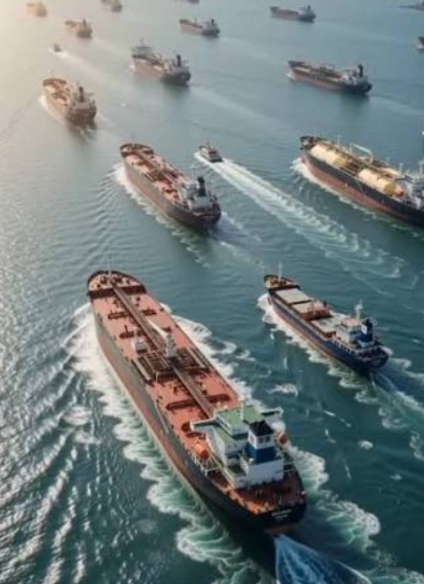
Japan’s crude oil supply from the Middle East is expected to recover this month as two more Japanese-owned supertankers carrying Saudi crude successfully exited the Strait of Hormuz on Tuesday, easing concerns over disruptions caused by regional tensions.
Shipping data showed the two vessels joined a convoy of previously stranded tankers that departed a day earlier, bringing the total volume of crude aboard Japan-linked ships leaving the strategic waterway this week to about 16 million barrels.
The latest departures significantly reduce the volume of oil that had been trapped in the Gulf following months of heightened security concerns.
The two supertankers—one operated by Nippon Yusen KK and the other by Kawasaki Kisen Kaisha—each loaded about two million barrels of Saudi crude on March 1, according to shipping intelligence firm Kpler. Neither company immediately commented on the development.
A spokesperson for the Japanese Shipowners’ Association said the number of Japan-related vessels still stranded in the Gulf has dropped to 26 from 45 at the height of the conflict, reflecting a gradual improvement in maritime traffic through the vital shipping corridor.
On Monday, six very large crude carriers transporting about 12 million barrels of crude from Saudi Arabia, the United Arab Emirates and Qatar also cleared the Strait of Hormuz. Two chemical tankers, a vehicle carrier and a container ship linked to Japan exited the waterway the same day.
Most of the vessels are managed by Japanese shipping giant Mitsui O.S.K. Lines (MOL).
The recovery in shipments comes as Saudi Arabia resumed crude loadings in late June at Ras Tanura, its largest export terminal in the Gulf. Kpler data indicate that five additional very large crude carriers loaded with Saudi oil are expected to sail to Japan in the coming weeks.
Japan depends heavily on the Middle East for its energy needs. Before the Iran conflict erupted in February, about 94 per cent of the country’s crude oil imports came from the region.
The disruption to Gulf shipping routes dealt a major blow to Japan’s energy supplies, with crude imports from the Middle East plunging sharply. In April, Japan’s total oil imports fell to their lowest level in more than six decades after shipments from Gulf producers dropped 68 per cent compared with a year earlier.
The latest movement of tankers through the Strait of Hormuz is expected to ease supply pressures and support a gradual recovery in crude imports as regional shipping operations return to normal.
We’ve got the edge. Get real-time reports, breaking scoops, and exclusive angles delivered straight to your phone. Don’t settle for stale news. Join LEADERSHIP NEWS on WhatsApp for 24/7 updates →
Join Our WhatsApp Channel