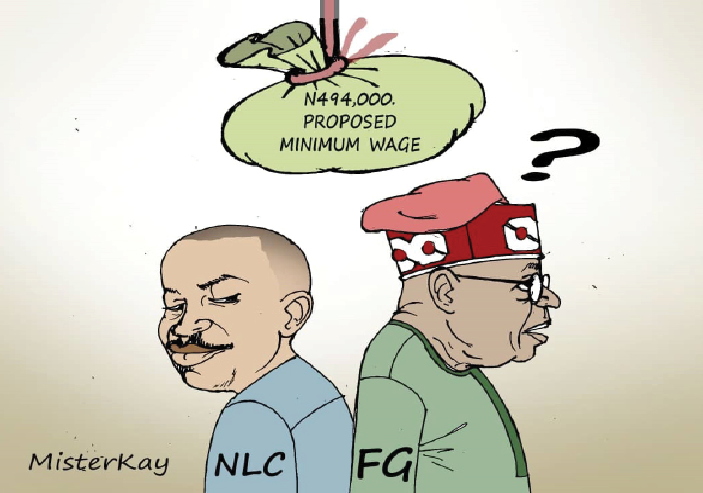
It is good that Labour has allowed reason to prevail, hence suspending its indefinite strike embarked on to demand a ₦494,000 national minimum wage and the immediate reversal of the recent electricity tariff hike. But the need for a pay rise for Nigerian workers is indisputable. The pressing issue lies in determining the appropriate percentage increase.
Also, I’m fully in support of Labour’s demand for the reversal of the electricity tariff increase. This hike is callous and shows a sheer lack of empathy from the government, particularly given that this increase and the discriminatory segregation of Nigerian power users into Bands are occurring amidst policies that have significantly impoverished many Nigerians.
The government’s removal of the fuel subsidy, floating of the naira, increase in interest rates, and subsequent electricity tariff hike mean that Nigerians, including small business owners, are facing higher costs for power consumption. This is incompatible with the government’s professed goals of attracting foreign investors, alleviating poverty, and reducing unemployment. A government implementing these measures cannot convincingly claim to be addressing unemployment and poverty.
With an unemployment rate exceeding 41 percent and 63 percent of the population deemed multi-dimensionally poor, the government should prioritize social welfare policies. Instead, it keeps adhering to anti-poor economic policies imposed by Bretton Woods institutions that do not want us to progress and compete with their paymasters. In light of this, I support Labour’s demand for an immediate reversal of the electricity tariff hike, which appears to be a deliberate effort to further impoverish Nigerians.
Unrealistic demand
Regarding Labour’s primary demand of a ₦494,000 minimum wage, I strongly disagree with the workers’ union, as it is not a realistic demand. Neither the Nigerian government nor the private sector can afford to pay workers a ₦494,000 minimum wage now or in the foreseeable future. Labour’s insistence on N494,000 minimum wage is a joke taken too far.
Negotiations for wage increase, whether with public or private sector employers, should be driven by the ability to pay, with consideration also given to the willingness to pay. In this context, one wonders if Labour is demanding a minimum civil service wage or a national minimum wage.
It appears that Labour is negotiating for a minimum civil service wage rather than a national minimum wage, which should apply to all employers. If Labour has states and private sector players in mind, it wouldn’t have been making this outrageous offer. If the Labour insist on having this humongous amount as minimum wage, which is clearly not feasible anyway, then we may as well be giving room for mass retrenchment with all the attendant consequences.
I believe that states and even the private sector should be allowed to determine their minimum wage with a benchmark which it should not go below clearly defined. Experience has shown that national minimum wages are rarely implemented by all employers largely because of the issue of capacity to pay.
When the national minimum wage law was passed in 2019, not all states implemented it due to differences in available resources. While some states could afford to implement it and still undertake infrastructure projects, others could not.
For instance, some states struggled to implement the ₦30,000 wage partially, using a template that discriminated against senior civil servants, while Zamfara State did not implement it at all. It was only recently that the incumbent governor, Dauda Lawal Dare, announced that the state would begin paying the ₦30,000 minimum wage. Previous governors, Abdulazeez Yari and Mohammed Bello Matawale, ignored the minimum wage law.
Where was Labour when Zamfara State failed to pay the minimum wage? What guarantee does Labour have that Zamfara, which has just begun implementing the national minimum wage law, will adopt the new wage? Can other states and most private organizations afford this, assuming even if the federal government can?
Labour is quite aware that years after the ₦30,000 minimum wage law was signed, some state governments and the private organisations still have not implemented it, citing various reasons, including a lack of funds amidst competing demands. As a matter of fact, more than 40 percent of private companies aren’t paying the existing minimum wage of N30,000 and here we have Labour talking of N495,000!
Uniform wage not feasible
Is uniform implementation of the minimum wage structure practical? Organized labour insists on uniform implementation despite knowing the vast disparities in resource allocation and availability among states. There is also the issue of variation of services. What do the civil servants even do? Can a national minimum wage adopted by the federal government adequately address the unique circumstances of each state and even some of the private organisations?
The implications of this demand seem lost on organized labour. Does Labour seriously believe that the private sector can pay the demanded wage and still remain in business? How much do we pay our domestic staff? If a national minimum wage as demanded by organized Labour is implemented, can we still afford to retain those domestic staff? Would such an exorbitant wage demand not exacerbate inflation? Can private schools, restaurants, filling stations, supermarkets, and malls afford to pay their workers such high wages and still stay in business?
As someone in the management cadre of a leading media organization, I know firsthand that most private-owned media organizations, just like countless other private organisations, cannot afford the wage demanded by organized Labour.
It is time for the Nigerian public to engage Labour on its unrealistic demand for a ₦494,000 minimum wage. Accepting this demand would mean the government printing more money to pay salaries, leading to inflation that would further weaken the naira. If the government yields to Labour’s demand, it will become a government that exists solely to pay salaries, which is unsustainable.
As the debate over the new national minimum wage continues, we must not forget the importance of considering the ability to pay in every financial transaction.
We’ve got the edge. Get real-time reports, breaking scoops, and exclusive angles delivered straight to your phone. Don’t settle for stale news. Join LEADERSHIP NEWS on WhatsApp for 24/7 updates →
Join Our WhatsApp Channel