Former senate president and national chairman of the African Democratic Congress (ADC), Senator David Mark, has said lawmakers in Nigeria are subjected to relentless pressure from constituents, state governors, political parties, the executive and the judiciary with expectations arising from election campaigns.
He said members of the National Assembly operate under enormous strain, referring to them as the “weakest link” among the country’s three arms of government despite their constitutionally defined responsibilities.
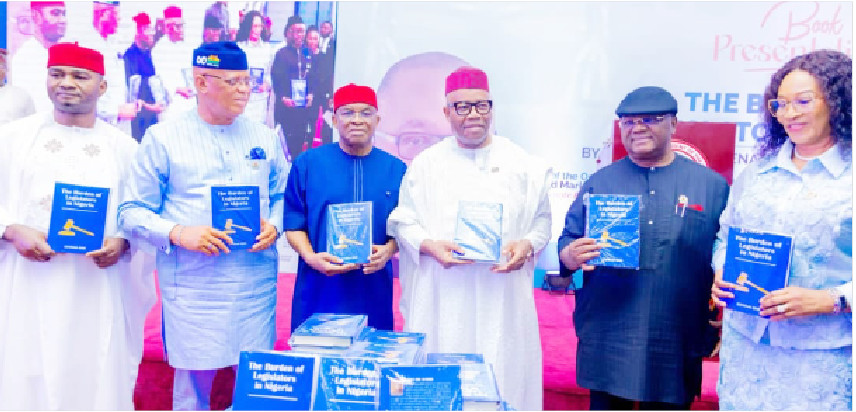
He made the remarks yesterday in Abuja at the public presentation of a book titled: “The Burden of Legislators in Nigeria,” written by Senator Effiong Bob.
According to the ADC chairman, although the roles of the executive, legislature and judiciary are clearly outlined, legislators endure the most intense public scrutiny.
He explained that the burden on politicians often begins as soon as they emerge as party aspirants.
“The moment you become an aspirant, either through your own desire or by imposition, you become Father Christmas. From that point onwards, you solve all sorts of problems. You pay school fees, settle medical bills, rent and many other demands,” he said.
The former senate president recounted personal experiences to illustrate the pressure faced by aspirants, recalling how a supporter once woke him before 6 a.m. to ask for money for fuel while.
He noted that the situation becomes more demanding after elections, as constituents often expect compensation for their support.
“As soon as you become senator-elect or House of Representatives member-elect, people will tell you how much they suffered for your victory and expect immediate assistance,” he added.
Mark also accused state governors of exerting considerable influence on lawmakers’ chances of securing party tickets for re-election.
He recalled an instance when he appealed to a governor on behalf of a colleague seeking a return ticket, only to be rejected because the governor controlled the party structure at the state level.
The former senate president advised legislators to strengthen their grassroots support in order to withstand pressure from governors and party leaders.
He identified the judiciary as another source of uncertainty, noting that court rulings sometimes remove elected lawmakers from office months before the end of their tenure.
Mark also criticised campaign promises made by politicians, describing them as “self-inflicted burdens” because many of the pledges fall outside the constitutional duties of legislators.
Defending constituency projects, he insisted that lawmakers do not personally receive funds allocated for such projects.
“No senator or member of the House of Representatives takes money from constituency projects. The funds are reflected in the national budget for projects in their constituencies,” he said.
The former lawmaker further lamented the practice in some constituencies where legislators are limited to a single term, arguing that experience enhances legislative effectiveness.
Drawing from his 20 years in the Senate, Mark said long-serving legislators have deeper knowledge of parliamentary procedures and wield greater influence in lawmaking and oversight.
He praised Bob for documenting the challenges confronting lawmakers and expressed hope that the book would help improve public understanding of legislative responsibilities.
Mark also called on Nigerians to support the National Assembly, describing it as the arm of government closest to the people.
“Despite the pressure, the legislature remains the arm that directly represents the people,” he said.
In his welcome address, the author, Effiong Bob, said the book was designed to serve as both a memoir and a practical guide for legislators and aspiring public office holders.
He explained that the publication simplifies the complex path into parliament, including nomination and election processes, legislative realities, and the expectations and pressures faced by lawmakers.
Bob described the book as a political manual that offers candid insight into the responsibilities of representation in Nigeria, while also examining policy reforms required to strengthen democratic governance.
He highlighted the persistent pressure from constituents, attributing it to gaps in service delivery by constitutionally mandated tiers of government.
“When a lawmaker becomes the community’s project-executing unit, its welfare ministry and its social safety net, something fundamental has gone wrong,” he said.
He called for urgent reforms to strengthen grassroots governance and improve service delivery so legislators can focus on their constitutional roles of lawmaking, oversight, and representation.
Bob also criticised political godfatherism, particularly the dominance of state governors in candidate selection processes, warning that it undermines internal party democracy and denies citizens the freedom to choose their representatives.
According to him, the consequences include abandoned party manifestoes, weak governance, and the erosion of responsive representation.
“This is not the democracy we fought for, nor is it the democracy we deserve. Addressing this matter is essential to restoring integrity and credibility to our political system,” he added.
We’ve got the edge. Get real-time reports, breaking scoops, and exclusive angles delivered straight to your phone. Don’t settle for stale news. Join LEADERSHIP NEWS on WhatsApp for 24/7 updates →
Join Our WhatsApp Channel