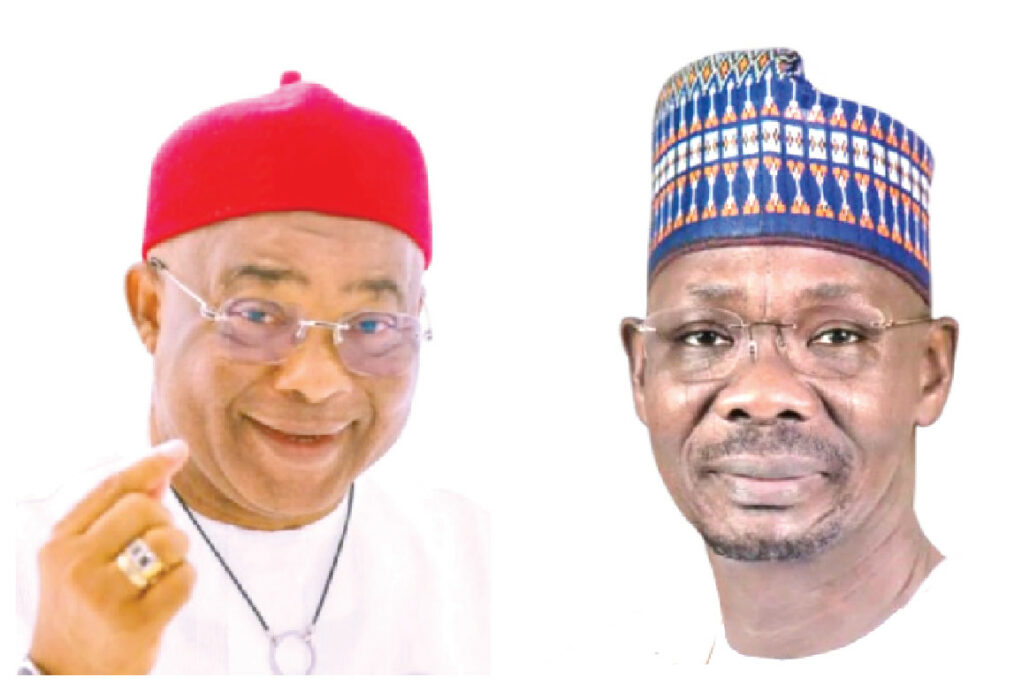
For Turning Nasarawa Into Nigeria’s Emerging Investment Hub; And For Redefining Imo State’s Public Service As A Platform For Progress And Unity, Engineer Abdullahi Sule And Governor Hope Uzodimma Are…
When Governor Abdullahi Sule assumed office, he came not with slogans but with a blueprint — the Nasarawa Economic Development Strategy (NEDS), the state’s first comprehensive roadmap for growth.
Anchored on industrialisation, infrastructure, human capital development and good governance, NEDS redefined Nasarawa’s economic identity from a quiet agrarian state into a rising investment frontier. Under his leadership, the state has attracted local and foreign investors across manufacturing, mining, power and agriculture, steadily repositioning Nasarawa as an emerging industrial hub in Nigeria’s North-Central region.
Governor Sule’s governance model treats industry as critical infrastructure. From expansive urban road networks and the Nasarawa Technology Village industrial parks to renewable energy projects, the state has become a magnet for capital. Strategic partnerships have drawn investments in cement production, lithium mining, ethanol processing and agro-industrial value chains, creating jobs and expanding revenue. Collaboration with the Nigerian National Petroleum Company Limited (NNPCL) on gas utilisation and the Nasarawa Oil and Gas Exploration Project further signal a bold push toward energy self-sufficiency and value retention within the state.
At the core of this transformation is a technocrat’s approach infused with inclusion. Infrastructure renewal spans roads, schools and hospitals across all local governments, while reforms in digital land administration, investment-friendly taxation and public-private partnerships make Nasarawa easier to do business in. Educational and vocational expansion is building the human capital needed to sustain industrial growth. Drawing on his engineering and corporate background, Governor Sule has balanced precision with empathy, giving Nasarawa a human face to industrial progress — and recasting the state as the new investment frontier of the North-Central.
When Senator Hope Odidika Uzodimma assumed office as governor of Imo State on January 15, 2020, skepticism trailed his emergence. Five years on, that doubt has given way to a record of steady reforms and purposeful governance. Through decisive leadership, he restored public confidence by reclaiming state-owned assets such as the former Eastern Palm University—now Kingsley O. Mbadiwe University—reviving Imo State University’s College of Medicine, and quietly facilitating the elevation of key institutions, including Alvan Ikoku College of Education and the Federal Medical Centre, Owerri. Today, Imo boasts a strengthened education and health ecosystem that affirms Uzodimma’s belief that governance is about protecting public interest, not personal legacy.
His impact is equally visible in infrastructure and urban renewal. Once a symbol of decay, Douglas Road has been reclaimed as a clean, orderly commercial hub, reflecting a broader transformation across the state. Major arterial roads—Owerri–Okigwe, Owerri–Orlu, Owerri–Mbaise–Umuahia, Orlu–Ugah–Akokwa, and the challenging Owerri–Omarelu corridor—are being rebuilt, reconnecting communities, boosting trade, and improving security. The commissioning of the Assumpta Roundabout twin flyover by President Bola Ahmed Tinubu further underscored Imo’s renewed status as a gateway state in the South-East and a centre of national attention.
Beyond concrete and asphalt, Uzodimma has invested heavily in people. Through the Skill-Up Imo Project, over 50,000 youths have been trained in cutting-edge digital skills, positioning the state as a rising technology talent hub. His administration has also restored peace to previously troubled areas through a blend of security reinforcement and community engagement, while healthcare reforms—anchored by the Imo State Health Insurance Scheme—have earned national recognition. As Chairman of the Progressive Governors Forum, Uzodimma’s influence now extends beyond Imo, symbolising a leader whose journey proves that resilience, collaboration, and service-driven leadership ultimately shape history.
It would be recalled that LEADERSHIP, in November 2025, unveiled its 2025 awardees with Nigeria’s First Lady, Senator Oluremi Tinubu emerging as Person of the Year 2025.
According to the LEADERSHIP Board of editors, despite the country being on the brink of another election year, there was no winner for the Politician of the Year award.
Six governors which include: Governors Uzodimma, Governor Sule, and four others-Abiodun Oyebanji (Ekiti), Dauda Lawal (Zamfara), Uba Sani (Kaduna), and Sheriff Oborevwori (Delta)-emerged Governors of the Year. The governors earned the award for “diligently focusing on the implementation of programmes and policies that transformed lives in their respective states.”
Governor Abiodun Oyebanji clinched the Governor of the Year 2025 award for his people-centred leadership that has transformed Ekiti State through inclusive governance.
Governor Dauda Lawal won the award for his unwavering commitment to restoring security, as well as his massive investment in education, healthcare, and infrastructure, which have repositioned Zamfara on the path of peace, progress, and sustainable development.
Governor Uba Sani emerged Governor of the Year 2025 for his inclusive and reconciliatory leadership that unites people across divides in Kaduna, while Governor Sheriff Oborevwori clinched the award for his visionary ‘MORE Agenda’ that has redefined governance in Delta State through peace, inclusion, and pragmatic reform.
According to the newspaper, Deputy Speaker of the Nigerian House of Representatives, Dr Benjamin Kalu, clinched the Legislator of the Year award for his exceptional record in lawmaking, representation and oversight.
The LEADERSHIP Public Service Person of the Year award was won by the chairman of the Federal Inland Revenue Service (FIRS), Dr Zacch Adedeji, for championing a new era of tax reform anchored on efficiency, transparency and service. The award was for a public servant(s) whose service delivery record and responsiveness made significant outcomes in the sector.
Thomas Etuh won the Business Person of the Year award for his visionary leadership in transforming Nigeria’s fertiliser and agribusiness sector.
The Banker of the Year Award went to the Managing Director/CEO of Development Bank of Nigeria, Dr Tony Okpanachi, for pioneering inclusive finance through innovation and integrity, and for empowering over 700,000 MSMEs. Meanwhile, Providus Bank clinched the Bank of the Year award for contributing to digital transformation and driving innovation in financial services.
The Founder of Tantita Security Services, High Chief Government Ekpemupolo (Tompolo), won the Social Impact Person of the Year award for transforming conflict into cooperation, creating jobs, defending peace, and advancing social, cultural, and economic renewal in the Niger Delta.
The Federal Competition and Consumer Protection Commission (FCCPC) was named Government Agency of the Year for expanding Nigeria’s enforcement frontiers and recovering over N10 billion for consumers.
The LEADERSHIP Environmental Impact Agency of the Year award went to the National Agency for Science and Engineering Infrastructure (NASENI) for championing sustainable industrialisation, renewable energy and climate-friendly technologies that reduce carbon emissions and promote clean power solutions.
Green Energy International Limited (GEIL) won the Oil and Gas Local Content Champion of the Year 2025 for pioneering the development and operation of Nigeria’s first onshore crude export terminal.
Other winners include Fintech Company of the Year, won by OPay for revolutionising digital finance through inclusion; Product of the Year, Nestle’s Pure Life; and Company of the Year, Trade Modernisation Project.
Mrs Mabel Ijeoma Duaka and Dr Seidu Adebayo Bello jointly won the Primary Healthcare Model of the Year award, while the Outstanding Young Person Award went to David Adeyemi for nurturing innovation, empathy and excellence by developing an AI-powered app that transforms access to education for visually impaired learners.
Nafisa Abdullahi Aminu clinched the Young College Person of the Year 2025 for her outstanding achievement in elevating Nigeria’s presence on the international academic stage.
This year, the Artiste of the Year award was clinched by the duo of Raoul John Njeng-Njeng, better known as Skales and Kanyeyachukwu Tagbo-Okeke.
The LEADERSHIP Sports Person of the Year award went to Justine Madugu for guiding the Super Falcons to their record-breaking 10th WAFCON title.
The awardees will be celebrated for their outstanding leadership, vision and commitment to national development at the LEADERSHIP Conference and Awards ceremony scheduled to take place on 12 February 2026 at the International Conference Centre, Abuja.
We’ve got the edge. Get real-time reports, breaking scoops, and exclusive angles delivered straight to your phone. Don’t settle for stale news. Join LEADERSHIP NEWS on WhatsApp for 24/7 updates →
Join Our WhatsApp Channel