
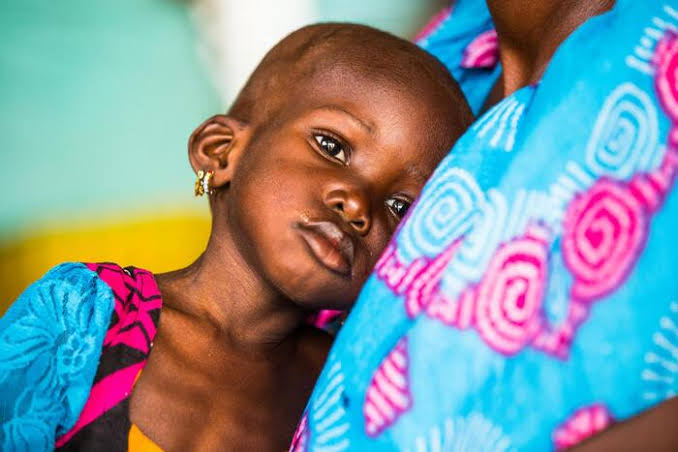
Current data from the United Nations Children’s Fund (UNICEF), nutrition partners and state governments have revealed that 10,165 children have died from Severe Acute Malnutrition (SAM) in Borno, Adamawa and Yobe States from January 2017 to July 2021.
According to the data, the number of children that were admitted for SAM in OTP within the period in the three states were 1,375,681 and those admitted in stabilisation centre were 58,903, making a total of 1,434,584.
Analysing the data during a 3-day media dialogue on Child Malnutrition Reporting, organised by UNICEF in collaboration with the Child Rights Information Bureau (CRIB) of the Federal Ministry of Information and Culture, in Maiduguri, Borno States,
nutrition specialists UNICEF, Ifeanyi Maduanusi, explained that the children with SAM admitted in OTP were those without medical complications while those with medical complications were admitted in stabilisation centre (SC)
According to the data, the number of death recorded in OTP in the period were 7,020 and 3,145 in SC, totally 10, 165.
Breakdown of the statistics indicates that admission in OTP was higher in 2018 (381,074), followed by 2017 (352,212), then 2019 (254,984), 2020 (236,553) while January to July 2021 recorded 150,000,858.
Meanwhile, UNICEF has identified multiple displacement, conflict, food crisis and others as factors fueling malnutrition in North Eastern Nigeriia.
Officer in charge, chief of field office, UNICEF Maiduguri, Samuel Sesay, said households in the region are experiencing unprecedented levels of food crisis and hunger, household food insecurity, poor infant and young child feeding and care practices as well as poor feeding environment, hygiene and health.
Sasay, who stated this during the media dialogue, noted that “In North East Nigeria, conflict, multiple displacement, destruction of sources of livelihood for households, destruction of basic infrastructures and services, climate change, and the COVID-19 pandemic are peculiar contributors to the growing number of children affected by undernutrition.”
He described these factors as the underlying causes of undernutrition in children while identifying malnutrition as the biggest threat to child survival and development in the North East.
“Malnutrition is the underlining cause of nearly half of all deaths in under-five children globally and it is currently the biggest threat to child survival and development in North East Nigeria,” he said.
Sesay reiterated that the importance of good nutrition on children’s development has far-reaching impact on child education, health, adult earning power, individual and family finance as well as the country’s economy.
He stressed that early detection, referral, and good management of severe acute malnutrition in children remains key in saving children under the age of five from preventable deaths.
He, therefore, urged governments of Borno, Adamawa, and Yobe states to increase their respective budgetary allocations and timely release of funds for nutrition, and also engage a multi sectoral approach where all relevant Ministries, Departments, and Agencies (MDAs)/combine efforts to address the undernutrition in the region.
Sesay, however noted that UNICEF has been supporting government and non-government partners on early detection, referral and management of severe acute malnutrition; provision of ready-to-use therapeutic food in outpatient therapeutic feeding programme; deployment of community nutrition mobilisers in communities and IDP camps and establishment of mother-to-mother support groups.
Others are the conduct of cooking demonstrations in communities; supplementation of children with Vitamin A, deworming prophylaxis, fortification of children diets with multiple micronutrient powder; supplementation of pregnant and lactating women with Iron and Folic acid supplements to prevent malnutrition.
Communication officer, UNICEF Maiduguri, Folashade Adebayo, informed that the purpose of the workshop is to increase the knowledge and capacity of media practitioners on child malnutrition, adding that the outcome of the workshop is expected to elevate the visibility of child nutrition issues among policy makers.
We’ve got the edge. Get real-time reports, breaking scoops, and exclusive angles delivered straight to your phone. Don’t settle for stale news. Join LEADERSHIP NEWS on WhatsApp for 24/7 updates →