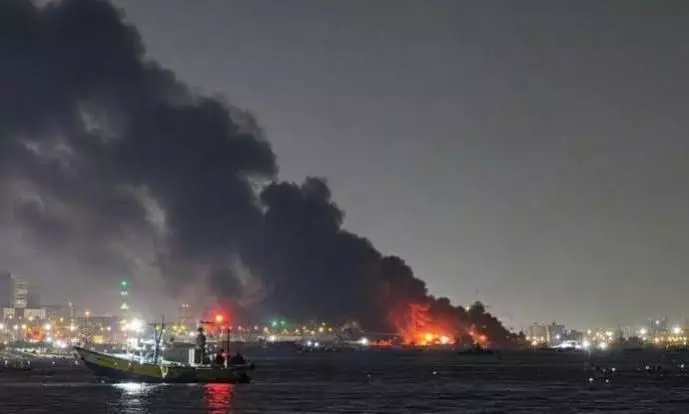
Fresh military exchanges between the United States and Iran have triggered another wave of disruption to global maritime trade, with shipping traffic through the Strait of Hormuz falling sharply following attacks on three commercial tankers earlier this week.
Data from maritime intelligence firm Kpler showed that only 23 tankers and cargo vessels transited the strategic waterway on Wednesday, down from 47 recorded a week earlier, underscoring growing concerns over the security of one of the world’s most important shipping corridors.
The latest attacks targeted three vessels—a Qatar-owned liquefied natural gas (LNG) tanker, a Saudi-owned crude oil tanker and a Liberia-flagged crude oil tanker—as they navigated a US-recommended shipping route through Omani waters.
Following the incidents, traffic along the Omani corridor ground to a halt, with no vessels using the route on Wednesday, compared to three the previous day.
The route had averaged about 10 transits daily in the week before the attacks.
The Strait of Hormuz is a critical global maritime chokepoint through which more than one-fifth of the world’s oil and gas supplies, as well as fertilisers and other essential commodities, pass. Before the recent conflict, an average of 138 vessels transited the waterway daily, according to the Joint Maritime Information Centre (JMIC).
Shipping activity had already been severely disrupted after the US and Israel launched strikes on Iran on February 28, prompting Iran to attack vessels attempting to cross the strait and deploy naval mines, while Washington imposed a blockade on shipping to and from Iranian ports.
Although a ceasefire agreement signed on June 17 paved the way for reopening the waterway and the US eased its naval blockade and sanctions on Iranian oil exports, the recovery proved short-lived. Vessel movements initially rebounded, peaking at 72 ships on June 24, before renewed tensions reversed the gains.
A major point of contention remains disagreement over approved shipping lanes. Iran insists that commercial vessels should use routes designated by Tehran close to its northern coastline, describing them as the only safe passages through the strait.
“The only safe route for the passage of commercial ships and oil tankers in the strait is the route determined by the Islamic Republic of Iran,” Iran’s Khatam al-Anbiya Central Headquarters reiterated following the latest attacks.
However, the JMIC has continued advising ships to transit via a southern route through Omani waters, a recommendation backed by the United States and its allies, who maintain that the Strait of Hormuz should remain an open international waterway with unrestricted passage.
The dispute intensified after two vessels navigating the Omani route were struck on June 25 and June 27, prompting Iran to warn ships against using routes not sanctioned by Tehran.
US President Donald Trump subsequently accused Iran of violating the ceasefire, ordering retaliatory strikes on Iranian targets. Tehran responded by accusing Washington of breaching the interim agreement and launching attacks on targets linked to US forces in the region.
Maritime security analysts warn that the latest escalation could prolong uncertainty for international shipping and energy markets.
Martin Kelly, senior intelligence analyst at EOS Risk Group, said the pattern of escalating military exchanges followed by temporary calm is likely to continue.
“There will now be a bit of back and forth between the US and Iran before they make friends again. Shipping will peak and trough cautiously until Iran attacks another ship and the cycle starts again,” he said.
The renewed instability has heightened concerns among shipowners, insurers and energy traders over the security of commercial navigation through the Strait of Hormuz, a vital artery for global maritime trade and energy supplies.
We’ve got the edge. Get real-time reports, breaking scoops, and exclusive angles delivered straight to your phone. Don’t settle for stale news. Join LEADERSHIP NEWS on WhatsApp for 24/7 updates →
Join Our WhatsApp Channel