The National Agricultural Development Fund (NADF) has explained the selection process for 4,000 tractor operator and mechanic trainees under its National Agricultural Mechanisation Service Providers Training Programme, saying the exercise deliberately targets existing operators, youths and women to build the human capacity required to sustain Nigeria’s mechanisation drive.
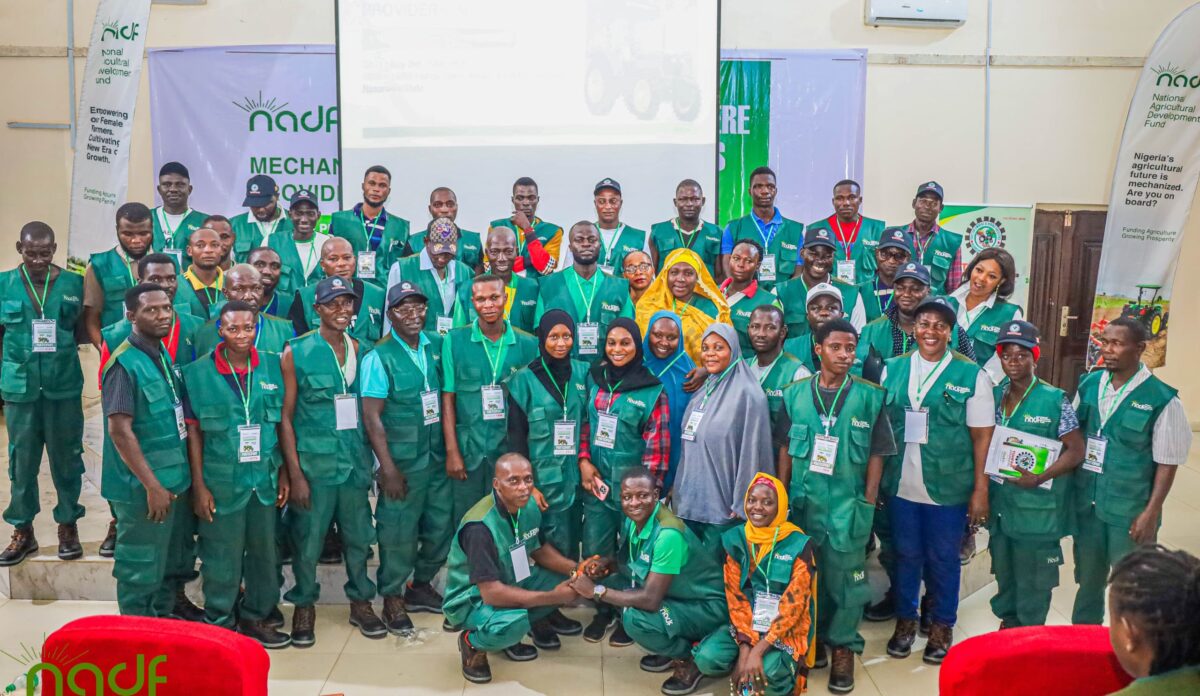
LEADERSHIP reported that the Fund, on Monday, flagged off the training programme at the CSS Farms Training Complex, Gora, Nasarawa State, with the first cohort of 250 participants drawn from across the six geopolitical zones.
In a statement on Tuesday, NADF explained that the 4,000 beneficiaries were selected through established agricultural and mechanisation organisations, including the Tractor Owners and Operators Association of Nigeria (TOOAN), Tractor Owners and Hiring Facilities Association of Nigeria (TOHFAN), Women in Mechanized Agriculture (WIMA) and Agricultural Development Projects (ADPs).
According to the Fund, the selection process also provided for deliberate inclusion of women and youths, in line with the fund’s objective of developing a broad-based workforce for Nigeria’s expanding mechanisation ecosystem.
The programme is being implemented in partnership with John Deere representatives, AGCOMS International Trading Company Limited, the Industrial Training Fund (ITF) and the Federal Ministry of Agriculture and Food Security.
The initiative is designed to produce a pool of certified tractor operators and mechanics capable of operating, maintaining and managing modern agricultural machinery deployed under the federal government’s agricultural transformation agenda.
Speaking at the inauguration, the Executive Secretary Mohammed Ibrahim, represented by the Fund’s General Manager, Technical, Ernest Ihedigbo, described the training as a strategic investment in human capital needed to modernise Nigeria’s agricultural sector.
Ibrahim said the programme was aligned with President Bola Tinubu’s Renewed Hope Agenda, particularly its objectives of using agriculture to strengthen food security, create jobs, diversify the economy and promote inclusive growth.
He said Nigeria’s agricultural potential remained constrained by low mechanisation, inadequate technical skills and limited access to modern farming technologies.
He noted that the country’s tractor density stood at about 0.3 horsepower per hectare, compared with 2.6 horsepower per hectare in India, describing the disparity as both a challenge and an opportunity for Nigeria to accelerate mechanisation.
According to him, the training would help address the shortage of skilled mechanisation service providers while complementing government efforts to expand farmers’ access to tractors and other agricultural equipment.
“The effectiveness and sustainability of any mechanisation programme ultimately depend on the quality of the people responsible for operating, maintaining, managing and commercialising the technologies upon which it relies,” he said.
Also speaking, NADF Head of Mechanisation, Samuel Aende, said the programme was part of the Fund’s partnership with John Deere for the supply of 2,000 tractors.
He said the training would ensure that the machinery programme was supported by competent operators and mechanics, thereby improving the utilisation, maintenance and sustainability of the equipment.
Aende urged the trainees to take the opportunity seriously, describing the programme as an investment in their careers and in the future of Nigeria’s agricultural sector.
ITF Training Manager of the Model Skills Training Centre, Fatima Baidu, said achieving food security could no longer rely solely on manual labour, stressing the need for modern agricultural technology operated by properly trained personnel.
She said the trainees would receive practical instruction in precision field operations, preventive maintenance and safety protocols to prepare them for certification and professional engagement in the mechanisation sector.
The Chief Operating Officer of AGCOMS International Trading Company Limited, Sadiq Halilu, urged the participants to actively participate in the training by asking questions and sharing their field experiences to maximise the benefits of the programme.
In his welcome address, Director of the Federal Department of Agricultural Mechanisation, Engr. Maruf Olalekan, commended NADF for investing simultaneously in agricultural machinery and human capacity.
He said sustainable agricultural transformation required not only access to equipment but also a skilled workforce capable of operating and maintaining the machinery.
Olalekan said the federal government was pursuing one of Africa’s most ambitious mechanisation programmes through the procurement of 2,000 tractors, more than 9,000 implements and spare parts under the Nigeria-Belarus partnership, as well as the Green Imperative Project with Brazil.
He urged development partners and private investors to explore opportunities in mechanisation service centres, equipment leasing, maintenance hubs, precision agriculture and local equipment manufacturing.
According to him, expanding these areas would deepen private-sector participation and help Nigeria achieve its food sovereignty objectives.
We’ve got the edge. Get real-time reports, breaking scoops, and exclusive angles delivered straight to your phone. Don’t settle for stale news. Join LEADERSHIP NEWS on WhatsApp for 24/7 updates →
Join Our WhatsApp Channel