
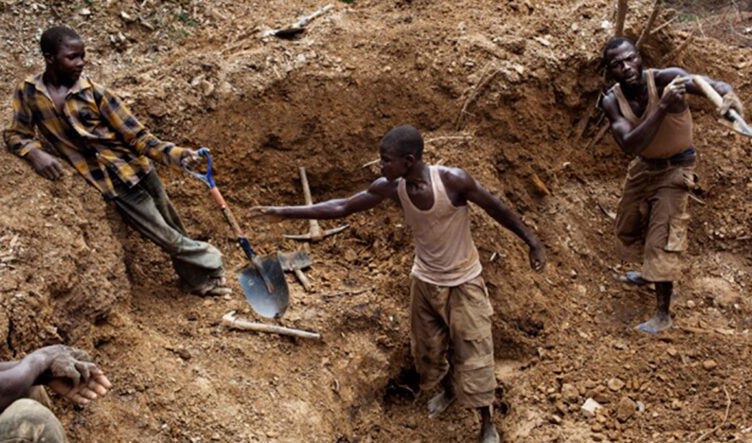
A series of fatal incidents linked to artisanal and small-scale mining (ASM) across Africa has triggered renewed calls for urgent reforms, independent investigations, stronger safety standards and greater protection for miners and mining communities.
Women in Mining Africa (WiM-Africa), the Nigeria Union of Mine Workers (NUMW), Women in Mining Nigeria (WIMIN), the Federation of Nigerian Mining Host Communities (FNMHC) and the Miners Association of Nigeria (MAN) have raised concerns over recent deaths and called for changes in the way artisanal mining is regulated, formalised and enforced.
The calls followed fatal incidents reported in Mali, Ghana and Nigeria involving mine collapses, abandoned mining pits and, in Nigeria, the deaths of people who had reportedly been arrested and detained during an anti-illegal mining operation.
Not All 37 Who Died In NSCDC Custody Were Artisanal Miners – Bago
The organisations have emphasised different aspects of the crisis, ranging from independent investigations and accountability to safer detention conditions, improved emergency response, easier access to mining licences and formalisation of artisanal mining.
WiM-Africa, in a special newsletter signed by its executive director, Dr Comfort Asokoro-Ogaji, said the recurring loss of lives exposed weaknesses in safety standards, emergency response, regulatory enforcement and formalisation.
“Africa now needs operational reform—not another cycle of tragedy, condolences and temporary reaction,” WiM-Africa said.
It cited several recent incidents as evidence of wider vulnerabilities within Africa’s artisanal mining ecosystem.
In Mali, at least 43 people, mostly women, were reported killed in the Bilalikoto/Kéniéba artisanal gold-mining disaster in February 2025, although some reports put the death toll at 48.
In Ghana, it was reported that more than 20 miners were trapped and feared dead in July 2025 after a gold-mining pit at Akyem Wenchi was inundated by water and mud. Ghana’s Parliament subsequently cited the incident alongside other fatal mining accidents.
The organisation also referenced figures from Ghana’s National Disaster Management Organisation, indicating that more than 22 people drowned in abandoned mining pits in the Central Region during the first seven months of 2025. The victims included women and children who were not necessarily involved in mining.
More recently, seven miners were confirmed dead following a pit collapse at Manso Domi Keniago in Ghana’s Ashanti Region on September 3, 2026, according to the newsletter.
In Nigeria, WiM-Africa highlighted the deaths of 37 people detained on suspicion of illegal mining in Niger State.
The organisation stressed that the Nigerian incident was different from conventional mine-site accidents because the deaths occurred following enforcement action and while the individuals were in custody.
“Some people died underground. Others died around abandoned mining pits. The 37 deaths in Nigeria occurred after enforcement action, in custody,” it said.
WiM-Africa identified unsafe mine workings, abandoned pits, weak emergency response, informality, limited pathways to formalisation, poverty-driven participation, enforcement practices and institutional weaknesses among the vulnerabilities requiring attention.
The organisation urged governments and industry stakeholders to strengthen mine inspections, geotechnical risk management, closure and rehabilitation of abandoned workings, community-based emergency response, accessible licensing systems, cooperative development, responsible mineral traceability and occupational health and safety.
It also called for greater protection of women, children and young people in mining communities.
It said the Niger deaths, although occurring outside a mine site, reinforced the broader principle that people operating at the margins of Africa’s mineral economy must be protected “at the mine, within mining communities, throughout mineral supply chains, and within the institutions established to regulate them.”
“Africa cannot build a responsible minerals economy while preventable deaths become routine,” WiM-Africa said.
“The continent has spent enough time counting the dead. It is time to operationalise reform and start preventing the next number.”
On its part, the Nigeria Union of Mine Workers (NUMW) has demanded an independent and transparent investigation into the reported deaths of 37 artisanal miners who allegedly died after being arrested and detained by personnel of the Nigeria Security and Civil Defence Corps (NSCDC) in Niger State.
NUMW national president, Comrade Hamza Muhammad, said the investigation must include representatives of the union, affected communities and families of the deceased.
The union said the affected miners were from Shiroro and Munya communities in Niger State and described the deaths as requiring urgent investigation and accountability.
NUMW said the investigation panel should comprise representatives of its national headquarters and Niger State council, traditional rulers and youth leaders from the affected communities, as well as relatives of the deceased.
It said it would not accept an investigation conducted solely by the NSCDC because the deaths occurred following an operation involving personnel of the corps.
“Justice must not only be done but must be seen to be done by the people,” the union said.
While acknowledging the NSCDC’s responsibility to combat illegal mining, NUMW stressed that enforcement must be conducted within the law and with respect for human life.
The union also expressed concern over the alleged conduct of the operation without the knowledge of the Federal Ministry of Solid Minerals Development and NUMW.
It called on the federal and Niger State governments to ensure accountability for officers found culpable, compensate affected families and release any surviving detainees.
NUMW further called for stronger inter-agency coordination in mining enforcement and urged the government to pursue formalisation of artisanal mining rather than criminalising miners.
The union said it had directed its lawyers and Niger State council to compile the names of the deceased and vowed to pursue the circumstances surrounding their deaths.
As a mark of respect, NUMW declared three days of mourning and postponed its National Delegate Conference scheduled for September 24.
It also called on the Nigeria Labour Congress and workers nationwide to support its demand for justice.
In its reaction, Women in Mining Nigeria (WIMIN) condemned the reported deaths of 37 artisanal miners in NSCDC custody in Minna and demanded an independent judicial inquiry.
In a press release, WIMIN said the victims were among scores of people arrested during enforcement operations on September 15 and 16 in the M.I. Wushishi and Lukoto areas of Minna.
The organisation expressed condolences to the families of the deceased and raised concerns over reports that some victims were teenagers between 14 and 18.8
WIMIN said the NSCDC initially attributed the deaths to an alleged disease outbreak. The organisation, however, said accounts attributed to survivors and intelligence reports pointed to severe overcrowding, extreme heat, dehydration and poor ventilation.
WIMIN alleged that as many as 65 people were held in a single cell and that survivors reportedly described detainees banging on doors for assistance as fellow detainees collapsed.
The organisation stressed that the allegations must be independently investigated and established.
WIMIN founder and national president, Janet Adeyemi, linked the incident to the socio-economic pressures driving people into artisanal mining.
“We cannot continue to use iron fists and lethal containment strategies against young citizens who are driven into mining pits by the sheer desperation for survival.”
Adeyemi called for formalisation and safer mining practices, arguing that enforcement alone could not resolve the challenges facing artisanal mining.
“It is a profound injustice to criminalise poverty. When the state treats the desperate quest for a livelihood as a capital offense—resulting in the suffocation and death of dozens in custody—we have failed fundamentally as a nation.”
WIMIN also linked the crisis to poverty in Niger State, citing figures it attributed to the National Bureau of Statistics and World Bank indicating high levels of multidimensional and extreme poverty.
It pointed to the state’s deposits of gold, lithium and tantalite and argued that valuable mineral resources, combined with widespread poverty, have made artisanal mining an important source of livelihood for vulnerable communities.
The organisation called for policies that address the economic drivers of informal mining while improving safety, environmental protection and regulatory compliance.
WIMIN also condemned the reported use of force and tear gas against grieving families and community members who protested in Minna.
It demanded a fully independent judicial panel, independent medical experts to monitor autopsies, an audit of detention facilities operated by security and paramilitary agencies and stronger emergency medical procedures.
On mining, it called for a shift from criminalisation to formalisation through legal frameworks, training, safer equipment and cooperatives.
It also called for stronger child-labour protections, educational alternatives for children and teenagers and support for affected families.
Mining Host Communities Demand Independent Investigation Accountability
Similarly, the Federation of Nigerian Mining Host Communities in Nigeria (FNMHC) has called for an independent and transparent investigation into the deaths of 37 suspected illegal miners reportedly in NSCDC custody.
In a statement signed by its Co-Chairs, Dr. Temitope Olaifa and Alh. Abubakar Wushishi, the federation said the victims were arrested on September 15 and 16 around the M.I. Wushishi/Lukoto axis of Minna.
The federation said the deaths were discovered in the early hours of September 17 after the detainees had been taken to an NSCDC facility.
FNMHC raised concerns over the initial attribution of the deaths by the NSCDC to a suspected disease outbreak before the cause had been established, while welcoming the subsequent position that the cause remained under investigation.
The Niger State Police Command has commenced an investigation, while the Niger State NSCDC Commandant, Suberu Siyaka Aniviye, was suspended pending investigations.
The federation said the scale of the incident required a process capable of determining what happened from the time of arrest until the deaths.
“An incident in which 37 people lose their lives within two days in state custody demands an investigation that is independent, transparent, comprehensive, and capable of establishing individual and institutional responsibility.”
FNMHC also raised concerns over reports that some victims may have been minors and called for investigation of allegations concerning denial of food and demands for money for the release of detainees.
“People who are suspected of illegal mining remain entitled to the protection of the law. Arrest and detention do not suspend the state’s obligation to protect life and human dignity.”
The federation called for forensic determination of the cause and manner of death, preservation of evidence, accountability where wrongdoing is established and protection for witnesses, surviving detainees and relatives.
It also called for an inquiry into reports of force used during protests following the deaths.
The federation said the Niger State Government’s three-day mourning declaration should be accompanied by accountability.
“Mourning cannot substitute for accountability, and an investigation cannot be considered complete unless it establishes how 37 people came to die in the custody of the state and identifies those responsible where wrongdoing is found.”
It added: “The families of the deceased, the affected mining communities and the Nigerian public deserve nothing less than the truth.”
Miners Association Demands Forensic Probe, Safer Enforcement
Also reacting to the tragedy, the Miners Association of Nigeria (MAN) demanded a full account of the deaths of 37 people reportedly arrested during an anti-illegal mining operation in Niger State.
Its National Publicity Secretary, Engr. Fatai Jimoh Kolawole, expressed shock over the deaths and extended condolences to the families of the deceased, the Niger State Government and the people of the state.
MAN said it does not support illegal mining, noting that the practice can damage the environment, deprive the country of revenue and expose licensed operators to risks.
However, it stressed that suspects should not be treated as convicts.
The association demanded details of who was arrested, why they were arrested, where they were detained, how long they remained in custody and what medical attention they received.
MAN also demanded the publication of autopsy and forensic findings and urged authorities to keep families informed throughout the investigation.
It said any officer or government agency found to have failed in its duty should be held accountable.
On illegal mining enforcement, MAN urged authorities to broaden operations beyond workers at mining sites to include financiers, equipment suppliers and mineral buyers.
It also advocated easier access to mining licences and training in safe mining practices to help bring more small-scale miners into the formal sector.
MAN proposed a standard enforcement protocol involving security agencies, regulators and industry stakeholders to guide the screening, detention and care of suspects during mining operations.
The association appealed for calm while investigations continue and said it was prepared to assist any panel seeking input from the mining industry.
We’ve got the edge. Get real-time reports, breaking scoops, and exclusive angles delivered straight to your phone. Don’t settle for stale news. Join LEADERSHIP NEWS on WhatsApp for 24/7 updates →
Join Our WhatsApp Channel