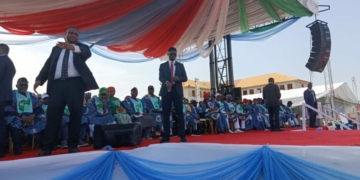

The federal government the minister of State for Education, Prof. Suwaiba Said Ahmad, has directed vice-chancellors of Nigerian universities to prioritise transparency, accountability and due process in financial management, procurement, recruitment, promotion, admissions and other activities to strengthen governance and improve academic standards.
Ahmad, gave the charge when he opened the 2026 retreat of the National Universities Commission (NUC) with the vice-chancellors in Abuja, yesterday.
He stressed that effective leadership and sound governance were essential to achieving sustainable excellence in the Nigerian University System (NUS), urging university administrators to provide strategic direction, promote academic excellence and ensure the responsible use of institutional resources.
“University leadership must, therefore, operate within established governance structures, entrenched due processes and prioritise transparency and accountability in financial management, procurement, recruitment, promotion, admissions, examinations and other institutional processes,” she said.
She urged vice-chancellors to establish clear institutional visions, set measurable performance targets and create conducive environments for teaching, learning, research and other academic activities.
The minister said the retreat, themed “Enhancing Regulatory Compliance, Governance, Leadership, and Partnership in the Nigerian University System”, was timely, given the Federal Government’s efforts under President Bola Tinubu’s Renewed Hope Agenda to transform the university system.
She noted that higher education institutions worldwide were being reshaped by artificial intelligence (AI), digital learning, data analytics, virtual laboratories, changing funding models, research and development, graduate employability and international competitiveness.
Ahmad, however, cautioned that the adoption of artificial intelligence must be accompanied by measures to protect academic integrity, uphold ethical standards, safeguard data and promote responsible use through appropriate institutional policies.
She said the rapid changes in higher education required sustained engagement between the NUC and university leadership to ensure effective policy implementation and institutional responsiveness.
“The challenges confronting higher education cannot be fully addressed through isolated institutional efforts or regulatory directives alone,” she said.
Earlier, the Executive Secretary of the NUC, Professor Abdullahi Yusufu Ribadu, said the retreat provided an opportunity for stakeholders to assess the state of university education, review existing policies and identify sustainable solutions to the challenges confronting the sector.
Ribadu said the university system needed to remain nationally relevant, globally competitive and responsive to changing societal needs, particularly in an era of rapid technological advancement and artificial intelligence.
He noted that universities were expected to produce graduates equipped with the knowledge, skills, competence and creativity required to contribute meaningfully to society.
He disclosed that the commission had developed new guidelines for the awarding and use of honorary doctorates, including sanctions for universities that violated the rules.
On research and innovation, Ribadu called on universities to translate research findings into practical solutions and products that could address national challenges in agriculture, healthcare, education, technology, manufacturing, the environment and the creative industry.
We’ve got the edge. Get real-time reports, breaking scoops, and exclusive angles delivered straight to your phone. Don’t settle for stale news. Join LEADERSHIP NEWS on WhatsApp for 24/7 updates →
Join Our WhatsApp Channel