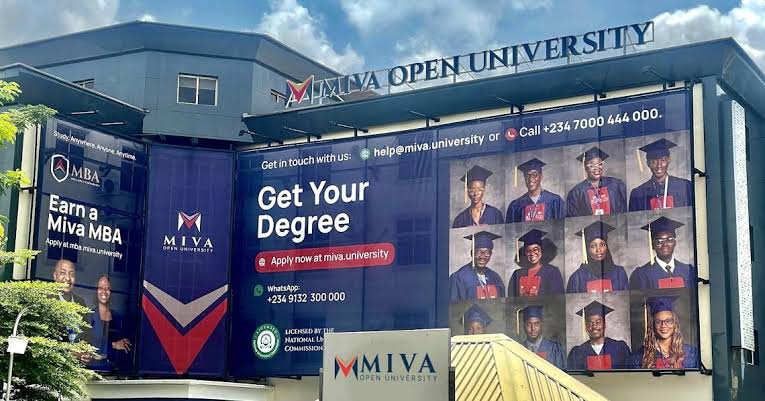
Miva Open University has secured full operational licensing and accreditation from the National Universities Commission (NUC).
The Vice Chancellor of Miva Open University, Professor Tayo Arulogun, disclosed this yesterday while speaking on the institution’s journey and vision for the future of higher education in Nigeria.
He said the institution has also made six-month internship compulsory for all students as part of efforts to bridge the gap between university education and employment.
According to Arulogun, the NUC granted Miva full operational licensing on September 23, 2026, with all its take-off programmes now carrying full accreditation status required of Nigerian universities.
The development, he noted, represented a significant milestone for an institution established only three years ago and demonstrated that open and technology-driven education could provide a credible pathway into Nigeria’s workforce.
“We know some people still doubt online degrees. This is our answer. Our graduates are the evidence,” Arulogun said.
He said the institution started with eight disciplines but has since expanded to five undergraduate schools, including Communication and Media Studies. It also offers eight postgraduate programmes, including Doctor of Business Administration, Master of Business Administration, Master of Public Administration, Master of Public Health and Master of Information Technology.
The Vice Chancellor said its model combines digital learning with physical support centres and practical experiences designed to prepare students for life beyond the classroom.
“No one should have to give up their income or their location to earn a degree.
“We mandated that all our students must go through six months of internship. Even if your programme is not aligned with that, you must do that,” Arulogun said.
He noted that students are also encouraged to volunteer their skills and services while studying, with the university seeking to help them build substantial professional experience before graduation.
“Everybody has a skill, no matter how small it is. Volunteer, and by the time you graduate from us, you must have gained not less than three to four years’ experience,” he said.
The emphasis on employability is particularly significant against the backdrop of the ongoing debate over the participation of open university graduates in the National Youth Service Corps (NYSC).
Arulogun noted that although the Federal Government had previously indicated that graduates of open universities should be allowed to participate in the scheme, the policy had yet to translate into reality.
He argued that while the university would continue to pursue the matter, graduates should also be equipped with skills and experience that would enable them to secure employment without relying solely on NYSC participation.
According to him, about 70 per cent of Miva’s graduates are already employed, which he attributed partly to the institution’s focus on internships, volunteering and practical skills.
“We should start adapting and changing because a graduate from an open university has more advantage if you have something you have done, if you have the skill. It means you have that one year to showcase yourself,” he said.
Arulogun said the university’s long-term ambition was to reach millions of learners across Nigeria within the next decade, but stressed that expansion would only be meaningful if it translated into better employment opportunities.
“That growth only matters if it leads to employment. So we are strengthening the bridge between what students learn and what the market needs,” he said.
The university’s Chief Technology and Innovation Officer, Paul Ehiagbonare, further explained that the institution’s practical approach was designed to ensure students could apply what they learn to real-world challenges.
“At Miva, our goal for our students is that they learn to become, not just to pass,” Ehiagbonare said.
He explained that the university’s laboratories were designed to allow students to build and experiment with their hands rather than rely solely on theoretical instruction.
“In the laboratory, they build things with their hands. So learning sticks when you do it, and not just when you memorise it,” he said.
We’ve got the edge. Get real-time reports, breaking scoops, and exclusive angles delivered straight to your phone. Don’t settle for stale news. Join LEADERSHIP NEWS on WhatsApp for 24/7 updates →
Join Our WhatsApp Channel