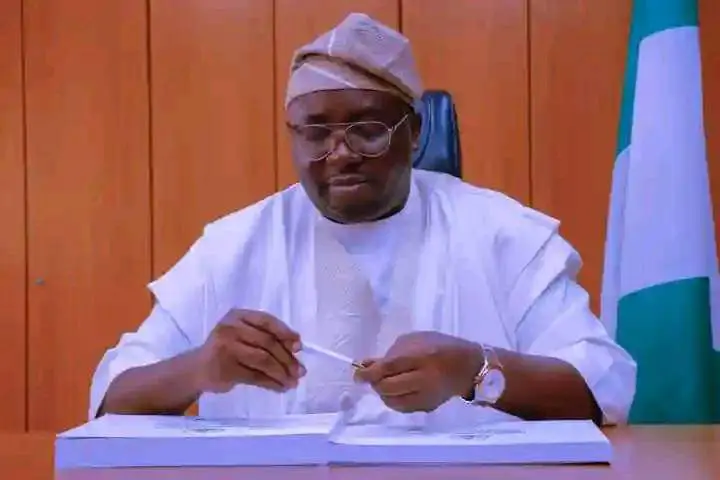
The tenure of Chief Adebayo Adelabu as minister of power ended on Thursday, 30 April, 2026, marked by partial gains in generation, tariff, and revenue reforms, but also by persistent grid instability, unresolved structural weaknesses, and a national grid that collapsed about 22 times between August 2023 and April 2026.
This is even as peak power generation briefly touched 6,003 megawatts (MW) and the federal government launched a N501 billion debt-relief bond under a broader N3.3 trillion power-sector restructuring plan.
Adelabu’s Reflection On His Tenure
In a resignation letter dated 22 April 2026 and addressed to President Bola Ahmed Tinubu, Adelabu outlined key achievements during his tenure, including the implementation of the Electricity Act 2023, which decentralised the electricity market, strengthened regulatory oversight, and improved the investment climate.
While formally handing over the Ministry of Power to the permanent secretary in Abuja, he urged continuity in the reforms his office championed.
“These reforms are a journey, not an immediate destination. If the process is disrupted, it could derail progress. Civil servants and technocrats must therefore guide the incoming leadership to sustain and build on what has been achieved,” he said.
He likened the transformation to laying a foundation on swampy terrain, arguing that early efforts may not be immediately visible but are essential for long-term stability.
“Our achievements may not yet be obvious to Nigerians, but as the next leadership builds on them, their impact will become clear,” he added.
Generation gains and grid instability
Adelabu said peak power generation rose to over 6,000MW during his tenure, driven by the integration of the Zungeru Hydropower Plant, rehabilitation of thermal plants, and grid-strengthening efforts under the Presidential Power Initiative. Nigeria recorded a peak of 6,003MW on 2 March 2025, the highest in its history.
Industry data show output fluctuated between 5,000MW and 5,800MW, remaining vulnerable to gas supply constraints, plant outages, and grid instability.
Quarterly figures from the Nigerian Electricity Regulatory Commission (NERC) reflect this volatility: average generation rose to 4,922MW in Q4 2023 from 4,211.44MW in Q3 2023, dipped to 4,249MW in Q1 2024, climbed to about 5,296MW by Q4 2024, peaked around 5,430MW in Q3 2025, and fell to roughly 4,089MW by March 2026.
Grid Collapses And System Reliability
Sector reports indicate the national grid collapsed about 22 times within the period. Two major incidents occurred in September 2023 shortly after Adelabu’s appointment, followed by another in December linked to vandalism on the Gwagwalada–Kukwaba–Apo 132kV line.
Twelve collapses were recorded in 2024, while at least three to four incidents occurred in 2025.
The first months of 2026 saw additional failures, underscoring continued instability despite generation gains.
Adelabu acknowledged that “grid resilience has not kept pace with generation gains,” citing gas supply constraints, vandalism, and incomplete commercialisation of the electricity value chain.
Debt-Relief Bond And Tariff Reforms
The N501 billion bond, issued under the Presidential Power Sector Debt Reduction Programme, formed part of a wider N3.3 trillion restructuring effort.
The Nigerian Bulk Electricity Trading Plc (NBET) served as the disbursement vehicle.
By April 2026, about N223 billion had been disbursed, with the balance earmarked for further payments.
Adelabu said tariff reforms and restructuring increased market revenues from about N1 trillion in 2023 to N1.7 trillion in 2024 and N2.3 trillion in 2025.
“Cost-reflective tariffs cannot work in a vacuum; you must clear the debt overhang and restore the integrity of the value chain,” he said.
Band A Subsidy Removal And Public Pushback
Under Adelabu, electricity subsidies for Band A customers—those supposedly receiving at least 20 hours of daily supply—were removed, shifting them to cost-reflective tariffs. In April 2024, tariffs rose from about N66 to over N210 per kilowatt-hour, reducing a subsidy burden estimated at over N3 trillion.
“In simple terms, the country was paying N3 trillion each year to keep Band A and other consumers on artificial tariffs. That was economically unsustainable,” he said.
The policy was aimed at reducing fiscal pressure, boosting sector revenues, and attracting investment. While revenues improved and subsidy obligations declined, many consumers reported higher bills without corresponding improvements in supply, fuelling criticism from labour and consumer groups.
Distribution, Metering, And ATC&C Losses
Adelabu cited improvements in distribution, revenue collection, and reductions in Aggregate Technical, Commercial and Collection (ATC&C) losses.
Government interventions targeted the metering gap through initiatives such as the Presidential Metering Initiative, the World Bank-backed DISREP programme, and the NERC Meter Acquisition Fund.
Despite these efforts, metering remained a challenge. As of December 2025, only 6.9 million of 12.1 million active customers were metered, leaving a gap of over 40 per cent.
Adelabu acknowledged ongoing issues including gas constraints, vandalism, and the need for full commercialisation, proposing cost-reflective tariffs with targeted subsidies, DisCo recapitalisation, accelerated metering, and sustained transmission investment.
Strategic Proposals And Institutional Design
In his resignation letter, Adelabu also proposed the creation of a coordinating minister for energy to improve synergy across power, gas, water resources, and environmental sectors.
He argued that such coordination is vital for improving gas supply, optimising hydro resources, and advancing renewable energy.
Analysts say Adelabu leaves behind a mixed legacy: reforms such as the Electricity Act 2023 and the N501 billion bond have laid a foundation, but the gap between policy and grid performance remains significant.
The sector continues to grapple with gas shortages, a wide metering gap, and transmission constraints.
A public affairs analyst, Kingsley Obiakor, said investors must be assured of returns on investments in gas pipelines, power plants, and mini-grids, or “the turbines will stay silent and the grid will stay dark.”
Similarly, Adetayo Adegbemle, convener of PowerUpNigeria, called for the appointment of a technically competent successor with strong political backing.
“The era of political appointments and expecting quick results is over,” he said.
“The best-qualified candidate, tested on sector knowledge, must be given the tools to turn the sector around, with national interest as the primary criterion for appointments and policy.”
We’ve got the edge. Get real-time reports, breaking scoops, and exclusive angles delivered straight to your phone. Don’t settle for stale news. Join LEADERSHIP NEWS on WhatsApp for 24/7 updates →
Join Our WhatsApp Channel