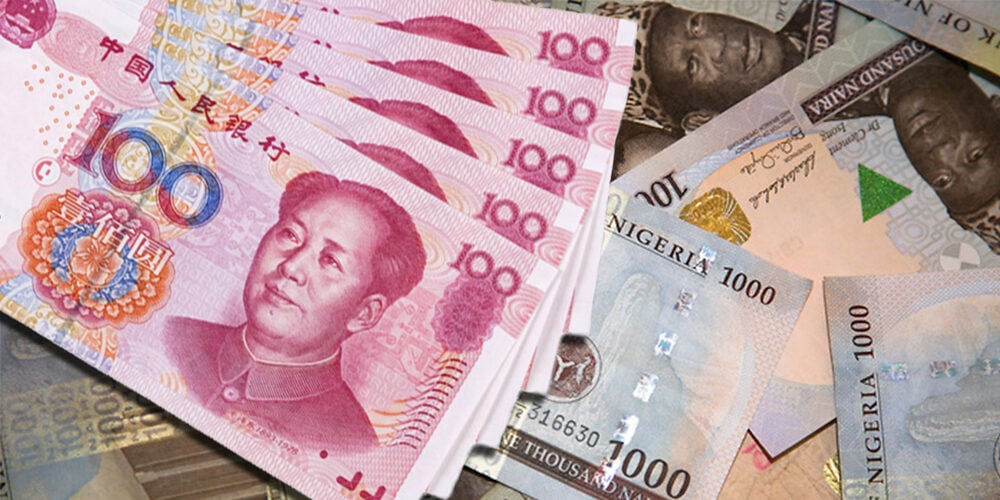
The Naira-Yuan currency swap deal between the federal government of Nigeria and the Chinese government seems to be strengthening the nation’s currency recently, as confirmed by some Chinese traders.
Experts who spoke to LEADERSHIP yesterday applauded this development. They said this deal impacts and has ensured stability, for example. They believe that, in the long run, it will ensure that goods imported from China are cheap.
For his part, Professor Tayo Bello, a development economist at Adeleke University, stated that the development would bode well for the naira and, by extension, the Nigerian economy.
He said the development means the demand for the naira is getting stronger, which would strengthen the local currency.
He said that with a stronger naira, the currency would be more stable, imported inflation would abate since China is Nigeria’s biggest trading partner, and that would help stabilise prices.
Bello, however, cautioned that Nigeria had to produce goods and services to sell to China; otherwise, there would be no basis for swapping currencies with Nigeria in exchange for goods and services.
Adding his thoughts, financial economist at Rivers State University, and member of the Board of Economists, NATIONAL ECONOMY, Dr. Chukwunenye Kocha, said, with a stabilised currency, there will be more attraction of foreign direct investment (FDI) into the country. He noted that there is much foreign portfolio investment (FPI), compared to FDI at the moment, largely due to the instability of the local currency, as investors usually struggle to repatriate their profits to home countries.
Kocha noted, however, that the currency swap arrangement, which is suitable for bilateral purposes, creates only narrow assets as the two naira and yuan are not internationally traded currencies.
Meanwhile, Ayokunle Olubunmi, the head of Financial Institutions Ratings at Agusto & Co, has attributed Chinese businesses’ growing acceptance of the naira to the rising footprint of Chinese firms in Nigeria and the role of fintechs.
There has been an increasing influx of Chinese businesses into the country, with two of them, Opay and Palmpay, dominating the fintech payment space.
Backed by substantial Chinese capital and investment, both companies have seen significant growth and market share in the mobile money and PoS agent space.
They leverage foreign capital and strategic pricing to attract customers and enhance financial inclusion.
Olubunmi noted that the CBN’s Yuan swap agreement had its successes and that it is not mainly responsible for the increasing use of the naira for trade between Nigerian and Chinese businesses. “I’m not sure you can say the currency swap contributed to it. If it were because of the swap, we would have seen the surge in acceptance as far back as 2017 or 2018, shortly after the first agreement in 2016. What we are seeing today is due to two main factors,” he explained.
According to him, the foremost factor is the influx of Chinese companies into Nigeria and the wider West African region, particularly in technology, e-commerce and payments.
“More Chinese companies are entering the payment system, while Nigerian businesses are also doing more trade with these firms. That naturally creates demand for the naira,” Olubunmi said.
Recently, Chinese e-commerce firm Temu entered the Nigerian market, offering affordable products directly from manufacturers and increasing the Chinese presence in the Nigerian e-commerce space.
The second factor, he added, is the increasing role of financial technology firms backed by Chinese investors. “Some fintechs operating in Nigeria are owned by Chinese investors. They transact heavily in naira and have corresponding operations in dollars. That’s another key driver,” he stated.
Olubunmi stressed that the activities of these companies are now a bigger force behind the trend than any policy measure. “The main reason for the increased acceptance of the naira is the presence and activities of Chinese companies in Nigeria,” he argued.
He observed that the naira’s growing role in Nigeria-China transactions reflects the deeper integration of Chinese firms into the country’s financial market.
“Many of these companies operate in Nigeria, and because of that, they have access to huge amounts of naira. For them, one way of getting their money out is by leveraging the naira they already hold,” he added.
We’ve got the edge. Get real-time reports, breaking scoops, and exclusive angles delivered straight to your phone. Don’t settle for stale news. Join LEADERSHIP NEWS on WhatsApp for 24/7 updates →
Join Our WhatsApp Channel