
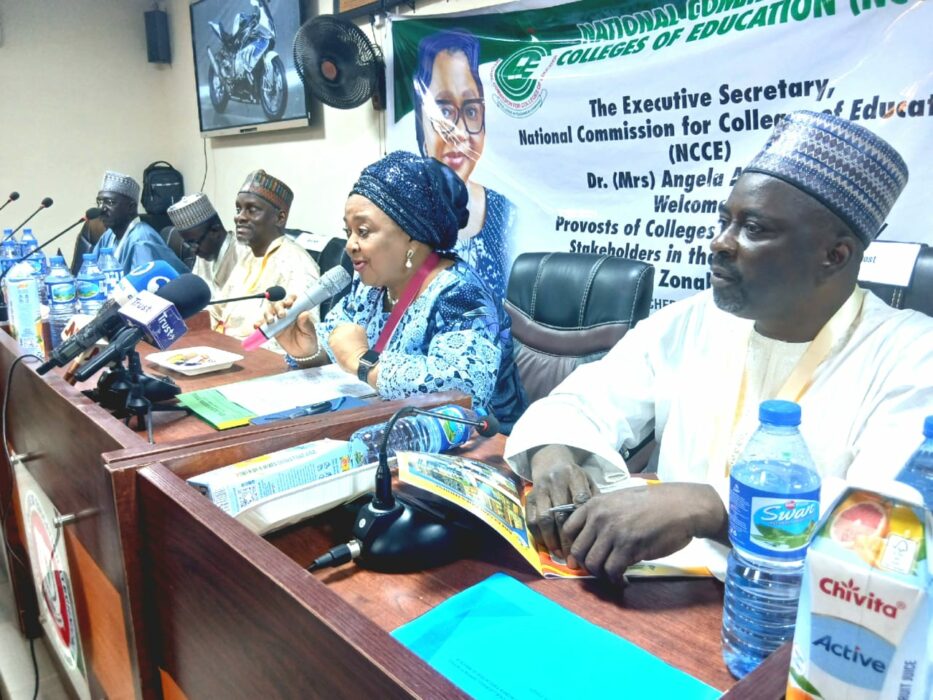
The National Commission for Colleges of Education (NCCE) has introduced a three-certificate model aimed at making Colleges of Education more attractive to young Nigerians and reversing declining enrolment in teacher training institutions.
Under the new model, students admitted into Colleges of Education will graduate with three qualifications, a National Certificate in Education (NCE), Bachelor of Education (B.Ed.) degree and a skills certificate.
The NCCE Executive Secretary, Angela Ajala, disclosed this shortly after a conference involving provosts of Colleges of Education across the North East at the College of Education (Technical), Gombe.
Ajala said the new structure was part of a broader reform of teacher education under the commission’s dual-mandate programme, which is scheduled to commence in September 2026.
She explained that the reform was designed to move teacher education beyond the traditional focus on classroom teaching by equipping graduates with practical and entrepreneurial skills.
“Teacher education is not what it used to be. It has now changed. You enter a college of education now, you get three certificates. You get an NCE, you get a B.Ed., you get a skills certificate,” she said.
According to her, the skills component is intended to make graduates economically resilient, particularly in situations where they are unable to secure formal teaching appointments.
She said graduates would no longer have to depend solely on state governments or other public institutions for employment, as the additional skills could enable them to establish businesses or provide services within their communities.
Ajala said the reform was also intended to produce teachers who could identify and solve problems in their communities rather than wait for white-collar employment.
She added that the commission’s “Teach Nigeria Forward” campaign was targeting the recruitment of 200,000 teachers annually, with an ambition to have one million skilled and digitally certified teachers within five years.
The NCCE boss said the implementation would begin with training-the-trainer workshops across Colleges of Education to enable lecturers to effectively deliver the new curriculum.
Also speaking, the Provost of the College of Education (Technical), Gombe, Mohammed Gazali Abdulhamid, said the reform could help address the decline in student enrolment experienced by Colleges of Education.
Abdulhamid said prospective students had become increasingly skeptical about pursuing NCE programmes, contributing to what he described as a drastic decline in enrolment.
He said the opportunity to obtain three qualifications from a College of Education could change the perception of prospective students and make the institutions more attractive.
“Prior to this, people have been skeptical about coming for the NCE programme. And it gave us a very bad position because student enrollment dropped drastically. With this dual mandate, students are now positioned to graduate with three different certificates: the NCE certificate, the degree certificate, and globally certified skills certificate.”
He said the practical skills component would be particularly important because students would acquire abilities that could be applied outside the classroom.
Abdulhamid, however, noted that the success of the programme would depend partly on the availability of adequate teaching tools and equipment.
He said while the College of Education (Technical), Gombe, had some of the required facilities, additional equipment would still be needed to deliver some of the technical components effectively.
The provost said the colleges were expected to identify their specific needs and present them for consideration, with the NCCE exploring support from TETFund, donor agencies, development commissions, NGOs and philanthropists.
The conference brought together provosts of Colleges of Education across the North East to discuss the implementation of the dual mandate, identify challenges peculiar to the region and develop strategies for strengthening teacher education institutions.
We’ve got the edge. Get real-time reports, breaking scoops, and exclusive angles delivered straight to your phone. Don’t settle for stale news. Join LEADERSHIP NEWS on WhatsApp for 24/7 updates →
Join Our WhatsApp Channel