The fault lines over the proposed reform of Nigerian football administration widened on Monday as state Football Association (FA) chairmen rejected a normalisation committee and insisted that the leadership vacuum in the Nigeria Football Federation (NFF) should be resolved from within the existing football structures.
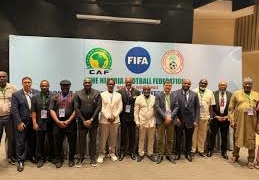
The development emerged as FIFA and the Confederation of African Football (CAF) continued consultations with Nigerian football stakeholders in separate batches in Abuja, with the different interest groups presenting sharply contrasting positions on how the reform process should be conducted.
While representatives of professional players, coaches and referees backed the reform pathway being championed by the National Sports Commission (NSC), the state FA chairmen, who command the overwhelming majority of the NFF Congress and its voting strength, opposed the proposed use of an external normalisation committee.
The division could further complicate efforts by FIFA and CAF to find a consensus on the way forward following the resignation of former NFF president Ibrahim Gusau and the emergence of a leadership vacuum at the federation.
The FIFA delegation, which arrived in Nigeria on Sunday, began consultations with key stakeholders on Monday and is expected to continue the engagements on Tuesday before making recommendations on the country’s football governance crisis.
Speaking to journalists after meeting the FIFA delegation, Yakubu Sarma, chairman of the Gombe State FA and leader of the state FA chairmen’s delegation, said the major disagreement between the Congress and the NSC was not whether Nigerian football needed reform, but the structure that should oversee it.
According to Sarma, the state FA chairmen believe the NFF Congress remains capable of establishing an interim or caretaker structure to drive the reform process without bringing in outsiders.
He said the state FA chairmen told FIFA that Nigerian football was not in crisis despite the leadership vacuum at the NFF.
“The key issue we presented before FIFA as Congress members representing the FAs is that Nigeria football is not in any way in crisis because our leagues are on, our clubs are playing their continental matches, our girls are playing international football and the secretariat of the NFF is functioning. So, there is no crisis in Nigeria’s football, that is number one.”
Sarma, however, acknowledged the existence of a leadership vacuum and said the solution should be found within the statutes governing Nigerian football.
“Secondly, we recognise that there is a leadership vacuum and how do we go about filling the vacuum so that we can continue.
“The position of FA chairmen as members of Congress is that the statute of the NFF, as provided for, as well as the CAF and FIFA statutes, have provided all the necessary mechanisms through which this kind of leadership vacuum can be settled.
“We don’t need to go outside the established framework to start actually bringing about a solution.”
‘Nobody is against reform’
Sarma insisted that the state FA chairmen were not opposed to reform, arguing that a substantial portion of the NSC’s proposed reform framework had already been incorporated into the NFF statutes.
“One cardinal thing that the Congress members as FA chairmen agreed upon and stated before FIFA is that nobody is against reform.
“In fact, it will interest you to know that we presented before FIFA the recent reform that we carried through the statute amendment. Out of the 54 reform frameworks that were presented by the National Sports Commission, 67 per cent has already been carried through the amendment of the statute, only some percentage is actually not there.”
He said the disagreement was over the “vehicle” for implementing the reforms rather than the principle of reform itself.
“We are ready for reform, but the reform vehicle is what we are actually saying that we do it internally. We don’t need people to come from outside to reform us.
“What we mean by outside is that the Congress is still standing and has the capacity to go through the statute to set up a caretaker committee to carry out the reform process and not an outsider to reform us.”
Normalisation committee becomes flashpoint
Sarma identified the choice between a normalisation committee and an interim committee as the central point of disagreement with the NSC.
“For now, it is whether there should be a normalisation committee or interim committee. That is only where we differ with the NSC as Congress, and our point is that you don’t bring somebody from outside to reform you. You can reform yourself if you so wish.”
The position puts the state FA chairmen on a collision course with the reform pathway being advocated by the NSC and supported by other football constituencies.
The disagreement is particularly significant because the state FAs constitute the bulk of the NFF Congress, giving their representatives considerable influence over any future electoral or statutory process.
Players, coaches, referees back NSC pathway
Speaking on behalf of the players’ union, Coaches Association and Referees Association, Chairman of the Advocacy for Nigeria Football Reform Initiative, Prince Harrison Jalla, said the three groups were united in their position on the proposed restructuring.
Jalla said the reform should result in a more balanced representation of the various stakeholders in the governance of Nigerian football.
“Representations on the Congress, NFF Board, its standing committees and voting rights must be equal in the new governing structure.
“We also agreed on a normalisation process driven by stakeholders.”
The contrasting positions presented to FIFA and CAF have now placed the proposed normalisation process at the centre of the consultations.
While the players, coaches and referees favour a stakeholder-driven normalisation process, the state FA chairmen insist that the existing NFF Congress should retain control of the transition and establish an interim or caretaker committee in accordance with the federation’s statutes.
FIFA, CAF face difficult balancing act
The competing positions leave FIFA and CAF with a delicate task as they assess the next steps in Nigeria.
The international bodies are expected to consider the submissions of the different constituencies before determining how the leadership vacuum and proposed reforms should be addressed.
The consultations followed the Federal Government’s push for fundamental changes in the administration of Nigerian football, amid concerns over the governance structure of the NFF and the country’s recent sporting setbacks, including the Super Eagles’ failure to qualify for the 2026 FIFA World Cup.
The NFF had been preparing for an elective Congress scheduled for September 27 in Lafia, Nasarawa State, before the resignation of Gusau and other developments disrupted the process.
With the state FAs insisting on an internally driven transition and players, coaches and referees backing a stakeholder-led normalisation process, FIFA and CAF now face potentially conflicting recommendations from the very constituencies whose support will be crucial to implementing any new framework.
The consultations are expected to continue on Tuesday, with the international football bodies set to weigh the competing proposals before deciding on the next stage of the Nigerian football reform process.
We’ve got the edge. Get real-time reports, breaking scoops, and exclusive angles delivered straight to your phone. Don’t settle for stale news. Join LEADERSHIP NEWS on WhatsApp for 24/7 updates →
Join Our WhatsApp Channel