
With only $2.5 billion mobilized out of the $27.9 billion required annually for climate finance in 2021/2022, Nigeria’s just transition ambition is facing a staggering $25.4 billion deficit.
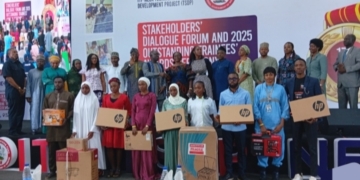
This was stated at the Stanbic IBTC Holdings Sustainable Finance Summit 3.0, held in partnership with the Lagos Business School Sustainability Centre (LBSSC), themed, ‘Financing Nigeria’s Just Transition: Mobilising Capital for People, Policy and Prosperity’, on Wednesday in Lagos.
Stakeholders said closing the gap requires Nigerian-defined solutions, progressive policy and restructuring of the financial ecosystem to unlock capital.
The chief executive of Stanbic IBTC Holdings Plc, Chuma Nwokocha, who opened the summit, said Nigeria’s pathway to a just transition must be defined by local realities, data and innovation.
“While sustainability is a global imperative, its impacts and realities are local, and therefore solutions must be aligned to Nigeria’s development priorities,” he said.
According to him, the summit, which started three years ago, has grown into an important platform for conversations on how stakeholders can collaborate to finance Nigeria’s transition.
“The central question we seek to answer is this: We know transition is important, but who is going to build the path? How do we mobilize the capital required? How do we accelerate it? How do we create that collaboration to make sure that growth is not just inclusive but also sustainable?” he queried.
He noted that for Stanbic IBTC, sustainability is no longer about the periphery but is now at the core of how the institution allocates capital, shapes policy and builds institutions capable of delivering prosperity for every Nigerian.
He listed Nigeria’s development priorities as expanding energy access, creating jobs, strengthening food security, building resilient infrastructure and supporting industrial growth, stressing that sustainable development and growth are inseparable.
“A just transition must not only reduce vulnerabilities; it must also improve lives, create opportunities, expand economic participation and unlock prosperity at scale,” he added.
Speaking on behalf of the Dean of Lagos Business School, Prof. Olayinka David-West, head of Faculty, Prof. Bongo Adi said the $2.5 billion mobilized, according to Climate Policy Initiative data, shows Nigeria is still far off its target.
“That is a substantial gap, but from a business and investor perspective, the more useful question is what is keeping capital from moving into the opportunities that already exist? Is it policy risk, the lack of investable projects, the cost and structure of capital, or a combination?” he said.
Adi said as Africa’s largest economy charts its course towards low-carbon resilience, economic growth and climate action can no longer be viewed as competing priorities.
He argued that a true just transition must not compromise livelihoods or industrial ambitions, but should build an equitable financial ecosystem that secures energy access, protects vulnerable populations and fuels long-term development.
At the centre of the transition, he said, are people and their livelihoods, and sustainable finance must catalyze human capital by enabling green jobs and empowering local enterprises.
“Capital allocation is not merely an exercise in managing risk; it is a tool to uplift millions of Nigerians,” he said, adding that private capital needs progressive policy frameworks to de-risk clean investments and attract global catalytic finance.
We’ve got the edge. Get real-time reports, breaking scoops, and exclusive angles delivered straight to your phone. Don’t settle for stale news. Join LEADERSHIP NEWS on WhatsApp for 24/7 updates →
Join Our WhatsApp Channel