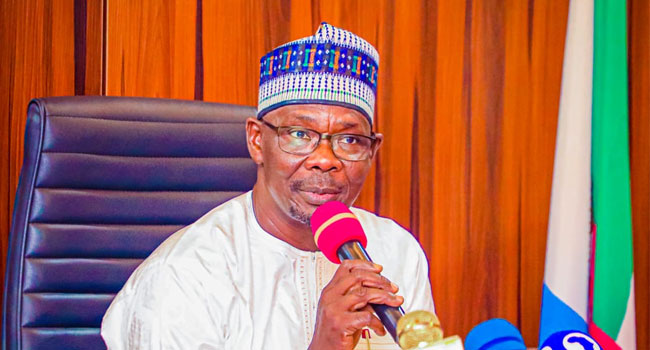
Nasarawa State governor, Engr. Abdullahi Sule, has said Nigeria is awash with money, but lacks the structural framework to channel these funds into transformative infrastructure.
The governor spoke yesterday as the keynote speaker on Day 2 of the 2026 Infrastructure Dialogue in Abuja, themed “Powering the African Future: Leadership, Entrepreneurship, Finance and Investment,” organised by Deutsche Partners Holding (DPH).
Sule, a former group managing director of Dangote Group, challenged the conventional understanding of infrastructure, insisting that physical assets like roads and power are only part of the equation.
“When we begin to talk about infrastructure, what most people think is just a bridge, power, maybe school, maybe water. But people don’t understand that infrastructure goes beyond that,” he said.
He argued that since funding exists, the real deficit lies elsewhere, saying “What is lacking is you need to put the structures together on how to access that money.
“An investor is not looking for money from you; he is looking for infrastructure, roads, power, water, security. But the biggest of them all is the buy-in of the community and return on investment. No investor wants to invest where there is no clear terms of return.”
According to the governor, the essential structures are transparency and trust. “You need to be able to trust the people you are working with. You don’t want that after doing that, tomorrow somebody else will come and take it away from you. You need the law that backs it,” he said.
To illustrate Nigeria’s hidden liquidity, the governor pointed to the impending public offering of the Dangote Refinery.
“Wait very soon, they are going to sell the Dangote Refinery to the market. Approximately $20 billion was used for the building of the refinery.
“If they sell 30 percent to the capital market, that is $6 billion. Just wait and see how that $6 billionn share will be oversubscribed. PENCOM, NSITF, hedge funds, banks, everybody has money. It will be oversubscribed at least three times. This I can tell you,” he said.
He argued that since funding exists, the real deficit lies elsewhere, saying “What is lacking is you need to put the structures together on how to access that money.
“An investor is not looking for money from you; he is looking for infrastructure, roads, power, water, security. But the biggest of them all is the buy-in of the community and return on investment. No investor wants to invest where there is no clear terms of return.”
According to the governor, the essential structures are transparency and trust. “You need to be able to trust the people you are working with. You don’t want that after doing that, tomorrow somebody else will come and take it away from you. You need the law that backs it,” he said.
Recounting his experience in Nasarawa State, he noted that when he assumed office in 2019, the state’s Internally Generated Revenue (IGR) was just N7bn for the whole year.
“Through blocking leakages and constructing strategic roads to mining and agricultural zones, IGR has now risen to about N35bn. Simple construction of a road, simple building of a super camp for the military changed the entire scenario. That’s how infrastructure brings in development,” he said.
Sule also revealed that he deliberately avoided foreign loans when other states were rushing to take them, citing the risk of currency devaluation.
“At the time, dollar was about N305. I asked, ‘What if it goes to N500?’ Today it went as high as N2,000. Thank God Nasarawa State didn’t take any such loan, and we are not in any panic,” he said.
He praised President Bola Tinubu for removing fuel subsidy, a decision he said he understood from his days running African Petroleum.
The governor concluded with a frank admission about political leadership, saying, “Most of us politicians come into office without getting ready. We are only ready for the position, and that’s one of the biggest disasters. If you come in ready, things go a little bit easier.”
Earlier, the convener of the Dialogue and managing partner of Deutsche Partners Holdings (DPH), Dr Onuoha Nnachi, revealed the origin of the Infrastructure Dialogue.
He disclosed that the federal government had engaged DPH, PricewaterhouseCoopers, and a consortium in 2014 to evaluate Nigeria’s infrastructure deficit. After 18 months, they produced a 593-page document detailing sector-by-sector, region-by-region, and state-by-state deficiencies.
“We classified infrastructure deficiency into two categories: economic infrastructure and social infrastructure. We concluded that 62 percent of the $30.1 trillion stock can be funded by the private sector.
“In 2015, there was a transition. A new government came on board and could not move with the document. I was invited to give a review. I reduced 593 pages to 118 pages. The team said it was too bulky. They asked me to do further reduction. I told them I couldn’t the content would be lost,” he said.
Refusing to let the work die, Nnachi convened the first stakeholder dialogue in 2018. “This cannot die. We have identified a problem. How can we address it?
“As of 2015, the ECOWAS Bank for Investment and Development, which Nigeria owns 33percent of, had never funded a single project in Nigeria. From 2018 when we started engagement with them to now, over $700 million has been used in funding Nigerian projects as a result of this dialogue,” he said.
He praised Governor Sule’s leadership, noting that fewer than five states in Nigeria have created an infrastructure fund backed by law.
“Nasarawa is one of them. It takes someone with determination to drive that. That is why we have the Governor of Nasarawa as our keynote speaker. It was intentional, not accidental. You must show the work as you talk the talk.
“We don’t have any other country. This is our country. We must do everything to change the narrative. There is no way we can transform this country through budgetary provisions alone. Let government fund social infrastructure, schools and hospitals, and let the private sector fund economic infrastructure,” he said.
We’ve got the edge. Get real-time reports, breaking scoops, and exclusive angles delivered straight to your phone. Don’t settle for stale news. Join LEADERSHIP NEWS on WhatsApp for 24/7 updates →
Join Our WhatsApp Channel