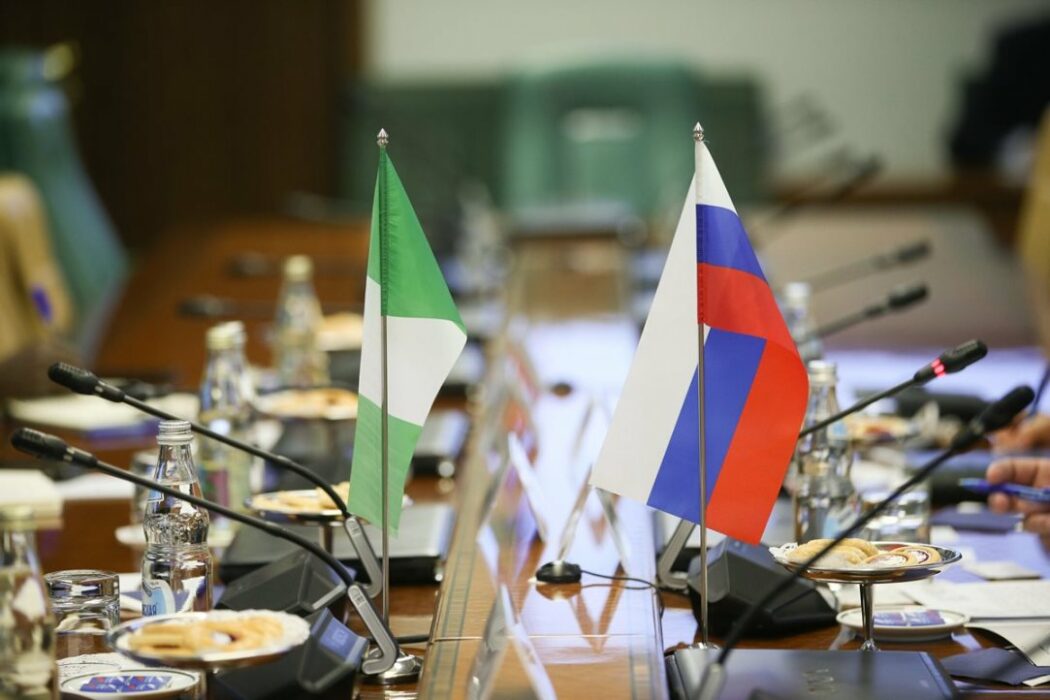
Nigeria and Russia have renewed their commitment to deepening bilateral ties across education, trade, and technology, following a high-level working visit by the Trade Commissioner of the Russian Federation, Mr. Maxim Petrov, to the Federal Ministry of Budget and Economic Planning in Abuja.
The Minister of State for Budget and Economic Planning, Dr. Doris Uzoka-Anite, received Petrov and his delegation, reaffirming the Federal Government’s readiness to build on existing cooperation frameworks and expand them into new areas of mutual benefit.
“We are here to listen to your plans and ideas, and as a Ministry, we remain fully committed to supporting initiatives that will deepen cooperation between our two countries and strengthen our future partnerships,” Uzoka-Anite said.
Central to the discussions was a new Russian government initiative that grants Nigeria’s state-level governments direct access to fully funded scholarship opportunities in Russian universities.
Under the programme, Russia covers tuition and accommodation costs, while Nigerian beneficiaries are responsible only for travel and personal allowances.
Petrov disclosed that approximately 200 Nigerian students are currently enrolled under the scheme, with expansion planned into critical fields including industry, hospitality, and medical sciences.
He described the approach as a deliberate shift toward engaging subnational governments to align educational exchanges with local development priorities. “We are not here to impose our interests but to understand Nigeria’s priorities and work together as true partners to support your development goals,” the Commissioner said.
The Director of International Cooperation at the Ministry, Dr. Sampson Ebimaro, who represented Permanent Secretary Dr. Deborah Odoh at the meeting, described the Nigeria-Russia relationship as productive and steadily evolving, expressing confidence that the engagement would yield more tangible outcomes in the years ahead.
Both sides acknowledged Russia’s growing strengths in technology and human capital development as a foundation for scaling up collaboration, with the Ministry signalling its intent to leverage existing bilateral agreements to accelerate progress across priority sectors.
Both delegations reaffirming their shared commitment to sustainable development through strategic partnerships — positioning education, trade, and technology as the core pillars of the renewed bilateral agenda.
We’ve got the edge. Get real-time reports, breaking scoops, and exclusive angles delivered straight to your phone. Don’t settle for stale news. Join LEADERSHIP NEWS on WhatsApp for 24/7 updates →
Join Our WhatsApp Channel