
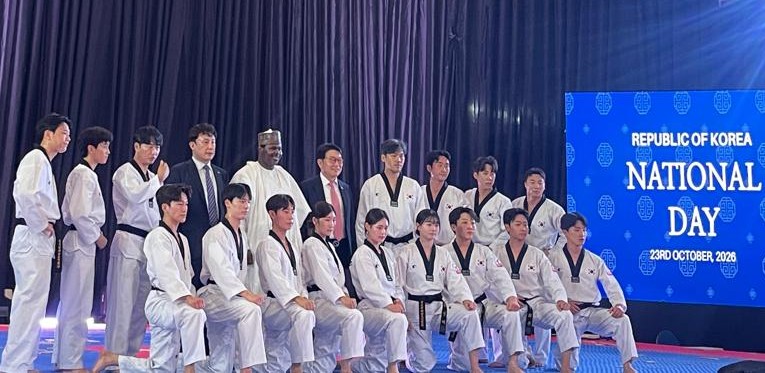
Nigeria and South Korea have expressed readiness to strengthen bilateral relations through expanded trade, investment, technology transfer and cooperation in agriculture, education and skills development.
Poo
The two countries reaffirmed their commitment to closer collaboration at a reception in Abuja on Friday, October 23, 2026, marking South Korea’s National Day.
Speaking at the event, South Korea’s Ambassador to Nigeria, Jeong Yoan, said the relationship between the two countries, established in 1980, offered opportunities for deeper economic cooperation and people-to-people exchanges.
He said South Korea’s development experience, shaped by education, hard work and international cooperation, could provide useful lessons for countries pursuing economic growth.
Recalling South Korea’s difficult post-war years, the ambassador noted that the country had rebuilt its economy from widespread devastation and an annual per capita income of less than $100 in 1953.
He said the country’s progress demonstrated the importance of investing in human capital, developing local industries and sustaining partnerships that support long-term development.
On Nigeria–South Korea cooperation, Jeong highlighted several initiatives aimed at entrepreneurship, education and agricultural development.
He said the Korea International Cooperation Agency (KOICA), in partnership with Nigeria’s Small and Medium Enterprises Development Agency (SMEDAN) and the United Nations Development Programme (UNDP), broke ground on an entrepreneurship centre in Abuja in September.
The centre is expected to support young entrepreneurs and start-ups.
He also cited the Smart School project implemented with the Universal Basic Education Commission (UBEC), which he said had reached about 8,000 children and provided training for more than 300 teachers and school leaders.
Another initiative involving KOICA and the Food and Agriculture Organisation focuses on creating green jobs for young Nigerians through agriculture.
The ambassador added that about 2,000 Nigerian officials had received training in South Korea through KOICA, describing capacity development as an important component of the bilateral relationship.
He also identified opportunities for Korean businesses to deepen their engagement with Nigeria, noting that companies such as Daewoo E&C, LG, Samsung and Hyundai were working with Nigerian partners across sectors including energy, manufacturing, clean water and digital technology.
According to him, the South Korean Embassy and the Korea Trade-Investment Promotion Agency continue to promote investment, technology sharing and local employment.
In his response, a Nigerian government representative commended South Korea’s achievements in technology, engineering, manufacturing and social development, noting that its experience could offer valuable lessons for Nigeria.
The representative called for broader cooperation in agriculture, industrial manufacturing, automobile assembly, shipbuilding and technology transfer.
He also identified education, digital technology, scholarships, technical training, academic exchanges and research as areas in which both countries could expand collaboration.
The Minister of Foreign Affairs Ambassador, Bianca Ojukwu, who was represented by Hon. Babagana Wakil, further stressed the importance of strengthening maritime cooperation, including maritime safety, transport, fisheries and technical capacity development. He also called for renewed engagement under the Nigeria–South Korea Joint Commission framework to identify practical ways of expanding bilateral trade and investment.
The representative noted that closer cooperation could help both countries respond to shared development challenges while creating opportunities for businesses and citizens.
Beyond economic relations, Jeong highlighted growing cultural exchanges between the two countries.
He said Korean pop music, television dramas, films and beauty products had attracted Nigerian audiences, while Korean audiences had shown interest in Nigerian Afrobeats and Nollywood productions.
The ambassador linked the cultural exchange to the theme of the celebration, “One Heaven. One Earth. One Humanity,” which he said reflected the importance of shared humanity, peace, dignity and international cooperation.
South Korea’s National Foundation Day, known as Gaecheonjeol, is celebrated on October 3.
AThe occasion commemorates the country’s traditional founding story associated with Dangun and the principle of Hongik Ingan, commonly interpreted as “to benefit all humanity.”
The Abuja reception featured a Taekwondo performance and Korean cuisine, showcasing aspects of South Korea’s cultural heritage.
Both countries expressed interest in building on their longstanding diplomatic relationship through stronger economic partnerships, capacity development and cultural exchanges.
We’ve got the edge. Get real-time reports, breaking scoops, and exclusive angles delivered straight to your phone. Don’t settle for stale news. Join LEADERSHIP NEWS on WhatsApp for 24/7 updates →
Join Our WhatsApp Channel