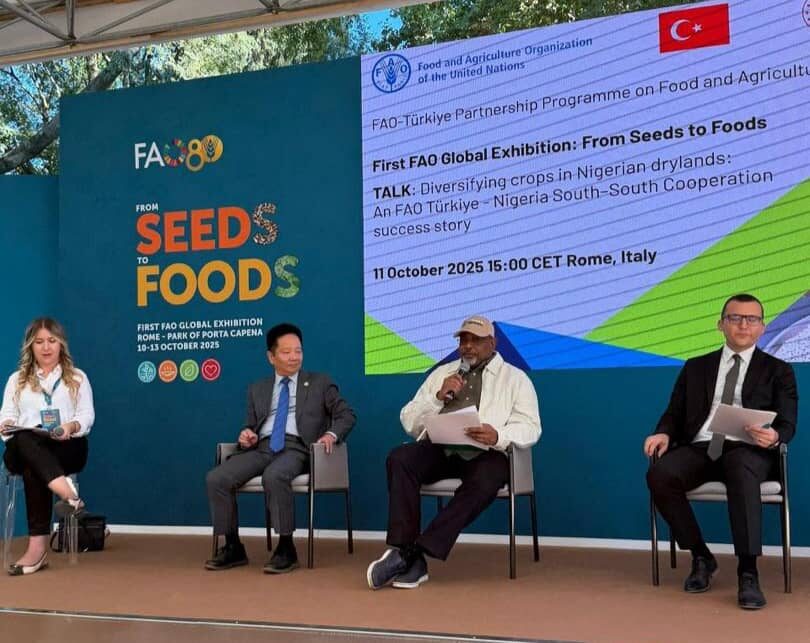
The Federal Government of Nigeria has reaffirmed strong commitment to South–South and Triangular Cooperation (SSTC) in new strategy to transform the agrifood systems and promote sustainable development through shared expertise, innovation and resources among developing countries.
Speaking at the Ministerial Dialogue on SSTC during the ongoing 2025 World Food Forum in Rome, Italy, the Minister of Agriculture and Food Security, Senator Abubakar Kyari, said the initiative remains vital to building resilient food systems and fostering inclusive economic growth across the Global South.
He explained that the SSTC framework strengthens the collective bargaining power of developing nations in international platforms and promotes a more balanced global economic order.
According to him, the model has become one of the most practical and cost-effective approaches for achieving food security and shared prosperity.
The Minister cited Nigeria’s ongoing collaboration with the FAO and China as evidence of the initiative’s impact, noting that the partnership has yielded measurable outcomes in technology transfer, aquaculture development, farmer training, and the establishment of Regional Multi-Service Extension Centers across the country.
A statement by the ministry’s Head of Information Department, Ezeaja Ikemefuna, said Kyari added that similar partnerships with Brazil and other developing countries continue to show that the Global South possesses the capacity and innovation to overcome its challenges when united in purpose.
He said Nigeria’s current focus is to embed SSTC programmes within its National Agrifood Systems Transformation Agenda, ensuring they align with national priorities and deliver measurable results.
He further emphasised the need to create flexible and sustainable funding mechanisms to expand existing partnerships, promote climate-smart and digital agriculture, and strengthen mechanization and irrigation systems to boost productivity and resilience.
“The lessons we continue to draw from our partnerships with China, Brazil, and other developing nations reaffirm that the Global South has the capacity, knowledge, and innovation needed to solve its own challenges if we work together in solidarity,’’ he stated.
We’ve got the edge. Get real-time reports, breaking scoops, and exclusive angles delivered straight to your phone. Don’t settle for stale news. Join LEADERSHIP NEWS on WhatsApp for 24/7 updates →
Join Our WhatsApp Channel