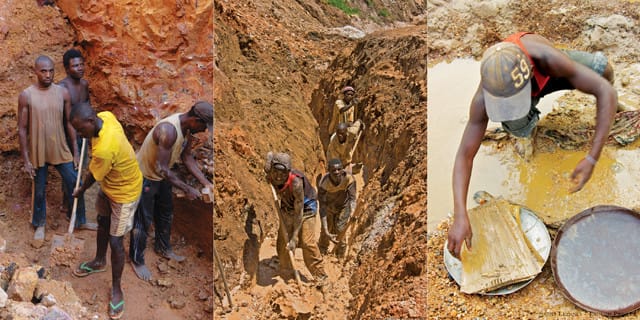
Nigeria is working on measures broader policy strategy to reduce oil dependence through mining development.
According to data, Nigeria’s subsoil contains $700 billion in mineral reserves.
To achieve this government has signed agreement with Africa Finance Corporation and Xcalibur Smart Mapping to collect geological data which was followed by a Memorandum of Understanding (MoU) with France to finance geological exploration.
Other African countries are equally taking similar measures to develop roadmap to sustain mining activities to boost the continents economy.
Botswana, Africa’s leading diamond producer by volume, launched a new state-owned exploration company dedicated to improving national geological data. Authorities announced the initiative last week on the sidelines of the Mining Indaba conference in South Africa. Gaborone aims to better showcase its mineral potential and attract additional investment.
Africa hosts major global producers of copper and cobalt in the Democratic Republic of Congo and platinum group metals in South Africa. Observers frequently cite estimates that Africa holds 30 per cent of global critical mineral reserves, which energy transition and industrial sectors require.
Nevertheless, investors must still spend millions of dollars on mapping and preliminary exploration before they can conduct drilling programs. Africa attracted only 10 per cent of global mining exploration spending in 2024, although the continent represents 22 per cent of the world’s landmass. Botswana’s Minister of Minerals and Energy, Bogolo Joy Kenewendo, told Reuters that the country has explored only about 30 per cent of its territory.
“We want to make sure that we have the right data and that we know where the resources are. You can lose a lot of money exploring and finding nothing,” minister Kenewendo said, referring to companies operating at early exploration stages that often hesitate to invest because of high failure risks.
Botswana plans new exploration investments as it faces an economic slowdown linked to lower diamond prices and weaker demand. The government aims to diversify the economy and expand its mining sector beyond diamonds to minerals such as copper and nickel.
Kenya has also advanced state-led exploration efforts. The government conducted a nationwide airborne geophysical survey that generated new geological data in 2023. Authorities identified 970 mineral occurrences, including critical minerals, across 15 counties. The government has promoted these opportunities to investors. Kenya invested public funds to mobilize additional capital and to raise mining’s contribution to 10 per cent of GDP by 2030 from less than one per cent at the end of the 2020s.
However, geological mapping and data collection alone cannot guarantee mining sector development. The Fraser Institute’s annual ranking of global mining jurisdictions shows that mineral potential represents only one factor in investment decisions. Governments must also ensure attractive mining policies, regulatory stability and predictable tax frameworks.
As major powers compete for access to Africa’s mineral resources, governments’ ability to combine rich mineral potential with clear legal frameworks will likely determine whether mining expansion supports long-term development.
We’ve got the edge. Get real-time reports, breaking scoops, and exclusive angles delivered straight to your phone. Don’t settle for stale news. Join LEADERSHIP NEWS on WhatsApp for 24/7 updates →
Join Our WhatsApp Channel