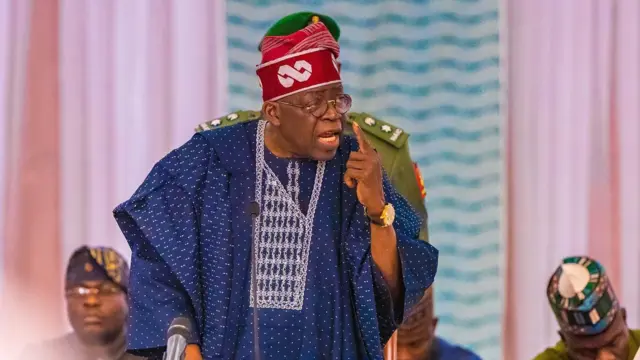
The Grassroots Mobilisation Initiative has called on Nigerian universities and political leaders to study the political trajectory of Bola Ahmed Tinubu as a blueprint for governance, leadership and nation-building.
In a press statement issued by the group’s National Coordinator, Samaila Musa, the organisation described President Tinubu as one of the most influential and controversial figures in Nigeria’s contemporary political history.
The group said Tinubu’s political style — which it characterised as a blend of resilience, coalition-building, fiscal innovation and long-term strategic planning — should become a major case study for students of political science and leadership studies across Nigerian universities.
According to the statement, Tinubu’s journey from a corporate accountant and pro-democracy activist to Nigeria’s 16th President represents “a masterclass in political engineering and long-term networking.”
The organisation urged the academic community to move beyond theoretical political studies and begin examining practical political strategies that shape governance and power dynamics in Nigeria.
“To understand where Nigeria is going, we must understand the man who spent thirty years mapping the route,” Musa stated.
He added that universities should analyse how Tinubu built political structures, maintained influence in the South-West and eventually led the opposition coalition that defeated an incumbent government for the first time in Nigeria’s history.
The group identified Tinubu’s role in the 12 June struggle and his participation in the National Democratic Coalition as examples of political resilience and democratic activism.
GMI also highlighted Tinubu’s tenure as Governor of Lagos State, noting that his administration transformed the state’s economy through aggressive internally generated revenue reforms despite federal funding challenges at the time.
According to the group, Tinubu’s recruitment of technocrats such as Babatunde Fashola and Yemi Osinbajo demonstrated the importance of building a sustainable political and governance structure.
The statement further described the 2013 merger of the ACN, CPC and ANPP to form the All Progressives Congress as a landmark political strategy that reshaped Nigeria’s democratic landscape.
GMI argued that the merger proved that strategic alliances across ethnic and religious lines remain essential for achieving national political relevance.
The group also referenced Tinubu’s “Emi Lokan” philosophy and recent economic reforms, including the removal of fuel subsidies and the unification of the exchange rate, describing them as evidence of political courage and a willingness to tackle structural economic challenges.
It called on universities to incorporate Tinubu’s political career into political science curricula as part of efforts to better understand the “mechanics of power” in Nigeria.
“Ultimately, the Grassroots Mobilisation Initiative believes that the ‘Lion of Bourdillon’ has provided a definitive map for political success,” the statement said.
The group also advised opposition politicians to focus on strategic planning and alliance-building rather than divisive rhetoric that could overheat the polity.
“True opposition is built on superior strategy and patient alliance-building, not on destabilising the nation. It is time for all political actors to learn that power is a product of deliberate engineering, not accidental noise,” the statement added.
We’ve got the edge. Get real-time reports, breaking scoops, and exclusive angles delivered straight to your phone. Don’t settle for stale news. Join LEADERSHIP NEWS on WhatsApp for 24/7 updates →
Join Our WhatsApp Channel