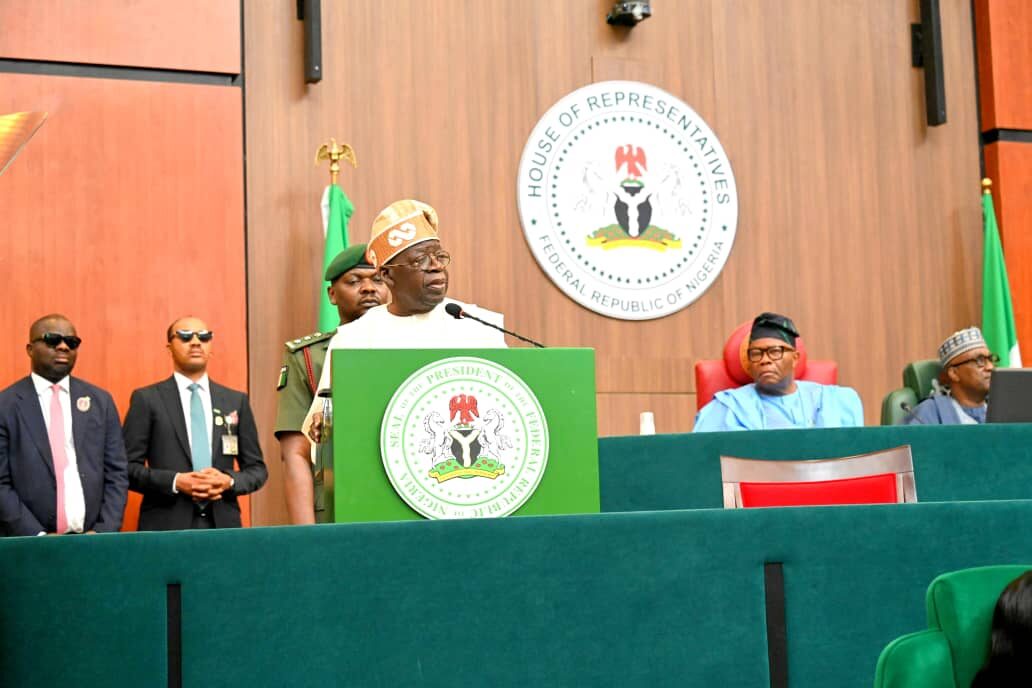
Nigeria’s 2026 federal budget, framed by President Bola Ahmed Tinubu as a “fiscal reset,” arrives at a moment of national delicacy. Presented to a joint session of the National Assembly recently, it was tagged the “Budget of Consolidation, Renewed Resilience and Shared Prosperity.”
It is anchored on four critical pillars: security, education, health, and infrastructure. President Tinubu described these sectors as interlinked, forming the backbone of Nigeria’s path toward inclusive growth, economic diversification, and social stability.
“Without security, investment will not thrive. Without educated and healthy citizens, productivity will not rise. Without infrastructure, jobs and enterprises will not scale,” he said, insisting that the budget is designed as one coherent programme of national renewal.
With an already strained economy, thin public trust, pervasive insecurity, and a social contract under visible stress, a national budget must be more than an accounting document. It must function as a statement of intent, a map of priorities, and a test of leadership.
This is why the 2026 budget deserves sustained editorial scrutiny – not applause, not dismissal, but rigorous interrogation.
The proposal puts total revenue at N34.33 trillion and total expenditure at N58.18 trillion, leaving a fiscal deficit of N23.85 trillion, equivalent to 4.28 per cent of GDP. In historical context, Nigeria’s budgets have followed a steady upward trajectory.
The 2015 “Transition Budget” stood at N4.92 trillion; 2016 at N6.06 trillion; 2017 at N7.44 trillion; and 2018’s “Budget of Consolidation” at N8.6 trillion, later raised by the National Assembly to N9.12 trillion. The 2019 budget was approximately N8.92 trillion. The 2020 budget, tagged “Sustaining Growth and Job Creation,” was initially ₦10.33 trillion but revised downward to about N9.97 trillion due to the Covid-19 pandemic.
Budgets for 2021, 2022, and 2023 stood at N13.59 trillion, N17.1 trillion, and N21.83 trillion respectively. Last year’s budget was signed at n28.7 trillion but later reset by the National Assembly in December 2025 to N43.56 trillion.
In this sense, the size of the 2026 budget is not radically different from its predecessors. Inflation, population growth, currency depreciation, and an expanding state continue to drive expenditure growth. Recurrent spending remains heavy, while debt servicing – estimated between ₦14.3 trillion and N15.5 trillion – consumes roughly 27 per cent of total expenditure, exceeding allocations to education and health combined.
Revenue assumptions still lean precariously on oil receipts and optimistic projections. Nigeria has seen large budgets before. Size, by itself, has never been our fundamental problem.
What distinguishes this budget – and why it matters – is its stated attempt at structural correction. The proposed fiscal reset seeks to end the practice of overlapping budgets and chronic rollovers that have plagued Nigeria’s public finance system since 2024.
Late passage, partial implementation, and endless extensions of capital components have weakened planning, distorted accountability, and normalised mediocrity in execution. These practices have attracted growing criticism from both citizens and experts.
Even members of the Senate Committee on Finance in their docility, faulted the Tinubu administration for operating multiple budgets within a single fiscal year through repeated extensions. Senator Danjuma Goje, representing Gombe Central, described the practice as unacceptable and insisted it must end.
Yet good diagnosis does not automatically produce good outcomes. The central question is not whether the reset is conceptually sound – it is – but whether the political will, institutional capacity, and discipline exist to sustain it. Nigeria’s complexity is not merely demographic or geographic; it is institutional. Weak coordination, rent-seeking incentives, bureaucratic inertia, and political interference have historically neutralised even well-designed fiscal plans.
A reset on paper must survive contact with ministries, departments, agencies, and the political economy that shapes them.
The budget also reflects the administration’s effort to balance reform with social stability. Increased allocations to security respond to a nation under siege – from banditry and terrorism to communal violence and organised crime. Yet Nigerians have learned, painfully, that higher security spending does not automatically translate into better security outcomes.
On the economic front, the budget signals continuity in reform direction – subsidy removal, exchange-rate unification, and revenue expansion – while grappling with the social aftershocks of these choices. Inflation, cost-of-living pressures, and unemployment have eroded household resilience. For millions of Nigerians, macroeconomic logic offers little comfort when daily survival is at stake.
One of the most persistent weaknesses of Nigerian budgets over the past decade has been the disconnect between aspiration and execution. Capital projects are announced with fanfare, only to be abandoned, underfunded, or endlessly recycled.
There should be a deliberate political will to stop that.
Revenue remains the budget’s soft underbelly. Despite repeated declarations, non-oil revenue mobilisation continues to lag behind ambition. The new tax law promoted by the Tinubu administration remains controversial and politically sensitive. Rather than overburdening a narrow and already overstretched citizens economically, Nigeria should prioritise improving human capital and broadening productivity.
With such an approach, economic growth would follow naturally, and compliance to tax regimes would be earned rather than coerced.
Nigerians are willing to accept sacrifice when they see fairness, transparency, and restraint at the top; they resist when the state appears extractive but wasteful.
This brings us to trust – the invisible currency of public finance. Over the past decade, budgets have steadily lost credibility because citizens rarely see a clear connection between allocations and improvements in lived conditions. Roads remain broken, schools deteriorate, hospitals fail, and power supply limps along despite trillions spent.
This newspaper believes that the 2026 budget offers an opportunity to reverse this narrative, but only if government communicates clearly, reports honestly, and visibly sanctions failure.
For a country as complex and delicate as Nigeria, budgeting must be both technocratic and political in the best sense of the word. It must recognise hard constraints while managing social expectations, invest in the future without ignoring present pain, and confront entrenched interests without destabilising the system.
Above all, it must be anchored in realism. Nigeria does not need magical thinking; it needs consistent, boring competence sustained over time.
We’ve got the edge. Get real-time reports, breaking scoops, and exclusive angles delivered straight to your phone. Don’t settle for stale news. Join LEADERSHIP NEWS on WhatsApp for 24/7 updates →
Join Our WhatsApp Channel