Africa’s billionaire class has reinforced its economic influence, with total wealth rising to $126.7 billion in 2026, according to the latest Forbes Africa ranking, underscoring both the resilience and the structural concentration of wealth across the continent.
Nigeria dominates Africa’s billionaire rankings once again, boasting four of the continent’s 23 ultra-wealthy individuals whose combined fortunes exceed $40 billion—more than a third of the total $126.7 billion in African billionaire wealth, per Forbes Africa’s 2026 list.
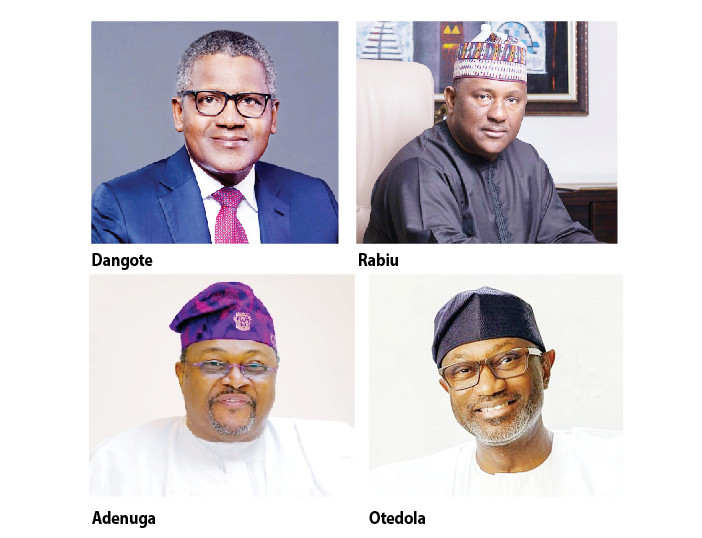
These Nigerian titans, led by Aliko Dangote ($28.5 billion), Abdulsamad Rabiu ($11.2 billion), with real-time estimates at $13.1 billion)Mike Adenuga ($ 6.5 billion) and Femi Otedola ($1.3 billion) built their wealth from cement empires, telecom revolutions, oil production, and power generation.
Their dominance underscores Nigeria’s pivotal role in West Africa’s economy and the continent’s industrial backbone, fueling infrastructure, digital access, and energy security amid broader African growth.
The report, which identifies 23 billionaires from the continent, shows that Africa’s richest persons continue to derive their fortunes largely from industrial manufacturing, natural resources, telecommunications, and energy sectors that remain central to the continent’s economic architecture and long-term growth trajectory.
At the top of the list is Aliko Dangote, who retains his position as Africa’s richest man with an estimated net worth of $28.5 billion, further cementing Nigeria’s prominence in the continental wealth hierarchy.
ther leading figures include Johann Rupert and Nassef Sawiris, reflecting a geographically diverse but sector-driven concentration of wealth spanning Southern and North Africa.
For Nigeria, the nation has maintained its position as West Africa’s billionaire bloc with four billionaires on the list—Aliko Dangote, Abdulsamad Rabiu, Mike Adenuga and Femi Otedola.
Collectively, the quartet accounts for a substantial share of Africa’s billionaire wealth, with combined fortunes estimated at over $40 billion, driven by dominance in industrial production, telecommunications, and energy infrastructure.
This concentration highlights Nigeria’s strategic importance in shaping not just West Africa’s economy, but also the broader continental outlook for private capital and enterprise development.
While looking through the sectoral drivers of their wealth. A breakdown of the Forbes data indicates that Africa’s billionaire wealth is concentrated in a narrow band of capital-intensive sectors: industrial manufacturing, mining, telecoms, luxury goods, and energy.
However, for Nigeria, three sectors stand out as the primary engines of billionaire wealth: industrial manufacturing, telecommunications, and energy infrastructure, each playing a critical role in economic expansion and regional competitiveness.
However, two (2) individuals from Nigeria demonstrated they are Industrial powerhouses. Even as Industrialisation remains the backbone of Nigeria’s billionaire success story, led by Dangote and Abdulsamad Rabiu.
Dangote’s cement empire, spanning multiple African countries, continues to underpin infrastructure development across the region, with the production capacity of over 48.6 million metric tons annually supplying essential materials for roads, bridges, and housing projects.
His ongoing refinery project is also expected to reshape Nigeria’s petroleum supply chain, reduce dependence on imports, and conserve scarce foreign exchange.
The Dangote refinery project stands out as one of the most ambitious industrial ventures on the continent.
The refinery is not just a business venture but is seen as a structural intervention in Nigeria’s economy, as the Dangote Refinery will list on the Nigerian Exchange Group between June and July 2026, opening ownership of this transformative project to individual investors nationwide.
Rabiu Samad is ranked third on the Forbes Africa list with a net worth of $11:2B. However, a real-time net worth of the businessman is listed at $13.1B and 223 in the world.
His BUA Group has similarly strengthened Nigeria’s industrial base, with significant investments in cement production, sugar refining, and infrastructure development, positioning the company as a major force in domestic manufacturing.
The businessman merged his privately owned Obu Cement Company with the listed firm Cement Co of Northern Nigeria, which he controlled, to form BUA Cement Plc, which trades on the Nigerian Stock Exchange, while he also owns 95 per cent of the publicly traded food conglomerate BUA Foods.
With interest in cement, food and his foray into the oil industry.
It’s vital to note that cement remains the backbone of Africa’s development, and Nigerian industrialists are firmly positioned at the centre of that value chain.
Analysts say the dominance of these firms has helped deepen local production capacity, improve price competitiveness, and stimulate cross-border trade within West Africa.
Mike Adenuga, a major player in the Nigerian telecommunications sector, is ranked 6th with a net worth of $6.5B.
Adenuga has played a transformative role in expanding access and affordability.
Through Globacom, Nigeria’s own indigenous telecom firm, Adenuga introduced per-second billing, a move widely credited with democratising mobile communication in Nigeria and forcing industry-wide pricing reforms that benefited millions of consumers.
He, however, built his fortune in telecom and oil production. With his oil firm, Conoil Producing, and operating six oil blocks in the Niger Delta.
Similarly, he owns 74 per cent of publicly traded gasoline firm Conoil and another 6 per cent of publicly traded Nigerian bank Sterling Financial Holding.
No doubt, Adenuga’s telecom firm has driven disruptive change in the telecommunications industry, serving as a critical enabler of Nigeria’s digital economy by supporting financial inclusion, e-commerce growth, and youth-driven innovation across the country.
Hence, Adenuga’s impact extends beyond profitability, contributing significantly to connectivity and economic participation in underserved communities.
Meanwhile, the 4th Nigerian on the Forbes Africa list is Femi Otedola, ranked number 22 with a net worth of $1.3B. The Nigerian billionaire made his first fortune in commodities before selling his Forte Oil shares to invest in the energy business.
His shift from oil trading to power reflects a broader strategic realignment toward long-term investments critical to national development and economic stability.
Otedola represents Nigeria’s billionaire presence in the energy transition space, with investments increasingly focused on power generation and infrastructure assets.
It’s essential to note that power remains Nigeria’s biggest economic bottleneck and its biggest investment opportunity. With Nigeria’s persistent electricity challenges, investments in power generation are widely seen as both commercially viable and economically transformative.
He, however, sold his majority stake in Geregu Power, a power generation business, in 2025, pocketing roughly $750 million. He had previously sold down his stake in Geregu, which once exceeded 95%, to bring in institutional investors while retaining a 5% stake in the Lagos-based company.
Despite the strong showing, the Forbes Africa list shows that Africa’s wealth remains highly concentrated in a narrow band of sectors and individuals. Analysts stressed that Africa’s billionaire wealth remains tied to hard assets such as cement, oil, and minerals rather than to broad-based innovation.
They alluded that the long-term significance of billionaire wealth will depend on its ability to drive job creation, industrial expansion, and inclusive growth across the continent.
The reports further show that Nigeria is at the Centre of Africa’s wealth narrative as Africa’s billionaire wealth expands. Even as Nigeria’s role remains pivotal, Africa’s wealth remains anchored in industrial and resource-driven sectors.
Consequently, from industrial production to telecom infrastructure and energy investments, the country’s richest individuals are not only shaping markets but also defining the course of key sectors across Africa. Hence, leveraging the scale and influence of private capital will be critical to achieving sustainable and inclusive economic growth.
We’ve got the edge. Get real-time reports, breaking scoops, and exclusive angles delivered straight to your phone. Don’t settle for stale news. Join LEADERSHIP NEWS on WhatsApp for 24/7 updates →
Join Our WhatsApp Channel