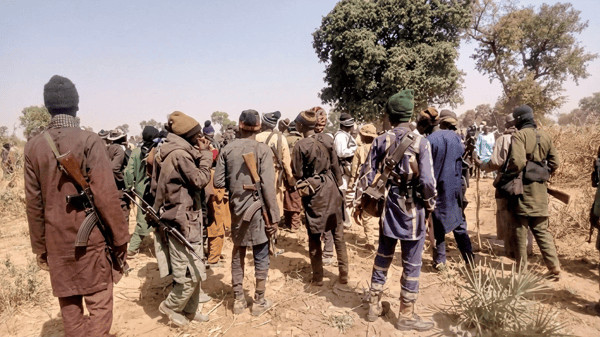
A new report from SBM Intelligence has placed a number on what most Nigerians already sensed from lived experience: the country’s kidnapping crisis has stopped resembling ordinary criminality and started resembling an industry with its own logistics, pricing and, increasingly, a dominant beneficiary.
Between July 2025 and June 2026, 7,825 people were abducted across 1,713 incidents, a 66 per cent increase in victims over the previous cycle. At least 1,142 people were killed. And N7.8 billion changed hands in ransom, with a single faction of Boko Haram, Jama’atu Ahlis Sunna Lidda’awati Wal-Jihad, collecting 90 per cent of it from just eight incidents. These are not the statistics of scattered banditry. They are the statistics of a war economy that Nigerian households are now, unwittingly, financing.
The most disturbing figure in the report is not the headline number of abductions but the collection rate. Everyday kidnap gangs and bandits demanded N13.5 billion during the period under review and collected only N719 million, a rate of roughly 5 per cent. JAS, by contrast, demanded N9.2 billion and collected N7 billion, a rate above 76 per cent. Two incidents alone, the abduction of 416 people from Ngoshe in Borno and the seizure of 315 pupils and staff from St Mary’s School in Papiri, Niger State, accounted for N7 billion between them, nearly the entire national ransom bill. What this tells us is that Nigeria does not have one kidnapping problem. It has two. The first is a diffuse criminal economy of opportunistic gangs preying on vulnerable communities. The second, smaller in incident count but vastly more lucrative, is a terrorist financing operation dressed in the language of banditry.
This distinction should reshape how the security establishment responds, because a strategy calibrated for the first problem will do very little against the second. Ordinary criminal gangs can, in principle, be worn down through community policing, improved rural security infrastructure and economic alternatives for the young men who make up their foot soldiers. A faction of Boko Haram that has learned to convert mass school abductions into billions of naira in guaranteed ransom requires a different order of response entirely, one that treats the payment pipeline itself as a strategic target. When a single actor can demand N9.2 billion and reliably collect three-quarters of it, that actor has effectively built a functioning revenue model, and revenue models do not collapse on their own. They have to be dismantled.
We have said before on this page that Nigeria’s security failures are compounded by an absence of coordination among the agencies meant to prevent them. The Papiri attack makes that failure impossible to ignore. A school, in a state that has weathered previous mass abductions, remained a soft enough target that 315 pupils and staff could be taken and a N2 billion ransom extracted from it. Ngoshe similarly demonstrates how a community can be stripped of 416 residents at once, feeding a ransom economy that has now proven itself more reliable, from the kidnappers’ perspective, than legitimate commerce. Each of these incidents is a case study in the state’s failure to protect the most predictable and repeatable targets in its territory: schools, rural communities and travellers along known corridors of risk.
The report’s finding on the Northwest deserves particular attention. Zamfara alone recorded 236 incidents and 1,921 victims, close to a quarter of the national total, while the North accounts for 93.7 per cent of all abducted persons against just 6.3 per cent in the South. This is not a uniform national emergency requiring a uniform national response. It is a heavily concentrated crisis that has been allowed to fester in specific states for years, with mass abduction as the dominant method, 92 recorded incidents of that type in Zamfara alone, followed by 76 in Sokoto. Any government serious about reversing these numbers must direct resources and personnel where the crisis is actually concentrated, rather than distributing attention evenly across a map where the danger is not evenly distributed at all.
There is also a grim finding buried in the data that deserves more public attention than it has received: payment is no guarantee of survival. In at least six cases, victims were killed even after ransom had been paid. Ransom-bearers themselves are increasingly being abducted. And in fourteen incidents, kidnappers demanded goods rather than cash, motorcycles, phones, food and fuel, a detail that reveals an economy adapting itself precisely to the thin resources of the communities it preys upon. This is not opportunistic crime responding to circumstance. It is a criminal enterprise refining its methods against a population it has studied and priced accordingly.
The policy implication the report offers is the correct one, and it should not be treated as an afterthought buried in a research document: disrupt the financial flows underwriting insurgency, and address the economic desperation supplying its foot soldiers. Nigeria’s security agencies have spent years responding to kidnapping primarily as a law enforcement problem, chasing perpetrators after the fact rather than starving the system that rewards the crime in the first place. That approach has produced the numbers now on the table.
Ransom payment, however understandable as a desperate family’s last resort, has become the fuel powering an armed group’s expansion. Tracking and interdicting these payments, working with financial institutions and mobile money operators to flag the patterns that repeatedly precede large transfers, and prosecuting the facilitators who negotiate on behalf of kidnappers are not optional refinements. They are the minimum required response to a crisis that has demonstrably outgrown the framework currently being used to fight it.
Nigeria cannot arrest its way out of a financing model. It must starve it.
We’ve got the edge. Get real-time reports, breaking scoops, and exclusive angles delivered straight to your phone. Don’t settle for stale news. Join LEADERSHIP NEWS on WhatsApp for 24/7 updates →
Join Our WhatsApp Channel