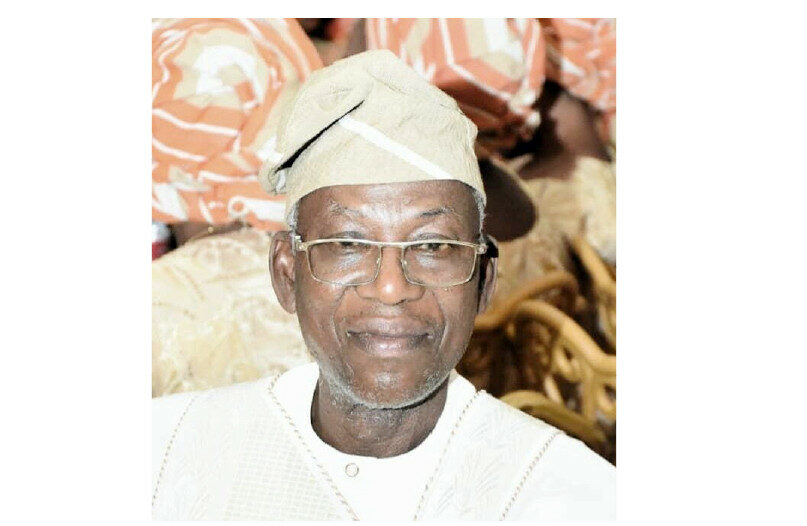
Amid growing concerns over banditry and worsening insecurity across the country, questions continue to arise over the effectiveness of Nigeria’s current security architecture. In this interview with ABDULLAHI OLESIN, a retired assistant inspector general of Police, Baba Adisa Bolanta (Rtd), says Nigeria’s fight against banditry and insecurity can only be effective through strong collaboration among the military, the police, the judiciary, and other relevant government agencies
How do you assess the existing security architecture under the incoming Minister of Defence?
Well, what we have on the ground now is a rigid arrangement with the predominance of the military. And you know, the security issues we are facing are not ones that require only a military solution. Most of them are acts of criminality that require agencies trained in that respect to take charge.
So, what I expect now is improved collaboration among the various security agencies and the military. And this collaboration should not be limited to the agencies alone; there must also be synergy among the various ministries. We have the ministry of defence, the ministry of police and health, the ministry of Interior, the ministry of justice, and the ministry of information, which is responsible for national orientation.
There should be increased collaboration. In the ministry of interior, we have the immigration service; in the ministry of finance, we have customs and the EFCC. All these teams must have a role to play in helping our country. This is not something one or two agencies can do. No, no, no. It has to be a collective fight. And for that fight to be successful, there must be strong synergy and collaboration among the various agencies and their supervising ministries.
Are you saying these collaborations and synergy are not in place right now?
They exist, but not to the expected level. They are not strong enough to lead us to greater success in our fight against banditry and other forms of criminality.
Can you clarify whether the bandits are largely foreigners or homegrown actors within our communities?
As I mentioned earlier, this goes beyond agency collaboration. Some of the people involved in core banditry are not Nigerians. Some are foreigners from our neighbouring countries. There is an agency responsible for the movement of people in and out of the country, and another responsible for regulating the flow of goods and commodities.
All these factors must be considered. Some of the bandits are locals, our own people, while others are foreigners taking advantage of our porous borders. Globally, climate change has led to reduced rainfall in certain regions. The southern part, which is wetter, includes our country. So, people are moving in, often unchecked.
With such influx, contraband inevitably follows, arms, ammunition, and other illegal items. And we must remember that our immediate neighbours, Niger, Chad, Burkina Faso, and Libya, are facing turmoil. Libya, though somewhat stabilised, still has two governments. All these factors must be considered when addressing our security challenges.
Should the feeding of animals by herders be criminalised?
Perhaps when redefining our national security system, we must factor in environmental realities. Climate change has affected many countries. Some now experience more rainfall, while others have suffered drastic reductions.
This has led to migration from areas with no means of livelihood to places where survival is possible. Our northern neighbours, Niger and Chad, are experiencing these conditions. It is natural for people to move in search of shelter and sustenance.
Some come genuinely because of the situation there, while others exploit our humility and generosity to engage in criminal activities.
What should Nigerians expect from the new Defence Minister in terms of vision and priorities for national security?
Nigerians should expect strong leadership. Our security problem is multidimensional and persistent. The new minister’s leadership should focus on three pillars.
First, ensuring better coordination among the military, police, DSS, and other security agencies. Second, defence operations must move from being reactive to proactive. We should anticipate threats based on developments elsewhere. Many believed such things could never happen here, but they are happening now.
Third, operations must be technologically driven, not just deploying troops. We need integrated communication systems, not the analogue systems we used before. This can be achieved by partnering with service providers like MTN or Airtel. Such systems are more secure and less prone to disruption.
Intelligence gathering must also be technologically driven. We may not achieve all this alone; we need support from countries that have done it successfully. These are the areas the minister should prioritise. I am not a military man, but these are core areas.
Is Nigeria’s current military capacity,manpower, equipment, and intelligence adequate to tackle today’s security challenges?
I would say they are adequate, but improvement is necessary in manpower, equipment, training, and intelligence. Security operations are not just about manpower; equipment is crucial.
In the 1980s, during the Shagari administration, there was deliberate investment in upgrading military and police equipment. By then, Nigeria had the best military capability in West Africa, unmatched in Central Africa except by Angola.
That strength enabled Nigeria’s decisive intervention in Liberia and Sierra Leone in the 1990s. Intelligence must also be strengthened, particularly internal intelligence, through strong synergy among the military, police, DSS, NIA, and local communities.
Grassroots intelligence is vital. In the Ukraine war, citizens were briefed beforehand, which helped them respond effectively. Involving locals enhances intelligence gathering.
In that regard, do you support giving traditional rulers a stronger constitutional role in national security?
Yes, there is a need for that. Traditional rulers are the closest institution to the grassroots. When issues arise, people go to the palace first, whether disputes or security concerns.
This institution should be recognised constitutionally, assigned clear roles, and sanctioned when they fail in their responsibilities.
The North-East insurgency and banditry have persisted for over a decade. What should be done differently under the new leadership?
The insurgency has an international dimension. It is not just Nigeria versus Boko Haram. Fighters from places like Somalia are involved. We must think beyond current approaches.
One critical area is finance. These groups cannot operate without funding, much of which comes from international sources. If we track and cut off these financial flows, their operations will gradually collapse.
Why has insecurity persisted in the North-West as well?
Our security challenges are complex and multidimensional. Terrorism, banditry, communal violence, and criminal acts require different strategies. Not everything requires a military solution.
The military’s role in internal security comes under MACA, military assistance to civil authority, and MACP, military assistance to civil power. These are temporary measures, not permanent solutions.
What we have in the North-West is criminality that was left unchecked for too long. Military intervention may be decisive, but the police must ultimately take over.
There has been little consequence. We rarely hear of bandits being prosecuted or sentenced. Without consequences, criminality thrives.
This fight must involve the military, police, state governments, and the judiciary. I gave the example of Honduras, once the murder capital of the world. Through judicial reform, joint military-police operations, and intelligence-driven strategies, violence was reduced.
Nigeria needs a similar comprehensive change in its modus operandi.
There are accusations that police officers are involved in corruption. How do you respond to this?
I do not agree that the police are not fighting corruption. The Nigerian Police Force has an internal disciplinary system that tries officers in a manner similar to a formal court.
Some believe foreign interests are behind insurgency in Nigeria. Do you share this view?
Of course. You cannot rule it out. Nigeria is the most prosperous nation in Africa and a potential global power. If we harness our resources, we could be among the world’s richest nations.
Nigeria’s military capability has also been demonstrated internationally, such as during the Liberia intervention in the 1990s. That makes us a threat to some countries.
When the insurgency began, Nigeria struggled to procure weapons despite having funds. Access only came later. These factors suggest external interference cannot be dismissed.
With insecurity crossing borders, how important is collaboration with ECOWAS and neighbouring countries?
It is extremely important. Strong regional cooperation within West and Central Africa is essential.
ECOWAS has a military wing that supports member states, as seen in Benin during an attempted coup, which Nigerian troops helped to suppress.
This underscores the need for Nigeria to further strengthen its military capability and regional partnerships.
We’ve got the edge. Get real-time reports, breaking scoops, and exclusive angles delivered straight to your phone. Don’t settle for stale news. Join LEADERSHIP NEWS on WhatsApp for 24/7 updates →
Join Our WhatsApp Channel