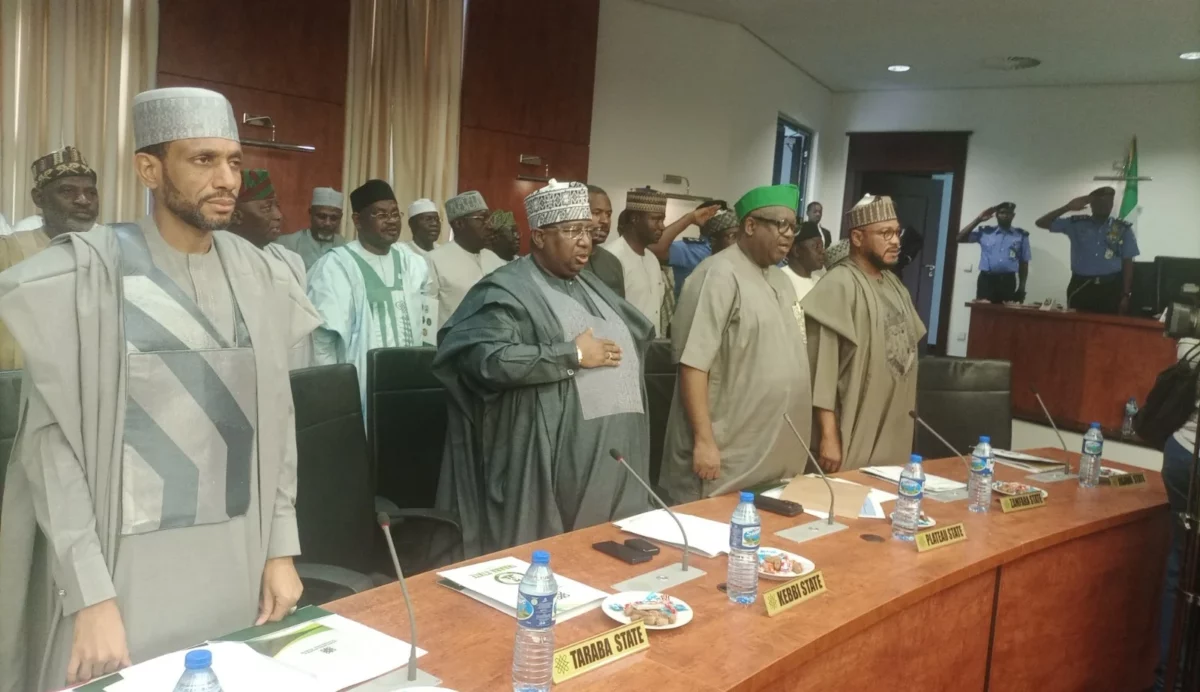
The 19 northern governors have finally done something many of us have been asking for since insecurity turned the region into a killing field. On Wednesday in Kaduna, the Northern States Governors’ Forum inaugurated the Board of Trustees of the Northern Nigeria Security Trust Fund, co-chaired by a former defence minister, Alhaji Mahmud Yayale Ahmed, and a former chief of defence staff, General Martin Luther Agwai.
On paper, this is one of the most impressive assemblies of retired security brass I have seen in a long time. Retired generals, a former Inspector General of Police, a former Secretary to the Government of the Federation, an ex Air Vice Marshall, security chiefs and commissioners drawn from all 19 states. Fine. Now let’s talk about what actually matters.
My first reaction when I read the list of names was relief that the governors did not, for once, hand this to a committee of yes-men and party loyalists. Mind you, these are people who have actually worn the uniform and know the terrain, not social media generals who only understand security from a comfortable studio in Abuja. That counts for something.
But before we break into applause, let’s ask the question northerners have been asking for over a decade. Is this fund going to be another shelf decoration, or will it actually move money and save lives?
I ask because the Sultan of Sokoto, Alhaji Sa’ad Abubakar, said something at the same event that should worry every serious-minded northerner. He revealed that the traditional rulers submitted a paper on tackling extremism to the Northern Governors’ Forum as far back as 2014. Twelve years ago. Twelve years of Boko Haram, bandits, and kidnappers turning farms into no-go zones, and the paper sat somewhere gathering dust until, in the Sultan’s own words, “today, with the inauguration of this committee, we believe we are ready to really start the job properly.”
This country does not suffer from a shortage of communiques, papers, and committees. What it suffers from is a lack of discipline to implement what has already been written down. If the 2014 paper had been acted upon with even half the urgency now being promised, how many communities in Zamfara, Katsina, and Borno would still have their sons and daughters today?
Governor Muhammadu Inuwa Yahaya of Gombe, who chairs the Forum, deserves credit for one thing he got right in his speech. He resisted the temptation to sell this as a magic bullet. He was honest enough to admit that military operations alone cannot end the crisis, and that poverty, illiteracy, unemployment and the swelling number of out-of-school children are feeding the insurgency from below while soldiers fight it from above. This is the most important sentence to come out of that Kaduna meeting, and I hope it does not get buried under the ceremony of trustee inauguration and photo opportunities.
Because here is the uncomfortable truth nobody wants to say out loud. UNICEF has long reported that the number of out-of-school children in Nigeria is in the double-digit millions, with the overwhelming majority concentrated in the north. You cannot bomb your way out of a crisis whose foundation is a generation of idle, unschooled, unemployed young men whom bandits and terrorists recruit for a plate of rice and a rifle. Governor Yahaya knows this. The question is whether the same governors who now speak the language of root-cause economics will show up at their state budget presentations and actually fund education and youth empowerment, rather than just issue communiques about them.
I have made this argument before on this page, and I will keep making it until northern governors prove me wrong. A region cannot out-recruit Boko Haram and the bandit camps with soldiers alone when its own primary schools are half empty, and its almajiri population runs into the millions. Every bandit kingpin who has ever been profiled by security agencies started as a poor, unschooled boy before he became a warlord with a Toyota Hilux and a satellite phone. Fix the pipeline, and you starve the recruitment. Ignore it, and the trust fund becomes an expensive way of treating symptoms while the disease keeps spreading.
Now to the fund itself. Names like retired Lt General Umar Farouk Yahaya from Sokoto, retired DIG Hafiz Mohammed Inuwa from Jigawa, retired Major General Bello Sarkin Yaki, a former coordinator of the Counter Terrorism Centre at the office of the National Security Adviser, from Kebbi, and former IGP Usman Alkali Baba representing Yobe, tell a story of governors reaching for men who have actually fought this war, not just watched it on television. Add former Secretary to the Government of the Federation, Boss Mustafa, from Adamawa, and you have a Board that, on paper, reads like a war cabinet rather than a talking shop. This is one area where the governors deserve applause rather than the usual suspicion northerners reserve for anything with “Trust Fund” in its name.
This is a serious attempt at competence over patronage, and it should be commended rather than dismissed with the usual northern cynicism. However, competence in the boardroom means nothing if the money does not follow. Governor Yahaya was careful to promise that the Trust Fund “must not be allowed to become an administrative structure that merely holds meetings.” That is the correct instinct. But instincts do not stop bandits.
Disbursement schedules, published accounts, and a public dashboard showing exactly what the fund has spent on and what it has spent it on would do far more to reassure a sceptical public than any inauguration speech.
There is also the matter of state police, which Governor Uba Sani of Kaduna raised again at the same event, describing it as “not only a necessity but an urgent and strategic imperative.” I have argued on this page for years that devolving policing to the states is long overdue, given the size of our country and the thinness of federal policing across it.
Governor Sani is right that the current arrangement is a poor multiplier against bandits who move freely across forests larger than some countries. But state police is not a slogan to be recycled at every security summit; it requires the state assemblies to actually pass the enabling constitutional amendments, and it requires governors, some of whom have questionable records with existing state institutions, to be trusted with an armed force of their own. That conversation deserves its own column. For now, the point is this: a security trust fund and a call for state police are two different instruments, and northern leaders must be careful not to let the newer, shinier idea, the trust fund, become an excuse to keep dragging their feet on the harder structural reform.
Let me also give credit where it belongs. President Bola Tinubu was commended by Governor Yahaya for what he described as strategic interventions across transportation, agriculture, healthcare, education and energy in the north, alongside the ongoing national conversation on state policing. Whatever one’s politics, a federal government engaging northern governors on structural reform, rather than treating insecurity purely as a policing problem, is a step worth acknowledging. God forbid this becomes another case of federal officials showing up for the cameras while the real burden falls on under-resourced state governments.
So where does this leave us? I want to believe this Trust Fund is different from the confabs and communiques of the past. The names on the Board suggest seriousness. The acknowledgement of poverty and out-of-school children as root causes suggests some honest self-reflection has finally crept into the corridors of northern power. But northerners have been burned before by fine speeches that produced nothing beyond a press release. The Sultan said it best: “We’ve been talking and talking and talking through various papers.” Twelve years between a paper and a committee are not an urgency; they are negligence dressed up as a process.
The test of this Trust Fund will not be measured in inauguration photographs or the calibre of retired generals on its letterhead. It will be measured in whether farmers can return to their lands in Zamfara without an armed escort, whether the girl-child in Kebbi State sees a functioning school rather than a burnt-out one, and whether the Sultan does not have to stand at a podium in 2038 lamenting that yet another paper from 2026 gathered dust for twelve years. Northern governors have set up the structure. Now they must fund it, staff it honestly, and resist the urge to treat its creation as the accomplishment rather than the starting point.
We’ve got the edge. Get real-time reports, breaking scoops, and exclusive angles delivered straight to your phone. Don’t settle for stale news. Join LEADERSHIP NEWS on WhatsApp for 24/7 updates →
Join Our WhatsApp Channel