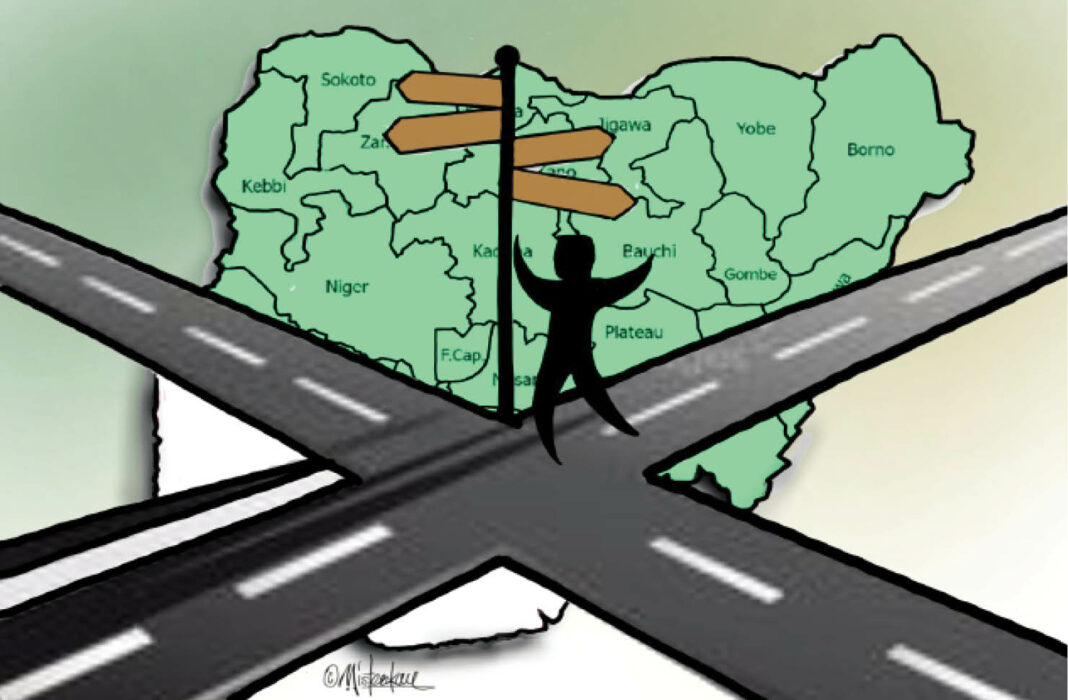
At the Arewa Consultative Forum gathering in Kaduna on 22 November, Professor Jibrin Ibrahim delivered a presentation that felt less like an academic paper and more like a historical reckoning. His analysis compelled the region to examine itself without sentiment or denial. It was an intervention filled with empirical clarity, intellectual honesty, and the unmistakable urgency of someone who recognizes that the North is approaching a decisive moment. His central point echoed the classic insight from Antonio Gramsci, who wrote that crises occur when the old is dying and the new cannot be born. Northern Nigeria now occupies that uncomfortable interregnum.
Professor Ibrahim outlined, with disciplined precision, the cumulative failures that have weakened Arewa’s political structures. He noted that insecurity has reached a level where leaders themselves are reluctant to remain in their states. Increasingly, governance is conducted from Abuja rather than from the capitals of the affected states. That relocation is not administrative convenience. It is a measure of the rising fragility of Northern political authority. It is also a symbolic withdrawal of responsibility from the very spaces leaders are meant to serve.
This reality is not an abstraction. Rural roads have become corridors of danger. Many markets have shrunk because farmers cannot safely transport produce. Parents now hesitate to send their children to school. In many districts, young men with arms have more influence than elected officials. These are the stark indicators of a political order losing its centre. When Professor Ibrahim argues that the North risks becoming ungovernable, he is not forecasting doom. He is describing an unfolding social fact.
Leadership, Agency, and the Missing Will
The professor’s analysis identified a gap that cuts across states and administrations. The North suffers not merely from bad policy but from the absence of political will. His argument recalls Chinua Achebe’s timeless assertion that the trouble with Nigeria is simply the failure of leadership. In the Northern context, that failure is amplified by demographic pressures, environmental stress, and a declining state capacity.
Leadership, in the classical sense, is the ability to anticipate crises, mobilize collective action, and make painful but necessary decisions. Yet Northern politics has gradually become a contest for privilege rather than a platform for public reform. Cash-transfer patronage replaces policy. Rhetoric substitutes for planning. Deflection becomes more common than accountability.
This absence of leadership explains the emergence of non-state actors who now mediate relationships between communities and the little that remains of the state. In parts of Kaduna, Katsina, Sokoto, and Zamfara, farmers report paying levies to armed groups who regulate everything from grazing to market access. The state does not simply appear weak. It appears optional.
A political vacuum never remains empty. Where authority retreats, coercion expands. Professor Ibrahim’s presentation therefore placed responsibility squarely on the political elite. The North is not a victim of destiny. It is a region shaped by choices. Some choices were made decades ago. Others are being made daily through neglect, inconsistency, or silence.
Youth, Education, and the Fractured Social Contract
To understand the magnitude of the crisis, Professor Ibrahim examined the social foundations of the region. The North is young, restless, digitally exposed, and structurally underprepared for the future. Millions of children remain out of school. Even those enrolled often encounter classes without teachers, laboratories without equipment, and curricula without relevance to modern labour markets.
This pattern has produced a large and expanding class of youths who feel alienated from formal institutions. Sociologists describe this segment as the precariat. They live with uncertainty, experience limited upward mobility, and face daily exclusion from economic life. When such a group becomes numerically dominant, the structure of society changes. It becomes more volatile, less predictable, and harder to govern.
This condition did not emerge overnight. It is the aggregated result of decades of underinvestment in education, weak policy implementation, and the steady erosion of public-sector competence. Professor Ibrahim observed that the region’s young people interact with global cultures through mobile phones, yet they lack the skills required to convert that exposure into opportunity. As a result, the psychological distance between aspiration and reality grows wider.
The consequences are visible in every sector. Agriculture struggles because many youths are unwilling to farm without access to technology or capital. Industry cannot absorb them because their training is inadequate. The military and police cannot recruit enough qualified young people because of basic literacy gaps. Even democracy suffers when large populations feel excluded from economic life.
This is why the professor’s insistence on rebuilding education is not rhetorical. It is structural. A region that fails to educate its youth has already surrendered its future. No amount of security spending or political messaging can compensate for the absence of human capital.
The Future Depends on Hard Choices
History provides sobering lessons. Societies that ignore structural decline often discover too late that collapse occurs gradually and then suddenly. In his presentation, Professor Ibrahim urged the North to look beyond sentiment and confront its reality with the rigor of engineers assessing a failing bridge. The warning is simple. If leaders continue to avoid making difficult decisions, the region will enter a period of long and painful decline.
Hard choices are not dramatic slogans. They are policy commitments that impose discipline. They require ending the culture of absentee governance. They require allocating resources to productive sectors, not political vanity projects. They require confronting those who undermine the state, irrespective of their identity or connections.
They require shifting from reactive security strategies to preventive governance that reinforces community resilience, expands economic opportunity, and restores trust in institutions. They require reconstructing the educational ecosystem from primary classrooms to vocational centres and tertiary institutions. Above all, they require a leadership class willing to think beyond election cycles and engage in long-term planning.
Professor Ibrahim’s analysis is therefore not merely a critique but a roadmap. It offers a composite understanding of how political, economic, demographic, and environmental factors intersect to produce instability. It also provides a framework for rebuilding order. A region that understands its crisis at this level of depth has the capacity to overcome it, provided it finds leaders with courage equal to the moment.
In one of his lectures, the historian Toynbee argued that civilizations do not die from external attack but from internal failure to respond creatively to challenges. Arewa now faces such a test. The question is whether its leaders will rise to it.
A Closing Reflection
Professor Jibrin Ibrahim’s intervention was an invitation to rethink the future of Northern Nigeria. He reminded the region that its destiny is neither predetermined nor irreversible. It is shaped by choices, by leadership, and by the willingness to confront uncomfortable truths.
The North must decide whether to preserve the illusions of the past or embrace the demands of the future. If it chooses the latter, it must act with urgency and clarity. It must learn from its history, reckon with its present, and build toward a future where stability is sustained not by force but by opportunity, justice, and competent governance.
The North can rise again, but only if it chooses to do so. The leaders should listen, reflect, and act. The future depends on it.
We’ve got the edge. Get real-time reports, breaking scoops, and exclusive angles delivered straight to your phone. Don’t settle for stale news. Join LEADERSHIP NEWS on WhatsApp for 24/7 updates →
Join Our WhatsApp Channel