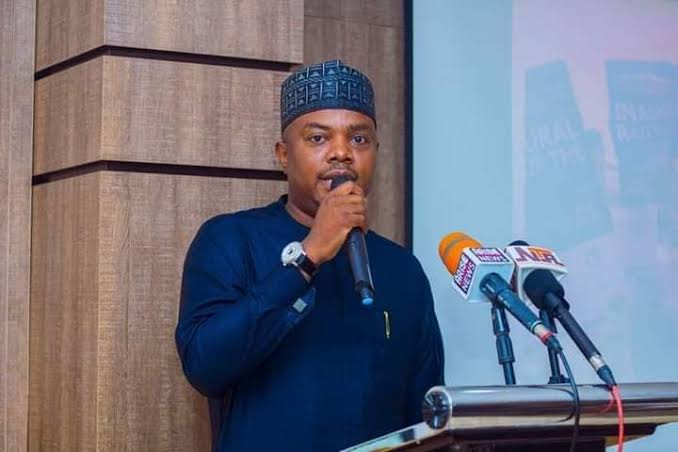
NWThe President of the Nigeria Weightlifting Federation (NWF), Dr Abdul Ibrahim, has revealed that the federation requires more than ₦100 million to take a team of five or six athletes to a single international competition.
Ibrahim made this known on the sidelines of the ongoing Nigeria Olympic Committee (NOC)/Olympic Solidarity Seminar on Good Governance for presidents of national sports federations in Abuja.
He said the high cost of international qualifiers had become a major challenge for the federation as it prepares Nigerian weightlifters for the next Olympic Games.
According to him, weightlifting requires athletes to compete in five compulsory qualifiers, making adequate funding critical to Nigeria’s qualification hopes.
“We are preparing for the first Olympic qualifier in Qatar,” Ibrahim said.
“For weightlifting, you have to go for five compulsory qualifiers, and these qualifiers are not close to each other. They range from Peru to Thailand to Uzbekistan.
“So you see that it is very costly. You need a lot of money to go for these competitions. We are preparing ourselves to see how we can achieve this objective.”
Ibrahim explained that the financial burden goes beyond transportation, as federations are required to cover accommodation, entry fees and other charges for athletes and officials.
“On average, it costs more than ₦100 million to participate in one competition, for about five or six athletes,” he said.
“For every competition you go for, you have to pay for accommodation, entry fees and other fees for athletes and officials. So it is not cheap.”
Despite the financial challenges, Ibrahim said hard work, teamwork and the quality of Nigeria’s athletes and coaches remained the foundation of the federation’s success.
“For us in weightlifting, we have just one secret, and the secret is hard work. We believe in hard work and we work collectively as a team,” he said.
“We have excellent athletes and amazing coaches. Because of the experience they have acquired over time, they have been able to translate it to the athletes. When we go for competitions, it is always success and medals.”
Ibrahim, however, acknowledged that the sport had yet to achieve the desired spread across the country, particularly in the northern states.
He attributed some of the difficulties faced by athletes in the region to insecurity, which he said had affected regular training programmes.
“It is almost impossible for athletes to go for their usual training because of the current insecurity in the North,” he said.
“However, in the years to come, you will see the work that the northern states are doing and you will see athletes winning medals in their respective competitions.”
On funding, Ibrahim said the federation had continued to operate within its available resources while working with the sports authorities and seeking sponsorship opportunities.
“Everything is about funding. We work within what we have. We work within our limits and try to make sacrifices. We also work with the Sports Commission and, by doing so, we get sponsorship for the events that we attend,” he said.
He appealed for greater corporate support, but acknowledged the difficulties involved in securing long-term sponsorship amid wider economic challenges.
“It is not as easy as it seems. Even football and athletics do not have all the sponsorship they require. The world is going through an economic challenge and corporate bodies are also going through this,” Ibrahim said.
He nevertheless expressed confidence in the value Nigeria’s weightlifting programme offers potential sponsors, pointing to the world rankings of some of the country’s athletes.
“Our athletes are our core values. When you have athletes who are ranked number two in the world, as we speak today, if you go to the Olympics, we are sure of a silver medal,” he said.
“We have athletes ranked number two, number three and so forth. With a little bit of hard work, we can get athletes who could be ranked number one.”
Ibrahim said the federation was determined to build on Nigeria’s recent successes and ensure the country remains competitive on the international stage, but stressed that sustained funding would be crucial to achieving its Olympic qualification objectives.
Available next action: Create a downloadable PDF file here in this chat containing the finalized decisions and immediate actions above
We’ve got the edge. Get real-time reports, breaking scoops, and exclusive angles delivered straight to your phone. Don’t settle for stale news. Join LEADERSHIP NEWS on WhatsApp for 24/7 updates →
Join Our WhatsApp Channel