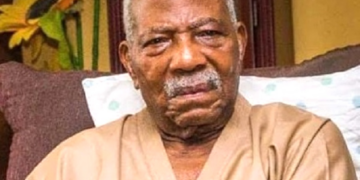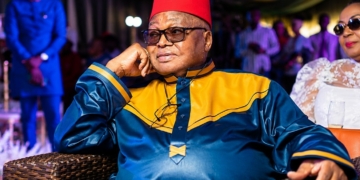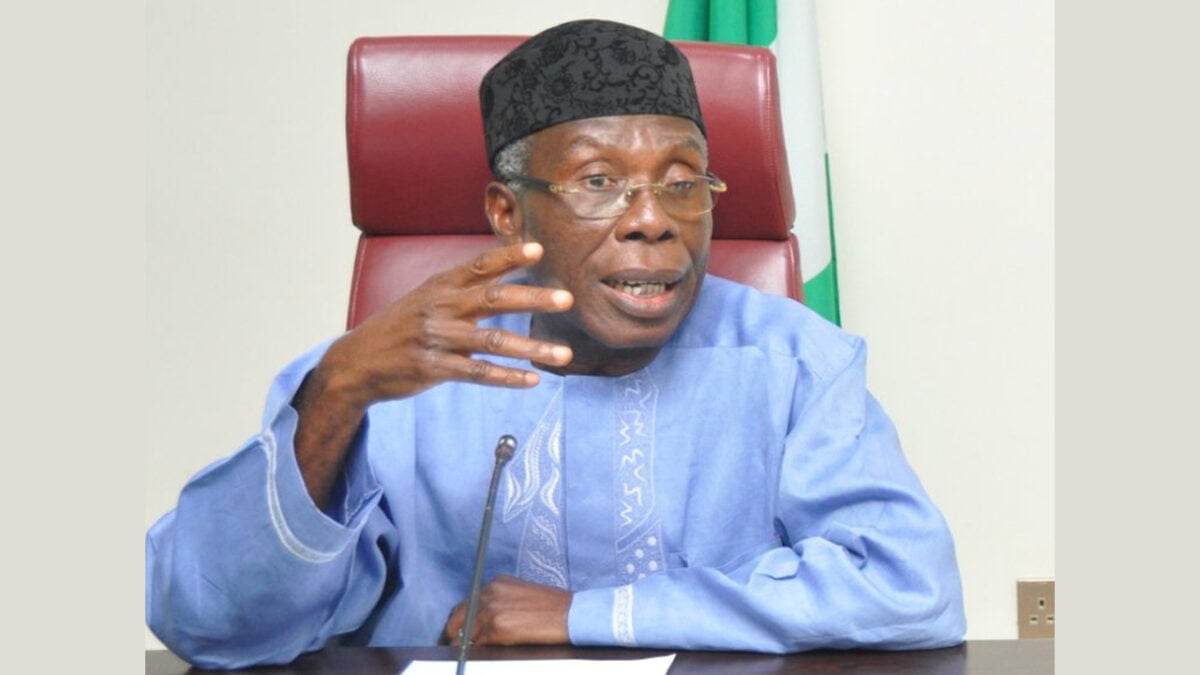
Audu Ogbeh’s death on August 9, 2025, closed the chapter on one of Nigeria’s more unusual public figures. This man moved between politics, literature, and farming with the stubborn conviction that each mattered, and that none excused failure in the other. He was 78.
Born in Benue on July 28, 1947, Ogbeh grew up in a household where education wasn’t optional. He passed through St Francis Primary School, St Michael Secondary School, and then King’s College, Lagos, where he graduated in 1968. He studied French at Ahmadu Bello University, and then at the University of Toulouse in France, eventually lecturing at the Institute of Education, Ahmadu Bello University.
But politics caught him young. In the late 1970s, as Nigeria wobbled into the Second Republic, Ogbeh was already serving as deputy speaker of the Benue State House of Assembly.
By 1982, at age 34, he was summoned to Lagos as minister of communications under President Shehu Shagari. John Odigie-Oyegun, who became the national chairman decades later, was his permanent secretary. Ogbeh was later shifted to the Ministry of Steel and Industry until the military coup of December 31, 1983, toppled the civilian administration.
That coup also took him to Kirikiri prison. He was locked up with governors, ministers, and businessmen, many of whom faded from relevance after release. Ogbeh, however, chose a different path.
After leaving prison, he returned to Benue and returned to farming. It was in farming that he found both identity and credibility.
In 2001, Ogbeh was appointed chairman of the Peoples Democratic Party, then the dominant force in Nigerian politics. He held the office through turbulent years until 2005, when his bluntness clashed with President Obasanjo. The end came abruptly and bitterly.
He had written a letter warning the president about the country’s direction, particularly the crisis in Anambra State. Obasanjo didn’t take kindly to that candor, and Ogbeh was shown the door.
That episode cemented his reputation as a politician who would not bite his tongue for survival. He eventually left the PDP, drifting through smaller parties before finding his way into the coalition that became the All Progressives Congress (APC).
In 2015, President Muhammadu Buhari appointed Ogbeh Minister of Agriculture and Rural Development. It was a fitting match: Buhari campaigned on self-sufficiency, and Ogbeh had lived that gospel. During his four years, he pushed programmes to expand local food production, curb import dependence, and support smallholder farmers.
But he also made enemies. By his own account, when Buhari was re-elected in 2019, he was dropped because “I knew too much. They didn’t want to stop the importation of rice.” It was a cynical admission, but few who followed Nigeria’s rice wars doubted it.
Parallel to his politics and farming was his literary work. Ogbeh wrote five plays, thereof which were e published, among them Epitaph of Simon Kisulu, which was staged at Muson Center in 2002. His writing wasn’t escapist; it often reflected the tensions of society and the contradictions of leadership. In that sense, he was part of a vanishing generation of Nigerian politicians who read, wrote, and quoted literature as part of their politics.
Since his passing, tributes have poured in. President Bola Tinubu described him as “a patriot whose wisdom, dedication, and pursuit of progress left an indelible mark on Nigeria’s political landscape,” noting his habit of arriving at meetings armed with facts and figures.
Secretary to the Government of the Federation and fellow Benue son, George Akume called the death “a national loss and a personal one.” Their relationship spanned decades, bound by geography and service.
The Arewa Consultative Forum, which he chaired between 2020 and 2023, remembered him as “a nationalist and a committed son of Arewa.” At his death, he was deputy chairman of the committee planning ACF’s 25th anniversary.
The Northern Elders Forum praised him as “a principled democrat, a patriotic nationalist, and a tireless advocate for peace and cohesion,” noting that in their councils, “he was a voice of reason and conscience.”
What is left of Ogbeh? Not the trappings of high office — he never built a personal empire from politics. Not mass adoration either — he wasn’t the sort of politician who courted crowds. His legacy is quieter, but perhaps more durable.
He represented a stubborn insistence that Nigeria could feed itself, that policy without integrity collapses, and that leadership requires honesty even when it costs you position. He embodied the tension between politics and principle, sometimes choosing wrong battles, but rarely for selfish reasons.
Ogbeh’s life reminds us of something politicians prefer to forget: Nigeria’s most significant problems are not technical puzzles but questions of will. He answered that question in his own way, through fields of rice in Benue, party struggles in Abuja, and plays staged in Lagos.
And now that he is gone, what lingers is not the titles he held but the example he gave — flawed, human, but rooted in conviction. Nigeria will miss Audu Ogbeh.
We’ve got the edge. Get real-time reports, breaking scoops, and exclusive angles delivered straight to your phone. Don’t settle for stale news. Join LEADERSHIP NEWS on WhatsApp for 24/7 updates →
Join Our WhatsApp Channel