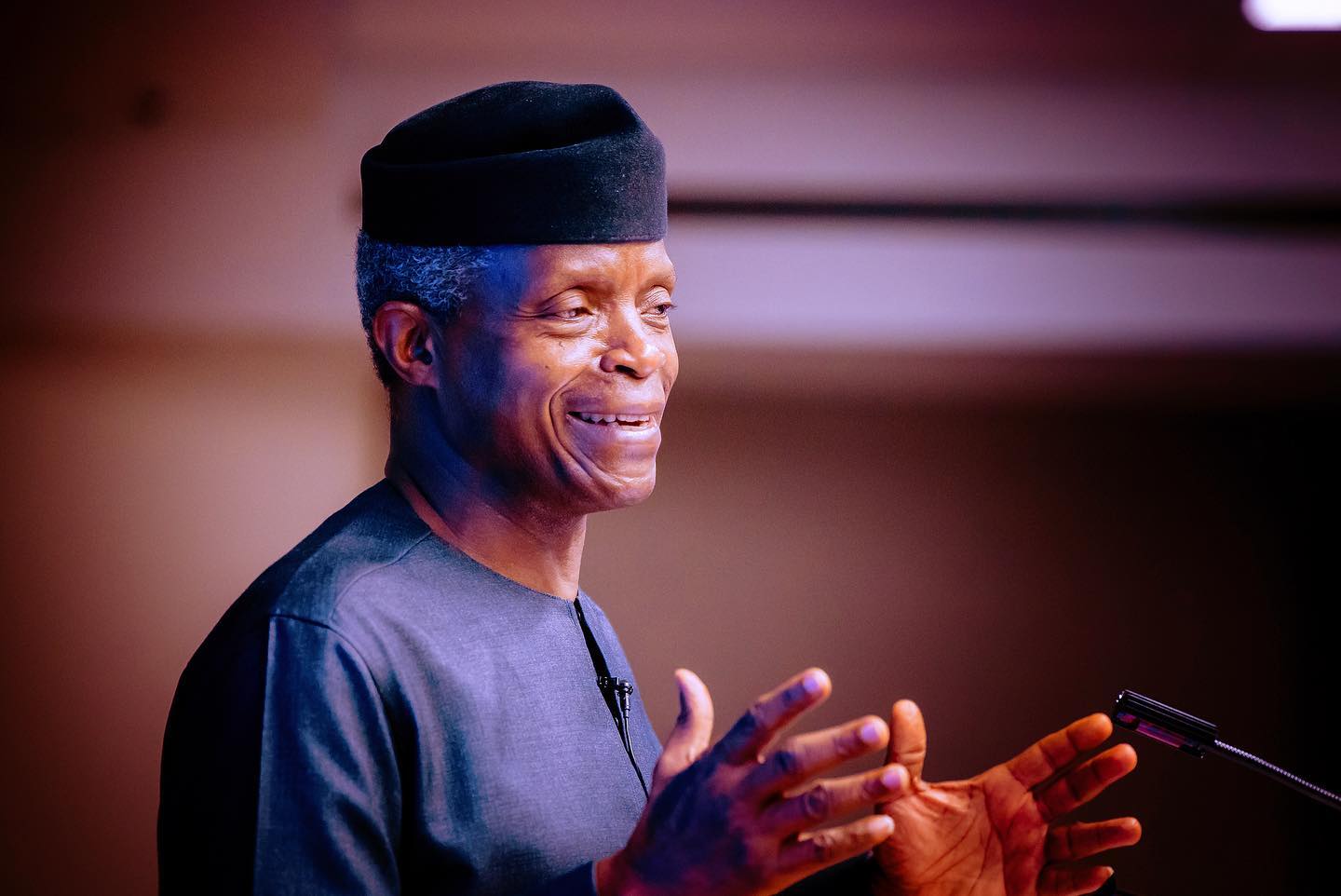
Former Vice President Yemi Osinbajo has said since the inception of insurgency and insecurity in 2009, too many Nigerians have been forced to flee their homes, families and communities.
Osinbajo said the inability of many young children in Internally Displaced Persons (IDPs) camps to access schools means that these problems maybe carried over to future generations.
Osinbajo said efforts by the government to provide some comfort by way of camps and facilities for IDPs have been inadequate, as the facilities struggle with the growing population, including children and disabled persons who have special needs.
In his speech at the 10th House of Justice Summit and Orange Ball Banquet held in Kaduna,
Osibanjo who was represented by his Chief of Staff, Ade Ipaye, said, “Many are forced to leave behind properties acquired over a lifetime and enter into a new life of abject poverty and destitution. This traumatic episode is very frequently accompanied by family break-ups, with loved ones lost or separated, rarely to be seen again.”
He noted, “The humanitarian crisis caused by the Boko Haram insurgency, communal clashes and natural disasters has continued unabated, leading to a significant increase in the number of internally displaced persons (IDPs) in Nigeria. The demography is especially disturbing. According to the Internal Displacement Monitoring Centre (IDMC), there are over 3.4 million IDPs in Nigeria as at the end of 2024 (records of the Nigerian Bureau of Statistics shows just about half that number), with the majority being women and children. Malnutrition and related health problems are rampant.”
Osinbajo stressed, “This is a big challenge, deserving of very urgent attention and practical, effective solutions. It requires a concerted effort from the government, humanitarian organizations, and the international community. There is no doubt that we need a comprehensive approach, including emergency assistance, rehabilitation, and reintegration, as well as finding other durable solutions.
“I believe that by working together, we can find solutions to the growing problems of IDPs in Nigeria and ensure that they receive the support and protection they need,” the former vice president said.
On her part, the convener of House of Justice summit, Gloria Mabeiam Ballason explained that since 2009, Nigeria has experienced blistering asymmetrical insecurity.
Ballason, a legal practitioner said the violence has displaced millions of people internally and forced hundreds of thousands more to flee to neighbouring countries like Cameroon, Chad, and Niger.
She stated that in states like Plateau, Benue,Kaduna, Zamfara, Niger and of recent Kwara, hundreds of communities have been displaced, “and replaced by insurgents some of whom have gained the audacity to rename those communities”
“Unfortunately, the recent escalation of hostilities does not empirically support the claim that the type of non-kinetic intervention employed by Nigeria’s government is the way to go.”
Ballason added, “The more complex challenge is that while the government could design a ‘non-kinetic’ intervention for insurgents and criminals, there has been no coherent commitment and intervention for justice and reparation for victims and victim communities. The trial rates for terrorists are abysmally low. Destroyed communities remain in ruins,” she said.
We’ve got the edge. Get real-time reports, breaking scoops, and exclusive angles delivered straight to your phone. Don’t settle for stale news. Join LEADERSHIP NEWS on WhatsApp for 24/7 updates →
Join Our WhatsApp Channel