
In the rapidly evolving landscape of African technology, a new cohort of innovators is moving beyond simple software solutions to address deep-seated systemic challenges. Among them is Pamela Manasseh, a data engineer and entrepreneur whose career has been defined by a consistent focus on using structured data to solve real-world problems in agriculture, healthcare, and governance.
From the classrooms of the University of Sunderland to the rural farming communities of Northern Nigeria, Manasseh’s trajectory reflects a growing trend: the return of highly skilled talent to apply global technical standards to local contexts.
A Career Built on Data Integrity
Manasseh’s technical foundation was established in the United Kingdom, where she earned a degree in Computer Systems Engineering and a Master’s in Information Technology Management. Upon returning to Nigeria, she entered the public sector, serving as a Data Engineer at the Abuja Geographic Information Systems (AGIS). Her work there on data cleansing projects was part of a broader effort to modernize public records through more transparent governance.
Her transition to the private sector saw her take on the role of Digital Governance Lead at Fidelity Bank Plc. There, she spearheaded a new framework designed to streamline data reporting and reduce compliance risks. The initiative, which reportedly cut risks by 30 percent, earned her the bank’s Digital Governance Excellence Medal in 2019.
Agrimarrt Hub: Solving the Last-Mile Challenge
In 2021, Manasseh turned her attention to one of Nigeria’s most persistent economic hurdles: agricultural inefficiency. Amidst rising insecurity that hindered traditional trade, she founded Agrimarrt Hub, an AI-enabled marketplace designed to connect smallholder farmers directly to wider markets.
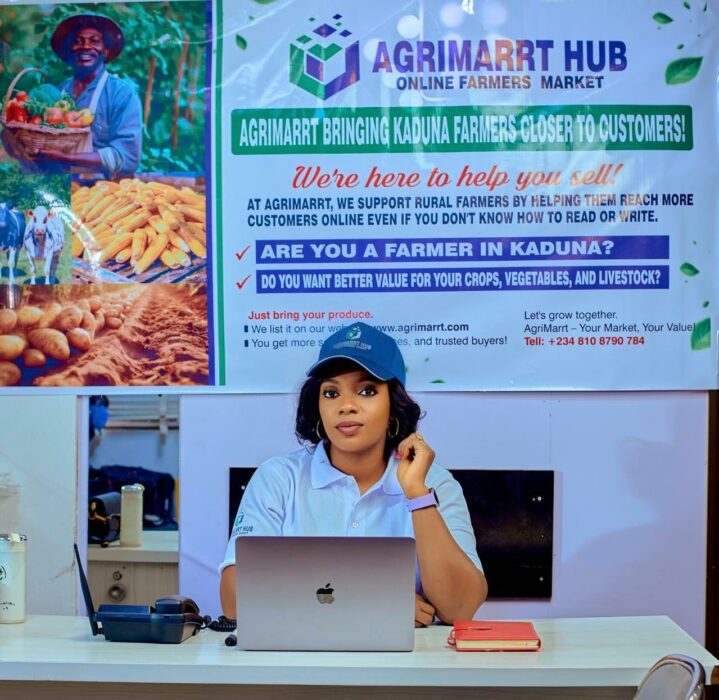
The platform’s hybrid model is its most notable feature, combining a digital interface with on-ground support for farmers with limited digital literacy. By providing price forecasting and risk scoring, the system aims to give farmers better bargaining power.
“I developed Agrimarrt Hub to address a pressing problem,” Manasseh says. “The key was creating a system that reduced exposure to exploitation and helped farmers reach wider markets safely.”
The platform’s impact has been measurable. Supporting over 1,000 households, it recorded an annual turnover exceeding 560 million naira in 2022. For the farmers involved, this has translated into a reported 15 to 20 percent increase in profitability and a significant reduction in post-harvest waste.
NUROVA and CareProof: Technology That Protects People
Manasseh’s work has also extended into the healthcare and social care sectors, where she is applying predictive analytics to safeguard vulnerable populations. She is currently developing NUROVA, a mobile application that uses on-device neural networks to support neurodivergent individuals, particularly children with autism.
The impact of such technology is significant; research indicates that over 90% of children with autism experience sensory processing issues, which can lead to severe distress and behavioural challenges. By anticipating sensory triggers through smartphone sensors and wearables, NUROVA aims to provide a proactive management tool that could reduce the frequency of sensory-related meltdowns by providing early warnings to caregivers and users.
Alongside NUROVA, she is building CareProof, a verification tool for service users in the social care sector. Now being developed in the United Kingdom, CareProof addresses a critical safety gap. With the UK health and social care sector recording nearly 80,000 workplace accidents and safety incidents annually, the app enables service users to verify care workers before they render any service, adding a layer of security to a sector that contributes over £77 billion to the UK economy.
Her healthcare credentials were established earlier as Data Quality Lead for the A360 Project, funded by the Bill & Melinda Gates Foundation, where her analytics work helped secure a 15 percent increase in funding from international donors.
The Human Element: Mentorship and Training
Beyond her technical projects, Manasseh has maintained a steady focus on skills development. Through initiatives like MadaTech Girls in Nasarawa State, she has trained more than 200 young women in basic AI and data concepts.
Her mentorship has also reached academic institutions, including Kaduna State University and her alma mater, the University of Sunderland. Several of her mentees have since secured roles at international firms such as PwC and Diageo UK.
“I build products, and I build people,” she notes, reflecting on the dual nature of her work.
A Two-Continent Perspective
Today, Manasseh’s work is increasingly split between Nigeria and the United Kingdom. In the UK, she is actively developing CareProof and NUROVA, while continuing to oversee her established projects back home. It is a cross-border approach that allows her to apply insights from one market to the challenges of another.
Whether her next major project emerges in Lagos or London, the pattern of her career remains consistent: a focus on building functional, data-driven tools for the communities that need them most.
We’ve got the edge. Get real-time reports, breaking scoops, and exclusive angles delivered straight to your phone. Don’t settle for stale news. Join LEADERSHIP NEWS on WhatsApp for 24/7 updates →
Join Our WhatsApp Channel