From the streets of Lagos to the Venice Biennale, Nigeria’s most fearless interdisciplinary artist is reshaping how the world sees African women and African art.
Born in 1975, Alatise trained as an architect at Ladoke Akintola University of Technology, graduating in 1998 just as Nigeria was emerging from military rule.
Architecture sharpened her understanding of structure and space, but it couldn’t quite hold everything she wanted to say.
She found herself drawn instead to the fluidity of art, spending time at the Jakande craft market in Lagos, experimenting across painting, sculpture, and jewellery-making.
Somewhere in that process, it became clear that art offered a different kind of construction, one that allowed for emotion, memory, and contradiction.
“Art as political expression is very important. For me, it is like the sounds of a revolution, but it is just me reacting to what’s around me.”
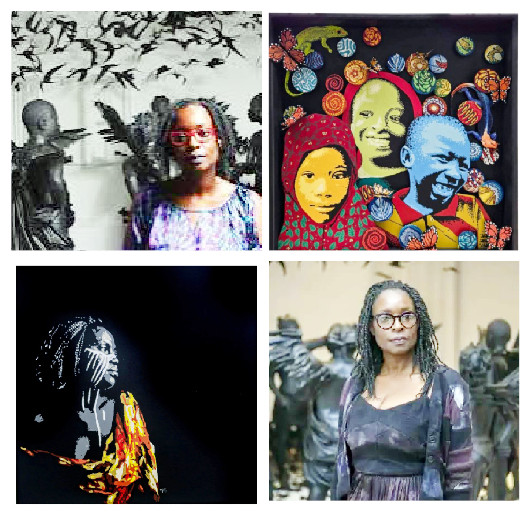
That instinct to respond, rather than observe, runs through her work. Her practice moves across sculpture, painting, installation, film, and writing, grounded in Yoruba cosmology, feminist urgency, and the social realities of contemporary Nigeria.
It’s layered, sometimes unsettling, often labour-intensive, and always deliberate.
Her most recognised installation, Flying Girls (2016), captures this balance with quiet force.
Eight life-sized girls with wings hover above the gallery floor, drawn from the imagined inner world of a ten-year-old domestic worker in Lagos. What begins as something visually delicate slowly reveals itself as something heavier, a meditation on labour, girlhood, and the fragile idea of freedom.
When it was shown at the 57th Venice Biennale in 2017, as part of Nigeria’s first official pavilion, it marked not just a personal milestone but a shift in how Nigerian narratives could occupy global space.
This approach defines much of her work. Pieces like Nine-Year-Old Bride (2013), created during Nigeria’s child marriage debate, or Nation Interrupted (2014), with its trapped, life-sized figures navigating a maze of barriers, refuse to look away from difficult truths.
“Missing” (2014), her response to the Chibok abductions by Boko Haram, carries that same weight, not as spectacle, but as insistence on memory.
“I am a storyteller. In Nigeria, storytelling is part of everyday life. My grandmothers told stories, all of them, all the time.”
That sense of storytelling sits at the heart of everything she does. Not just telling stories for their own sake, but using them as a way to hold history, to question power, to imagine something beyond what currently exists.
Her impact, though, extends beyond her own work. In 2017, she founded the ANAI Foundation (Alter Native Artists Initiative), a non-profit dedicated to developing visual arts in Nigeria.
Through sponsored training programmes and the creation of a purpose-built ceramic residency studio, the foundation offers both structure and space for emerging artists to grow. It’s a different kind of labour, quieter, but just as necessary.
She has also lent her voice to the Child Not Bride campaign in Nigeria, using both her platform and her art to raise public awareness of girls’ rights. Exhibitions and recognitions across New York, Florence, Morocco, Pittsburgh, and London’s Frieze Sculpture Park have only reinforced what her work has long suggested: that African art does not need to be reframed to belong globally. It already does.
Now dividing her time between Lagos and Glasgow, a shift that came during the Covid pandemic, Alatise continues to work with what she describes as a restless, labour-intensive practice.
She insists on local materials, on scale, on truth. And perhaps most strikingly, she insists that many of the artists redefining how the world sees Africa are women, not by coincidence, but as part of a long-overdue reckoning.
Peju Alatise remains a fellow of the Smithsonian Institution’s National Museum of African Art, with her work represented internationally.
At the same time, the ANAI Foundation continues its work from Lagos, steady, intentional, and quietly shaping what comes next.
We’ve got the edge. Get real-time reports, breaking scoops, and exclusive angles delivered straight to your phone. Don’t settle for stale news. Join LEADERSHIP NEWS on WhatsApp for 24/7 updates →
Join Our WhatsApp Channel