It is often said that there is ability in disability, but sad experiences seem to overshadow the potential of persons living with disabilities. PATRICK OFIKWU, NNAMDI MBAWIKE, KAMAL IBRAHIM, GODWIN ENNA, ACHOR ABIMAJE, ATTAH ANTHONY, OKEM MBAH, RICHARD NDOMA, ABDULLAHI OLESIN, IBRAHIM OBANSA, FRANCIS OKOYE, AZA MSUE and NONYE EKWENUGO, report.
Persons living with disabilities (PLWDs) have several stories that are difficult for them to tell. From inability to access high-rise buildings to rejection and stigmatisation, and difficulties for some to thumb-print during elections, their stories are similar.
In Bauchi State, they have raised concerns about the difficulties they face in accessing high-rise public buildings, including government offices, banks, hospitals, and educational institutions, due to the absence of disability-friendly infrastructure.
Many of the buildings, notably the Abubakar Umar State Secretariat, the Multipurpose Indoor Sports Hall, and lecture theatres at Abubakar Tafawa Balewa University (ATBU) and Federal Polytechnic Bauchi, lack ramps, elevators, and handrails, forcing persons with physical impairments to rely on assistance or avoid such facilities entirely.
The situation, they said, limits their access to essential services and undermines their independence.
Muhammad Ibrahim, a physically challenged resident of Bauchi who uses a wheelchair, said visiting government offices at the Abubakar Umar Secretariat has become a frustrating experience because most buildings are not designed with persons with disabilities in mind.
“Whenever I have official matters at the secretariat or in a bank located upstairs, I must depend on people to carry me. Sometimes I go back home because the process is humiliating,” he said.
Similarly, Aisha Yakubu, who has a mobility impairment, explained that hospitals and schools also pose serious challenges due to the lack of alternative access points to staircases.
“There are days I miss medical appointments because I cannot climb the stairs to the consulting rooms. It is even worse for students with disabilities who attend classes on upper floors,” she said.
Another physically challenged person, Bala Sadiq, called on the Bauchi State Government and private organisations to prioritise inclusive infrastructure when constructing public buildings. He urged authorities to enforce building regulations requiring ramps, elevators, and accessible facilities, so that persons with disabilities can move freely and access services without discrimination.
A woman who is visually impaired in the Karu local government area of Nasarawa State, Juliet Ochoche, said visual impairment is not what she would wish for her worst enemy. According to her, she had cataracts, which made her undergo a major surgery, thereby losing her visual acuity.
She lamented that her condition has led to her being stigmatised in public places. She narrated that she often waited endlessly for a vehicle from Mararaba to the Abuja city centre, where she works. Ms Ochoche said one Friday afternoon, close to the time of Juma’at prayers, she waited alongside other would-be passengers for over an hour before she could get a vehicle.
“That day, there were many people waiting for vehicles, but few vehicles were available. Even people without disabilities were having difficulty getting cars and buses. As vehicles stopped, before I could attempt to enter, they would zoom off. Eventually, a man tried to help me board a coaster, but when the conductor saw that I’m challenged, he told the driver to move,” she lamented.
In Katsina State, persons living with disabilities have called for the deployment of special assistants at polling units to support them during elections and ensure they can exercise their voting rights without difficulty.
One of the advocates, Sani Khalid, a physically challenged resident of Jibia Local Government Area, made the appeal while speaking with our correspondent in the state.
Khalid explained that people with special needs often face serious challenges during elections, particularly when large crowds gather at polling units.
According to him, the absence of designated officials to assist them has led to situations in which they are pushed aside, ignored, or even fall while trying to access the voting area.
He lamented that such experiences sometimes discourage many persons with disabilities from participating in the electoral process.
He noted that the same challenges occur in many public gatherings where persons with disabilities are forced to stand aside and simply watch events unfold.
Khalid also raised concerns about visually impaired voters who, in some cases, rely on party agents for assistance.
He said this often compromises the secrecy of the ballot, as some agents allegedly influence them to vote for specific parties against their wishes.
He therefore urged electoral authorities to deploy neutral assistants at every polling unit to guide and support voters with special needs.
According to him, assigning such agents would help guarantee the independence of their votes and promote inclusive participation in the democratic process.
Khalid emphasised that ensuring accessible voting conditions would strengthen democracy by allowing all citizens, including those with disabilities, to participate fully in elections.
For people living with disabilities in Bayelsa State, though elections represent an opportunity to participate in shaping the country’s leadership, even getting to the polling unit or accessing public buildings remains a daily struggle.
Members of the Joint National Association of Persons With Disabilities (JONAPWD) said barriers ranging from inaccessible polling units to poor infrastructure continue to limit their participation in public life.
Lack of accessible voting cubicles
The chairman of JONAPWD in Bayelsa State, Ekpomokumor Mayor, said that although the Independent National Electoral Commission (INEC) has made efforts to promote inclusion, many persons with disabilities still find it difficult to vote during elections.
According to him, one of the biggest challenges is the lack of accessible voting cubicles for wheelchair users and the failure to provide the assistive materials promised during voter education campaigns.
He added that while INEC often promises the availability of tools such as Braille ballot guides for the blind and interpreters for the deaf but the facilities are rarely available at polling units, particularly in rural communities.
Mayor said that in areas where electoral violence is common, many PWDs fear for their safety because escaping from violent situations is often harder for them than for able-bodied voters.
Despite these challenges, he acknowledged that INEC has been engaging disability groups through sensitisation programmes and discussions aimed at improving inclusion.
Beyond elections, however, the everyday experience of persons with disabilities in Bayelsa reveals deeper structural barriers.
Mayor said accessing public buildings such as banks, government offices and schools remains extremely difficult due to the absence of ramps, elevators and other disability-friendly infrastructure.
According to him, the problem persists largely because Bayelsa State has yet to domesticate the national disability law.
The Discrimination Against Persons with Disabilities (Prohibition) Act 2018, signed into law at the federal level during the administration of Muhammadu Buhari, establishes accessibility standards and provides a five-year grace period for enforcement.
Unfortunately, the law has not yet been fully implemented in the state.
Mayor disclosed that a similar bill sent to the Bayelsa State House of Assembly by Governor Douye Diri has gone through several legislative stages but has yet to be passed. “The bill has passed first reading, second reading, third reading and even public hearing, but nothing has happened since then,” he said.
The absence of enforceable policies has made daily activities difficult for many persons with disabilities, including those working in government offices.
He narrated that even within the Ministry of Women’s Affairs, the ministry responsible for disability-related matters, wheelchair users cannot access offices located upstairs.
“As I am talking to you, I am working in the ministry. But where the permanent secretary and the commissioner are, we cannot access it because it is upstairs,” he said.
He explained that when they need to submit official documents, they often have to call someone to come downstairs to collect the letter on their behalf. “If we want to submit a letter, we call somebody to come down, take the letter from us, go upstairs, acknowledge it and bring it back. It is very unfortunate,” he lamented.
‘Government to prioritise disability issues’
Mayor said wheelchair users often spend long periods waiting along the road because taxis and commercial tricycle operators are reluctant to pick them up. “For us to even access keke, we will stay on the road for over one hour before someone will carry us,” he said.
He urged the government to prioritise disability issues and ensure that all public buildings are accessible to persons with disabilities.
While acknowledging that the state government has provided some opportunities, such as employment and appointments, he said more attention is needed to address the systemic barriers affecting PWDs.
Advocacy groups are also increasing pressure on lawmakers to pass the pending disability bill.
The chairman of the Bayelsa State Gender Response Initiative Team (GRIT) and founder of the DO Foundation, Dise Ogbise Goddy-Harry, said civil society organisations are supporting efforts by disability groups to push for the passage of the bill.
She disclosed that members of JONAPWD plan to visit the state assembly to follow up on the legislation.
Goddy-Harry added that the issue would also be highlighted during events marking International Women’s Day, with a special focus on women living with disabilities.
For Rachel Gomihari Aggre, women living with disabilities are often left out of government programmes in the state, adding that they are rarely invited or considered except when activities involve their association directly.
She called on future administrations in the state to design special empowerment programmes that will recognise and support women with disabilities.
Aggre also lamented that many women with disabilities are abandoned after being impregnated, leaving them to struggle alone to care for their children.
She urged the government to enforce laws that would hold men responsible for such actions and called on gender-based violence advocates to extend awareness and support to physically challenged women who often have no one to speak for them.
Similarly, Mrs Hellen Tuokumo, a blind elderly woman, appealed to both the current and next administration to provide employment opportunities and welfare support for elderly persons living with disabilities, particularly those without formal education.
In Kaduna State, many persons with disabilities said, participating in civic activities such as voting during elections remains a daunting experience, largely due to physical barriers and limited accessibility at many polling units.
Speaking with our correspondent, the national chairman of the National Association of Persons With Physical Disabilities (NAPWPD), Rilwan Mohammed Abdullahi, said accessibility continues to pose a major challenge for many voters with disabilities, adding that several polling units are located in public schools and open spaces that were not originally designed to accommodate persons with disabilities.
He explained that the absence of disability-friendly infrastructure, such as ramps, smooth pathways and accessible entrances, often makes it difficult for persons with mobility challenges to reach voting areas without assistance, thereby limiting their ability to participate in the electoral process independently.
Also, the representative of students with disabilities at the Kaduna State University, Aaron Samaila Ayuba, said the challenges confronting PLWDs extend beyond elections to include everyday access to public facilities such as banks, schools and government offices.
He noted that many buildings across the state are still constructed without ramps, elevators and other accessibility features, forcing persons with disabilities to rely on assistance before gaining entry, a situation he said continues to undermine their independence and full participation in electoral processes.
Another person with disability, Tor Saater, a resident of Romi, Kaduna, while speaking with LEADERSHIP Sunday, accused the government and politicians of neglecting physically challenged citizens in the country, advising the government and others to stop using them only during elections.
“We people living with disabilities are not many, but the government has abandoned us for years. We are only known and remembered when government or politicians want to use us for voting, but when they are giving out goodies, nobody will remember us. We are all citizens of this country, and the government must look into our plight too,” he said.
In Kwara State, reports have shown that people living with disabilities (PLWDs) have little or no accessibility to public facilities in the state.
LEADERSHIP Sunday observed that most of the old public high-rise buildings, including banking halls in Ilorin, the state capital, were constructed without consideration for PLWDs.
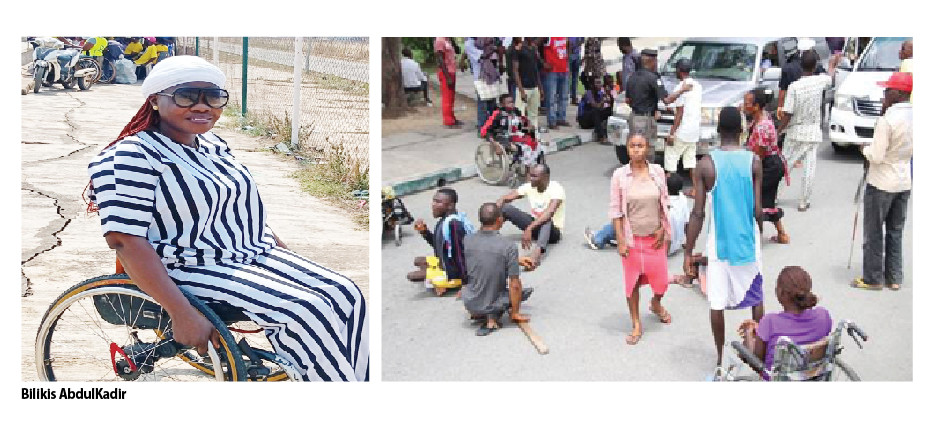
A PLWD table tennis star, Bilikis AbdulKadir (aka Romeo), revealed that she couldn’t attend a meeting she was invited to by an NGO because she couldn’t navigate the staircase alone.
“I had to stay downstairs while the meeting was going on upstairs; I only marked attendance after I was briefed about the discussion, which made me feel very bad that day.
“There was a time when I was also at a public function to represent the PWD community. I had to beg people to carry me upstairs, and in the process of being carried, I almost got injured, which reminded me of my disability,” she said.
Another PWD, Lamidi Ajao, narrated how he was forced to leave a public function because he was pressed to use the toilet, but all the toilets in the venue of the event could not allow him in with his wheelchair.
“I checked all the toilets in the event centre, they were all too small to accommodate wheelchairs to go in and come out easily; so I had to leave the event abruptly at a time I was not supposed to leave,” he said.
LEADERSHIP Sunday, however, observed that the new structures constructed by the state government over the last six years are equipped with facilities that aid movement and ensure the comfort of PWDs.
The chairman of the Joint National Association of Persons With Disabilities (JONAPWD) in Kwara State, Mr Adebayo Gbadamosi, acknowledged that their predicament was improving, adding, however, that there is still a long way to go.
He said that new projects embarked upon by the state government “were considerate of PWDs, but the old buildings and offices remained inaccessible.”
In Plateau State, the PLWDs also bemoaned neglect by government and private individuals. The chairman of the Joint National Association of Persons with Disabilities in the state, Mr Shindol Aaron, lamented that the Independent National Electoral Commission (INEC) has yet to address the challenges of Persons with Disabilities (PWDs) during elections.
According to him, the last time they engaged INEC on their plights during elections, they made commitments to address some of their challenges. He said about a month ago, they were called for a stakeholders’ engagement, during which they further reiterated their commitment.
“But the truth of the matter is that during the 2023 general elections, I went round and also discovered that our challenges have not been addressed. Accessibility and choice of location for voting are not really friendly to many persons with disabilities.
“INEC has promised to provide a magnifier for persons with low vision, but we have not seen any yet. They have not been able to make provision for all the things that make voting easier for us.
“Though I know it is not something we can get easily at once, like for the hearing-impaired, INEC needs to station an interpreter around, which is not there simply because of how sparsely distributed we are,” he said.
Speaking on the location of public buildings, Aaron said it is sometimes very difficult for his members, particularly those in wheelchairs, as they can hardly access cubicles at polling units, banking halls, lecture theatres, and other public buildings.
“My own polling unit is in a primary school, and the cubicle is on the veranda. For everybody coming to vote in a wheelchair, he or she cannot access it unless he or she is taken up there,” he added.
He appealed to INEC to try all they could to ensure that the choice of where voting is done is given consideration for the sake of persons with disabilities.
The chairman argued that cubicles should be placed where everybody can access it.
In Taraba State, the Joint National Association of Persons with Disabilities (JONAPWD) has decried the challenges its members face during elections, calling on INEC to implement more inclusive measures that enable persons with disabilities to participate in the electoral process without hardship.
The association said, special consideration should be given to persons with disabilities to prevent them from being subjected to undue stress at polling units during elections.
The state chairman of the association, Mr Ali Mstudi Tenrika, who spoke with LEADERSHIP Sunday on the plight of its members, commended Governor Agbu Kefas for appointing 12 persons with disabilities as aides and for engaging others in the state civil service.
He, however, noted that despite provisions in the electoral law that prioritise persons with disabilities during voting, the practice is hardly observed at the polling units.
“Considering our condition, persons with disabilities should be allowed to vote first, even before pregnant women and the elderly. Unfortunately, this provision is hardly observed at polling units. While the law supports it, the practice is often different from what the law says,” he stated.
Tenrika urged INEC and political actors to intensify efforts to ensure full implementation of the Electoral Act’s provisions on persons with disabilities.
“With the new Electoral Act, politicians and INEC should ensure strict compliance with these provisions. If our members are given the opportunity and the law is respected, persons with disabilities will come out en masse to vote,” he added.
Why persons with disabilities are often unable to cast their votes
He also lamented that many persons with disabilities are often unable to cast their votes despite their enthusiasm to participate in elections.
“All we want is to exercise our franchise and not to be subjected to suffering at polling units from morning till evening,” he said.
Tenrika further appealed to INEC to consider providing mobility support for persons with disabilities on election days, noting that movement restrictions during elections make it difficult for them to access polling units.
He disclosed that the association has about 10,000 members across the state, noting that politicians seeking the support of persons with disabilities should consider supporting initiatives that would assist them during elections.
Tenrika, who is also chairman of the Taraba State Disability Commission, said the condition of persons with disabilities in the state was pitiful before the administration of Governor Kefas.
“In Taraba State, we are grateful that the present administration has provided employment opportunities for persons with disabilities in the civil service and created a platform for us to operate.
“But like Oliver Twist, we still ask for more. More of our members should be employed, while those who are uneducated should be empowered through skill acquisition programmes to enable them to become self-reliant,” he said.
The Public Relations Officer of INEC in Taraba State, Mr Mathias Bandawa, said the commission has clear guidelines and procedures to assist persons with disabilities during elections.
Mr Bandawa explained that from the 2011 general elections to the 2023 polls, INEC has introduced several measures to support voters with disabilities, including braille ballot guides for the visually impaired, hearing aids, special voting arrangements, ramps and magnifying glasses.
On the ongoing voter registration exercise, he added that the commission has also incorporated special features in its registration machines to accommodate persons with disabilities.
Similarly, Persons Living With Disabilities (PLWDs) in Borno State have lamented their inability to gain access to public structures such as banks, hospitals, institutions of learning and other government facilities due to their physical conditions.
The vice chairman of the National Joint Association of Persons Living With Disabilities in Nigeria, Borno State chapter, Mohammed Mustapha, lamented the neglect of persons living with disabilities by INEC and other government agencies.
He regretted that, even at the just-concluded All Progressives Congress (APC) state congress in Maiduguri, PLWDs were not adequately represented, adding that, even in the governance structure, their people are sometimes represented by persons who are not disabled, despite having many graduates among them.
Mustapha recalled that Article 4 of the United Nations Convention on the Rights of Persons with Disabilities states that persons with disabilities must have a voice and the right to political participation.
“Most people don’t even know what disability means, and sometimes they nominate someone who is not disabled to represent PLWDs. Disability in Borno is a serious challenge. In both government and communities, disability inclusion is not practised. The physically challenged are most times not directly involved in their affairs,” he said.
In Enugu State, PLWDs have declared that INEC is still struggling to accommodate persons with disabilities in the electoral process despite promises.
The state chairman of the Joint National Association of Persons with Disabilities, Comrade Onyebuchi Mbah, told LEADERSHIP Sunday in Enugu that awareness levels remain very poor, adding that INEC staff can barely identify materials for persons with disabilities during the electoral process.
He insisted that there has been no institutional approach to include persons with disabilities in the electoral process.
On accessibility, Onyebichi said it was unfortunate that some of the polling centres are located in high areas where persons with disabilities cannot access.
He further disclosed that insecurity and threats were among the factors that affect persons with disabilities during elections, stating that most of them find it difficult to come out on election days because of fear and intimidation.
The Disability Community in Kogi has said that people living with disability have received more attention in the current administration of Governor Usman Ododo than in previous administrations.
The executive secretary of the Kogi State Office for Disability Affairs, Hon. Yakubu Nazir Abdulhakeem (popularly known as “Brain Not Leg”), commended the governor for his leadership and ongoing support for the disability community.
He reaffirmed his office’s commitment to promoting inclusivity and equal opportunity for all, especially Persons with Disabilities (PWDs) across the state.
Hon. Abdulhakeem also used the occasion to call for increased collaboration from stakeholders and advocates of disability rights.
Mal. Ishaq Dan-Imam, a practising journalist with the Voice of Nigeria in Kogi State and a person with a disability, expressed delight over some of the state’s achievements and improvements in the lives of PLWDs.
Dan-Imam said, “There are still many rivers to cross by the state government and the private sector to make the desired impact in disability inclusion.
“The state government should establish inclusive education for PLWDs, equip the facilities required and formulate an enduring inclusive education policy to enable them to compete favourably with the able-bodied in the task of developing the society.
“Make a visible annual budgetary allocation to the Ministry of Women Affairs and Social Development to enable it to address the major challenges confronting the implementation of the programmes that are related to the welfare of PLWDs.”
Dan-Imam also called on journalists to give more attention to PLWD-related issues in their stories to raise awareness of their plights.
Being a person with a physical disability is like a sour taste in the mouth
A 20-year-old polio victim, Abdulrasheed Mohammed, who now lives on alms in Lokoja, said, “Certainly, being a person with a physical disability is like a sour taste in the mouth. Indeed, physical challenge, most especially blindness, is not a situation anybody would wish for anyone.”
He called on the government and the private sector to ensure easy access for the disability community in public facilities in the state.
Collaborating with the claim of Haliru Haruna, the INEC voter education officer in the state, Muhammed noted that the electoral body has consistently sought to take the disability community into account in its planning.
In Cross River State, Esuk Etim Okon, a representative of the Joint National Association of Persons With Disability (JONAPDW) and a master’s degree holder in Special Education, highlighted the challenges faced by persons with disabilities.
Speaking against the government’s failure to initiate policies that support them, Okon highlighted the struggles they face, from inaccessible public places to a lack of support.
He stressed that persons with disabilities lack access to information on voting processes, especially in rural areas with limited electricity and radio. Okon urged INEC to conduct voters’ education targeting persons with disability to enable them to participate in the electoral process.
Okon expressed concern over inaccessible public places like high-rise buildings, banks and schools for persons with disability, lamenting that inaccessibility hinders their full participation in society.
He called on relevant agencies to advocate for accessibility in public places for persons with disabilities, including the provision of wheelchair ramps, guides for the visually impaired, and signals for the hearing-impaired.
Okon shared instances of discrimination faced by persons with disability, including in healthcare settings and recounted how a woman with disability was embarrassed at a hospital, as she went to attend antenatal care, highlighting the need for sensitisation.
He advocated for law enforcement to ensure equal opportunities for persons with disability by implementing laws that protect their rights and privileges.
Okon requested government support for persons with disabilities, including access roads, reliable transport, and scholarships to improve their lives and support poverty eradication.
He said that such support systems can significantly improve their quality of life and commended the Cross River State government for establishing a disability commission that attends to their members.
“This is a step in the right direction, but more needs to be done,” urging policymakers to include persons with disability in planning and implementation of programmes.
Sharing his personal struggles with transportation and accommodation as a visually impaired individual, he advocated for affordable shelter and transportation for persons with disability.
He lamented that employment opportunities are scarce for persons with disability, urging the government at all levels to prioritise support for persons with disability.
We’ve got the edge. Get real-time reports, breaking scoops, and exclusive angles delivered straight to your phone. Don’t settle for stale news. Join LEADERSHIP NEWS on WhatsApp for 24/7 updates →
Join Our WhatsApp Channel