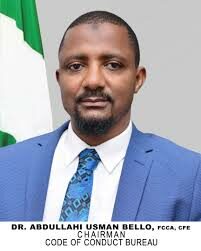
The chairman of the Code of Conduct Bureau (CCB), Abdullahi Bello, has disclosed that the personal character remains the strongest weapon in fight against corruption in the nation.
Bello urged young Nigerians to speak out against wrongdoing “even if your voice shakes.”
He made the charge at the 2025 International Anti-Corruption Day Public Dialogue with the theme:
“Uniting with Youth Against Corruption: Shaping Tomorrow’s Integrity,” organized by the Africa Network for Environment and Economic Justice (ANEEJ) in Abuja yesterday.
He emphasised the need for public officials to uphold integrity, declare their assets, and maintain transparency.
According to him, personal character remains the strongest weapon against corruption.
“Let me assure you that you are not alone. The government, EFCC, ICPC, civil society, and responsible elders are with you. We are ready to work with you, protect you, and amplify your voices,” he said.
He encouraged the youth to leave the event with renewed commitment to building a Nigeria rooted in truth and justice.
The event brought together stakeholders, philanthropic experts, civil society groups, students, youth associations, and development partners.
Similarly, the executive director of ANEEJ, David Ugolor, said the global anti-corruption day reminds the world of the devastating impact of corruption on development, public trust, human rights, and national prosperity.
He emphasised that this year’s celebration holds unique significance for Nigeria, coming at a time when the country is striving to consolidate gains in asset recovery, beneficial ownership transparency, anti–money laundering reforms, and citizen accountability.
According to him, the event was made possible through two major ANEEJ programmes: The Nigeria Illicit Finance Resilience Project, supported by the UK’s Foreign, Commonwealth and Development Office (FCDO), has strengthened the capacity of Nigerian institutions and civil society to address illicit financial flows, improve asset recovery systems, and enhance accountability in the use of recovered assets.
In addition, the project titled “Tackling Poverty through Livelihood Support, Advocacy for Social Protection, Climate Justice and Anti-Corruption,” supported by Bread for the World (BfTW), Germany, has deepened citizen engagement, strengthened youth leadership, and advanced the link between anti-corruption, social protection, and climate justice.
Ugolor noted that this year’s theme, “Uniting with Youth Against Corruption: Shaping Tomorrow’s Integrity,” speaks directly to ANEEJ’s mission.
He said Nigeria’s youth represent creativity, energy, innovation, and the moral conscience of society.
“When empowered with the right tools, knowledge, and platforms, young people can challenge corruption at all levels, inspire social movements, demand accountability, and reshape governance systems for the better. Indeed, the future integrity of our country will be determined by the courage and values of the young people sitting in this room,” he said.
He added that the dialogue aims to enhance youth understanding of the drivers and impacts of corruption and illicit financial flows, as meaningful action begins with knowledge.
In his remarks, the founder of the Institute for Social Impact, Practical and Leadership (ISIPL), John Onyeukwu, said Nigeria’s governance challenges are not abstract concepts but daily realities shaping the lives of 220 million citizens.
Citing data from NEITI and UNODC, he said 18% of Nigeria’s GDP is lost annually to corruption and leakages.
He added that between $15 and $18 billion is lost yearly to illicit financial flows, a figure large enough to fund both the country’s education and health budgets.
According to him, a 2024 World Bank survey shows that 70% of Nigerian youth believe corruption—not lack of competence—is their biggest barrier to opportunities, leading many to feel excluded despite their qualifications.
“Many think, ‘I didn’t get the job because I had no connection.’ It’s the system that has made things this way,” he said, noting that Nigeria’s growing youth population continues to face shrinking career opportunities due to systemic corruption.
He emphasised that institutional erosion renders effective planning impossible when national resources are siphoned off before reaching the treasury, and when capital budgets become avenues for personal enrichment.
We’ve got the edge. Get real-time reports, breaking scoops, and exclusive angles delivered straight to your phone. Don’t settle for stale news. Join LEADERSHIP NEWS on WhatsApp for 24/7 updates →
Join Our WhatsApp Channel