Forensic experts and key stakeholders have commended the Federal Government’s collaboration with Tantita Security Services Nigeria Limited (TSSNL), describing it as instrumental in strengthening pipeline security, increasing crude oil production, and improving revenue for the nation.
The endorsement followed a two-day National Dialogue on Pipeline Security held in Abuja, where participants linked recent improvements in oil output to enhanced coordination in surveillance operations.
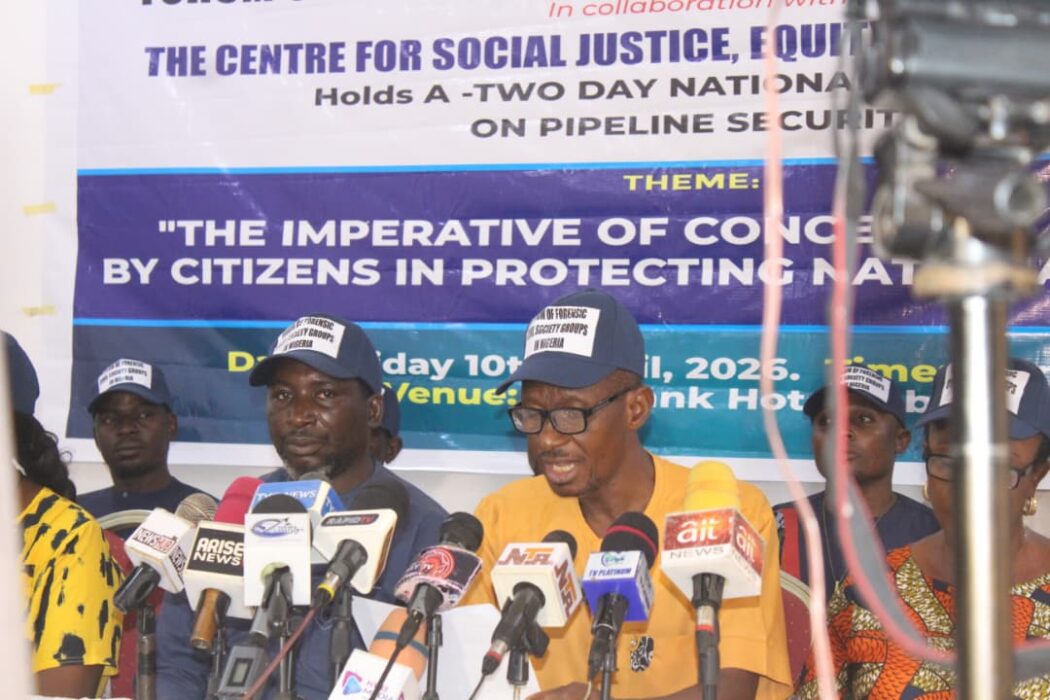
The event, themed “The Imperative of Concerted Efforts by Citizens in Protecting National Assets,” was organised by the Forum of Forensic Civil Society Groups in Nigeria in partnership with the Centre for Social Justice, Equity and Transparency. It brought together civil society organisations, security experts, policy analysts, community leaders, and government representatives to address ongoing challenges affecting Nigeria’s oil infrastructure.
Participants described oil pipelines as the backbone of Nigeria’s economy, noting that improved security has a direct impact on revenue generation and the government’s ability to meet public obligations. They attributed the recent decline in pipeline vandalism and rise in crude oil production to structured and coordinated surveillance frameworks.
In a communiqué issued at the end of the dialogue and signed by Dr. Opialu Fabian, the forum warned against introducing uncoordinated changes that could undermine the progress made so far. It cautioned that attempts to fragment surveillance arrangements in the name of inclusivity could weaken accountability, disrupt operational efficiency, and create opportunities for criminal exploitation.
Stakeholders emphasised that pipeline security is a critical national security function that requires discipline, trust, intelligence coordination, and a clear chain of command, rather than being treated as a platform for political patronage.
They also raised concerns that incorporating unvetted actors into pipeline surveillance systems could compromise intelligence and embolden oil theft networks, which have previously resulted in significant revenue losses. While acknowledging the importance of host community involvement, the forum stressed that such inclusion must be structured and supported by capacity-building efforts without jeopardising security outcomes.
The dialogue further highlighted the broader national implications of pipeline breaches, including reduced public spending, economic instability, and slowed development. Participants warned against politicising pipeline security debates, noting that divisive narratives could escalate tensions in the Niger Delta and distract from core security priorities.
As part of its resolutions, the forum called for sustained support for existing coordinated surveillance models that have proven effective. It urged that any proposed reforms be based on evidence, guided by national interest, and subjected to thorough security evaluations rather than influenced by competing interests.
The forum also recommended strengthening oversight, transparency, and accountability within current frameworks to enhance performance and build public trust. Stakeholders were encouraged to channel grievances through constructive means to avoid disrupting operations, while continuous civic education was identified as essential in promoting collective responsibility for safeguarding national assets.
The communiqué concluded with a call for unity, stressing that protecting Nigeria’s oil infrastructure requires precision, coordination, and a shared national commitment, rather than the broad distribution of sensitive responsibilities.
We’ve got the edge. Get real-time reports, breaking scoops, and exclusive angles delivered straight to your phone. Don’t settle for stale news. Join LEADERSHIP NEWS on WhatsApp for 24/7 updates →
Join Our WhatsApp Channel