
The Presidency has appealed to civil society organisations (CSOs) to deepen collaboration with government in tackling Nigeria’s economic, social and humanitarian challenges.
It stressed that sustainable national development can only be achieved through stronger partnerships and community-driven service.
The senior special assistant to the President on Delivery and Coordination, Dr Amina Kabir, made the appeal in keynote address at the investiture of Engr. Sikiru Adetona Owonikoko as the district governor of Rotary International District 9127 in Abuja.
Kabir said government alone could not meet the nation’s growing development needs, urging organisations such as Rotary International to intensify efforts in mobilising resources, mentoring young people and implementing programmes that directly improve the lives of vulnerable Nigerians.
“When government is stretched, civil society must be strong. When communities are hurting, service organisations must be present. Instead of asking who will fix the country, we must ask, ‘What is my own part in building the country?'” she said.
She emphasised that the true measure of leadership and service lies in lasting impact rather than public recognition.
“The real question is what has changed. Lasting impact is not noise; it is legacy. It is what remains after the cameras leave. It is the child who stays in school, the community that gets clean water, the young person who chooses hope, and the citizen who begins to believe again because leadership became honest and human,” Kabir stated.
The presidential aide urged Rotary members to adopt a more strategic approach to humanitarian interventions by prioritising measurable outcomes over project launches.
“Our service must be strategic. Service must go beyond launching programmes; it must deliver. We must invest in our young people, restore dignity to our communities and lead with integrity, empathy and excellence,” she added.
Kabir described the newly installed district governor as a mentor and servant-leader whose life exemplifies selfless service, recalling how he and his wife stood by her during one of the defining moments of her life.
“The most powerful impact is not always made public. Sometimes it is made in a labour room, an examination hall or a hospital corridor when someone simply says, ‘I am here.’
“Today, Rotary is not only investing you with an office; it is affirming what many of us already know—that you are a man whose life has already been a testimony of service,” she said.
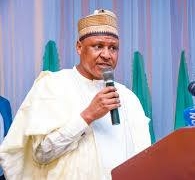
Former Kano State Governor and former National Chairman of the All Progressives Congress (APC), Dr. Abdullahi Umar Ganduje, commended Rotary International for its enduring humanitarian contributions, particularly its role in Nigeria’s successful eradication of wild poliovirus.
Reflecting on Kano State’s experience during the immunisation campaign, Ganduje said firm measures helped overcome public resistance and contributed significantly to Nigeria’s eventual certification as polio-free.
“We had to enforce compliance with the rules for polio eradication. At the end of it, people became convinced that prevention is better than cure, and we succeeded. Kano ceased to be the epicentre of polio as it once was.
“When Nigeria exited the list of polio-endemic countries, we celebrated because Kano contributed significantly to that achievement,” he said.
He added that Nigeria’s current security and economic challenges make collaboration between government and humanitarian organisations more important than ever.
“We have insecurity and economic challenges, and humanitarian services are needed now more than ever. Rotary is at the centre of this effort,” Ganduje said.
In her valedictory address, the outgoing District Governor, Joy Nky Okoro, disclosed that Rotary District 9127 executed more than 1,000 community service projects during her administration while recording growth in membership and Rotary Foundation contributions.
“You were the true driving force of service at the club level. Through your exceptional leadership, over 1,000 projects were successfully executed. Membership increased, new committees were launched and Rotary Foundation contributions exceeded our expectations,” she told club presidents across the district.
Okoro said the district expanded interventions in maternal and child healthcare, education, youth development, polio eradication and community service despite financial and logistical constraints.
“As I step back, I do so with gratitude and confidence. Leadership changes, but service remains. Rotary years come to an end, but the impact of service continues forever,” she said.
Speaking after his investiture, the new District Governor, Engr. Sikiru Adetona Owonikoko, unveiled his administration’s priorities, including aggressive membership expansion, digital transformation and enhanced welfare for Rotary members.
“We need to increase our membership like never before. We are also deploying information technology tools to improve our operations and will place strong emphasis on celebrating our members because when members are appreciated, they are motivated to do even more,” Owonikoko said.
He reaffirmed Rotary’s commitment to its Seven Areas of Focus, identifying education as one of the organisation’s most critical priorities.
“Basic education and literacy is one of Rotary’s Seven Areas of Focus. Alongside peacebuilding, maternal and child health, water and sanitation, community economic development, environmental protection, and disease prevention and treatment, education remains a non-negotiable priority. We will continue advancing all these areas as prescribed by Rotary International,” he stated.
Chairman of the occasion, Ahmed Raji (SAN), described Owonikoko as a compassionate humanitarian whose commitment to service reflects the values instilled by his family.
“Sikiru is like a younger brother to me, and humanitarian blood flows in him. His father was one of the kindest people I have ever known, and it is therefore not surprising that he has dedicated himself to humanitarian service through Rotary,” Raji said.
Tracing Rotary’s humanitarian legacy to its founding in 1905, Raji said the organisation’s impact had inspired him to consider becoming a member.
“What I have seen today has encouraged me. I believe my coming here is to enrol as a member, not with the ambition of becoming a governor, but simply to serve,” he added.
We’ve got the edge. Get real-time reports, breaking scoops, and exclusive angles delivered straight to your phone. Don’t settle for stale news. Join LEADERSHIP NEWS on WhatsApp for 24/7 updates →
Join Our WhatsApp Channel